

The Reagan Revolution didn't just usher in a wave of prosperity, but also wholesome patriotism. Every proper child of the 1980s has a wisp of nostalgia for the times. Reagan was an actor, and Hollywood wasn't so uptight about politics. Producers then shoveled cash into content that lionized the military, pleased the White House, and made America's blood pump. Veterans like Clint Eastwood and Chuck Norris practically reinvented the patriotic chic genre that died off after the 1960s, when Hollywood grew tired of making World War II movies and hunting commies.
One of my early memories was soaking in this sublime nationalistic deluge on various naval installations, when Reagan's 600-ship Navy filled the piers of American ports. The earliest was the USS Enterprise steaming proudly into port in San Francisco Bay, back when Alameda Naval Air Station was bulging at the seams with mighty fleet carriers and naval strike jets. And I remember running around the Enterprise's war room, with the officers' mess tables still above my eyeline, not long after they unjammed the carrier from the San Francisco silt.
But neither of those intimate and fond memories of that august boat compared to what Hollywood was able to do with the USS Enterprise some months later, when Top Gun hit theaters with the force of the B61 nuclear bombs that the Big E carried in her armory.
You want to talk nostalgia? Perhaps nothing hit the patriotic '80s kid like Top Gun's opening scene on the carrier's flattop. That was pure cinematic wizardry, the very pinnacle of the era's patriotic pictures. Harold Faltermeyer's slow synth pulse rising out of the darkness for morning flight ops, steam dancing across the Enterprise's deck, the F-14's twin turbofans igniting to afterburner, the crew's delicate choreography, sunlight breaking over the flattop and building a slow, steady tension until it breaks with Kenny Loggins's soaring electric guitar launching Tomcats into the great blue. It was solemn, muscular, technological, and almost religious in its reverence for U.S. airpower, an anthem for the golden center of the American jet age.
It did almost half a billion dollars at the box office, inflation-adjusted, of course, and topped the charts as 1986's highest-grossing movie. It ran in theaters for more than half a year. But it was more than just a financial smash. Top Gun was the living, breathing embodiment of 1980s America: cocky, confident, gutsy, technologically dominant, and glamorous. And maybe a little bit gay. Vietnam was in the rearview mirror. The military was cool again. And director Tony Scott's brilliance was that he got this hallowed vibe to eager audiences without the tedious moralizing so common in today's Hollywood.
Kids today watch Marvel movies and dream about being Thor or Iron Man. Top Gun served up those heroics on fine bone China. We all dreamed of being inverted and buzzing towers and "keeping up foreign relations." The beauty was that the '80s kid didn't need to be living in a goofy pseudo-scientific multiverse to be part of the magic. All you had to do was walk into your local recruiter and sign on the dotted line. The generation raised on this heady cocktail went on to volunteer in droves to serve in the War on Terrorism, present company included.
You didn't just want to fly jets. You wanted the danger, the adventure, and the most brotherhood that this two-hour Navy recruiting pitch offered. When Goose's ejection seat malfunctioned and Tom Cruise's Maverick wept over his body floating lifeless off the San Diego coast, it slugged you in the gut like you'd lost a close family member. But you still left thinking, "Sign me up, Gipper." Who, as it happened, screened Top Gun at Camp David on May 30, 1986, according to White House records.
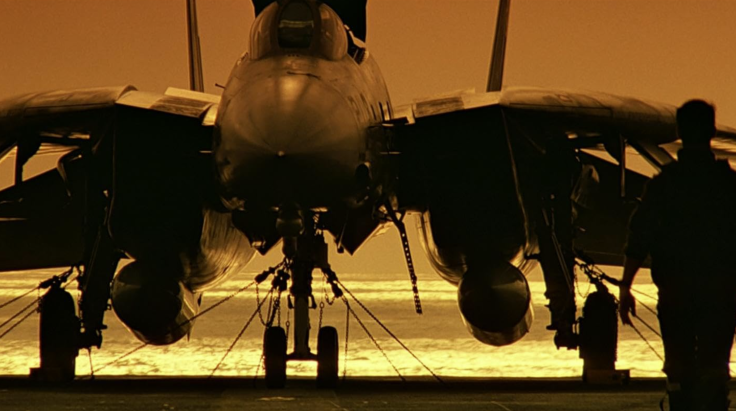
The F-14 Tomcat was effectively a costar and still today stands as the sexiest jet ever built. There is a moment, right before Maverick takes on the Soviets somewhere above the Indian Ocean, where he and his jet ride the elevator up to the flight deck and the shot of the Tomcat's front profile beautifully captures the jet’s predatory elegance. Every line on that masterpiece of American engineering felt sculptural. It's what Da Vinci would've built had he been born American. The twin tails rising in the back forming a dramatic silhouette, lending the aircraft a sense of menace and poise, the slight outward cant of the tails, the spacing of the engines, the way the fuselage seems to hunch over its landing gear—I didn't know beauty could make a boy stupid like that until I discovered girls years later.
Sure, there were some cringe lines, mostly foisted upon poor costar Kelly McGillis. "I was afraid that everyone in the TACTS trailer would see right through me, and I just don't want anyone to know that I've fallen for you." But Tony Scott so dazzled audiences with fast jets knife fighting above the California desert that you barely noticed.
Top Gun was such a cultural tour de force that it's astounding it took almost four decades to do the sequel. Gone was the great, worthy adversary in the Soviet Union, replaced with a nebulous bad-guy state. Top Gun: Maverick did no less splendidly at the box office, reminding producers that Americans still like simple, adrenaline-fueled adventures without Hollywood's weird politics or a comic book attached. But without the great Russian bear and an identifiable adversary, Maverick lost a bit of righteous ideological stakes that were the beating heart of the 1986 film. We used to root our films in realistic geopolitics, but then again the Russkies didn't have 80,000 cinema screens like the Communist Chinese. America is better when we have a proper adversary and so are our war flicks.
To the producers' credit, the mystery enemy in Top Gun: Maverick allowed filmmakers to retain the most important bridge from 1986 to today. The mighty Tomcat. Which at the time of filming, was only flown by the… Iranians. So in the end, Hollywood found the one thing capable of uniting American audiences and the Islamic Republic of Iran as if they were Val Kilmer and Tom Cruise on the flight deck in the movie's penultimate scene, a noble and mutual refusal to let the glorious F-14 Tomcat die.
Editor’s note: This retrospective review is one in a series celebrating 1986, arguably the greatest year in movies—inarguably if you’re Gen X.
John Noonan, a former Air Force captain, is senior adviser at Polaris National Security.