

Uneasy lies the head that wears the crown that was invented by the British and then funded by the Americans. Constantly lies the head of state who claims to protect the Palestinians while cooperating with the Mossad. Abdullah II is the fourth king of Jordan, the state that Winston Churchill lopped off the Palestine Mandate in 1921 with, he said, "the stroke of the pen one Sunday afternoon in Cairo." The plan, as proposed by Lawrence of Arabia in 1918, was to install the three sons of Hussein, the Sharif of Mecca, as the Hashemite emirs, Britain's proxies in the states it was carving out of Ottoman territory. Abdullah is the last Hashemite standing. He has a pronounced facial tic.
In 1951, the first Jordanian emir, Abdullah I, was shot to death at Jerusalem's Al-Aqsa mosque by a Palestinian terrorist. His son Talal lasted a year before being deposed on grounds of mental illness. But Talal's son Hussein saved his family. He saved Jordan too, notably by massacring Palestinians when they tried to overthrow him in 1970, then cutting them loose when the Palestinians in the West Bank rebelled against Israeli control in 1988. Abdullah II inherited the poisoned chalice after his father's death in 1999.
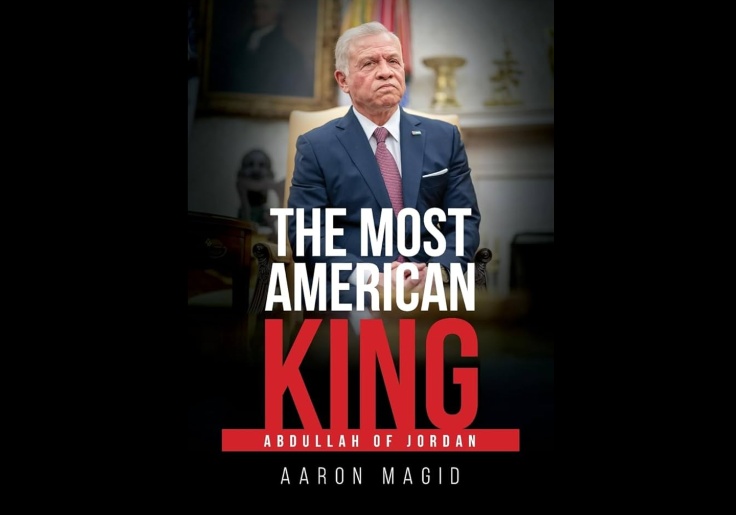
The Most American King, by the journalist Aaron Magid, is the first biography of Abdullah, who will probably still be king by the time your copy arrives. Deeply researched with plenty of interviews, it is both a groundbreaking primer on our man in Amman and a study in timeless imperial politics. Take away the helicopters and Swiss bank accounts, and the Hashemites' relationship to the United States is no different from that of the ancient Moabite and Edomite satraps to their Hittite, Assyrian, or Neo-Babylonian emperors.
The British invented Jordan, but the Americans took over after the Suez Crisis of 1956. Abdullah's mother was the daughter of a British military adviser; she may have met Hussein on the set of Lawrence of Arabia, where she was a typist and he was catching up on some family history. Abdullah was educated at an English boarding school, Deerfield Academy in Massachusetts for high school, and then Sandhurst for officer training, despite not being a British subject. He then read international relations at the University of Oxford despite, a contemporary tells Magid, having shown no academic aptitude at Deerfield beyond being the "incredibly ripped" captain of the wrestling team. Favorite food: cheeseburger. Language he had trouble learning: Arabic.
Abdullah returned to Jordan in 1983, for the first time in 15 years, short vacations aside, and joined an armored brigade. As Magid reports, he put away much "vodka and beer," wore cowboy boots when he listened to country music, and was never seen praying. He built up an extensive collection of Luger pistols, because you never know. In 1987, when he was studying at Georgetown, he impressed his Israeli tutor with a paper arguing that the Israelis had been right to pursue Palestinian terrorists across the Jordan River and into his father's territory in 1968. In 1993, Abdullah married Rania al-Yassin, a Kuwaiti-born Palestinian whose family had been expelled from Kuwait in 1991 by Saddam Hussein. They honeymooned in the United States, obviously.
"My children are the future, a mixture of Jordanian and Palestinian," Abdullah told CNN. The truth is, the Hashemite survival strategy requires the twain never to mix. The East Bank tribes are matched and probably outnumbered on their side of the Jordan River by the descendants of the West Bank Palestinians who decamped in 1948 and 1967. Some half a million remain without civil rights. If the government has conducted a census on the demographic balance between East and West Bankers in Jordan, it has not released it.
Jordan is a mukhabarat state, run by the security services. Hussein, who had ruled Jordan for 46 of the kingdom's 53 years of independence, played it safe. Abdullah's half-brother Hamzah, the son of Hussein's fourth and last wife, Lisa Halaby of Washington, D.C. (known to CNN as Queen Noor), was too young. Abdullah's military service meant he had good ties with the tribes who serve in the armed forces. Hussein picked Abdullah as his heir.
Abdullah solidified his rule by relying on his father's intelligence director, Samih Battikhi, then said that Battikhi had become "too powerful" and dumped him. He made his half-brother Hamzah his heir, but, when the time was right, demoted Queen Noor, made Rania queen, and named their son Hussein his heir. Hamzah did not take it well. In 2021, he was accused of fomenting sedition. Since then, he has been under house arrest in Jordan or, as Abdullah puts it, "in his palace under my protection."
To understand his people, Abdullah went undercover, dressing up as a television producer, taxi driver, and a "one-eyed elderly citizen." His costumes included a cane, worn-out sneakers, and "a layer of fake fat," though the more recent photos in Magid's book suggest he no longer needs that. Aided by Ivy League grads, Abdullah tried to get Jordan's basket-case economy off the ground by high-profile anti-corruption campaigns and privatizing Jordan's minuscule industrial sector.
Abdullah, said Oraib Rantawi of Amman's Quds Center for Political Studies, still spoke "very poor" Arabic. But he spoke excellent American. The United States gives Jordan diplomatic and military support, and billions of dollars to keep its economy afloat. That backing, not forgetting Abdullah's mukhabarat monopoly and his Luger collection, counts for more. Abdullah is more tightly bound to American power than Benjamin Netanyahu is, but the royal Blackhawk flies below the media radar. Magid's book is revelatory in its combination of strategic analysis, imperial blundering, and backroom gossip.
Jordan is a stable, Western-aligned Arab state in an unstable and vicious region. Jordan buffers Israel's long eastern frontier. It buffers American interests against the chaos that used to be Iraq and Syria and the chaos that Iran wants to spread. Abdullah's heart is in Jordan, but his head is in Langley, Virginia. That is how he keeps it on his shoulders.
Rania, we are unsurprised to read, "interviewed with CNN," "joined the board of the World Economic Forum," and "enthusiastically promoted women's rights." Abdullah decided women were, he said, "capable," and proved it by reserving 6 seats in the 110-member lower house of Jordan's entirely toothless assembly. He also allowed her to announce that women too could pass down Jordanian citizenship to their children if they had married a foreigner. This, Magid writes, "provoked a backlash across the country," because it would "provide citizenship to hundreds of thousands of Palestinians and dramatically impact the Hashemite Kingdom's delicate demographic balance." And that was the end of that.
Normal life, Abdullah told CNN—yes, them again—was impossible in his position. He relaxed by flying a Blackhawk helicopter. Speaking to the Discovery Channel in a typically bold deviation from the Royal Court's media protocols, he said it allowed him to "forget all of the problems." Rania also took flight. She had her own Challenger jet and $40 million in a private Swiss bank.
Filling the much-needed gap left by Princess Diana, Rania was photographed in St. Tropez with Naomi Campbell and for Vanity Fair by Mario Testino. While Palestinian Jordanians resented Rania's failure to secure improvements in their standing, Forbes called her one of the world's most powerful women for her "social justice work." The seasoned Middle East analyst Oprah Winfrey called her a "brilliant woman, a gorgeous mother, and an international fashion icon."
"Somebody said to me, several days ago, a very prominent American," Abdullah said as the George W. Bush administration was preparing to invade Iraq, "that if there wasn't a Jordan, we'd have to invent a Jordan." The other way of looking at it was expressed by George Tenet, director of the CIA from 1996 to 2004: "We created the Jordanian intelligence service, and now we own it." Familiarity breeds contempt. Skip Gnehm, the U.S. ambassador to Jordan in the run-up to the invasion, reports that Bush slammed the table as Abdullah was midway through the word "quagmire." No one listened.
Abdullah already faced a hard balancing act, rhetorically supporting Palestinian Islamists across the river while his secret police worked the pliers and wires on them at home. After 2003, notes Magid, he was obliged to add "hundreds of thousands of Sunni Iraqis" to Jordan's tinderbox, including "many Baathists and Saddam loyalists." He offset that by intercepting a 2004 al-Qaeda plot to blow up the U.S. embassy in Amman and volunteering Jordan as a black site for the "interrogation of highly sensitive terror suspects." Leon Panetta's CIA donated "millions of dollars" annually to Jordan's "covert action fund." General David Petraeus called the king a "seriously impressive leader" with "great vision."
When the Arab Spring protests broke out in 2011, Obama pushed out Hosni Mubarak and opened the path for the Muslim Brotherhood to take over Egypt. He did not depose Abdullah. "The prospect of the Jordanian regime falling was so awful that nobody wanted to go there," recalled Daniel Shapiro, then the NSC's Middle East director. The Obama administration increased aid to Jordan to subsidize the cost of hosting refugees from the Syrian civil war but refused to give advanced munitions for Jordan's fight against ISIS. With friends like these…
Abdullah also had to keep an eye on his frenemies across the river. Jordan needs Israel to survive. Abdullah needs Israel's protection against his own people, against his Arab neighbors, and against the Muslim Brotherhood (a "Masonic cult" run by "wolves in sheep's clothing," says Abdullah, again demonstrating his mastery of the basics). But, Magid writes, he also needs Israel as a "useful point of distraction." In 1999, Abdullah told ABC that he had "a lot of friends" in Israel, probably because he had already been on Larry King and CNN to say that he could imagine one of his children marrying an Israeli. A year later, when Hamas's suicide bombers were massacring Israeli civilians, Abdullah said Jordan honored the Palestinians' "martyrs" and withdrew his ambassador from Tel Aviv.
After the Gazans attacked Israel on October 7, 2023, thousands celebrated in the streets of Amman. Abdullah donned a military uniform, airdropped a symbolic payload of humanitarian supplies on Gaza, and recalled his ambassador again. Rania donned the tinfoil hat and told a complaisant Christiane Amanpour that CNN's report that Hamas had "butchered" children in an Israeli kibbutz hadn't been "independently verified." A year later, Abdullah's forces shot down Iranian drones on their way to Israel and allowed Israeli jets to transit his airspace on the way to Iran.
As Magid describes, Abdullah's ties to "the military, USAID, Capitol Hill and intelligence community" ensured that he survived the first Trump presidency. Abdullah objected to moving the U.S. embassy to west Jerusalem and criticized Trump's cuts to the UNRWA budget, but pocketed a 27 percent increase in U.S. subsidies to $1.275 billion a year. He turns a blind eye to the indignities of America's inconstant policy: He'll pretend not to notice the Biden administration imposing a new defense cooperation deal allowing U.S. troops to enter and exit Jordanian territory and Trump subsequently romancing Mohammed bin Salman of Saudi Arabia.
Abdullah is currently observing a strategic silence on the Abraham Accords, from which he will profit, while continuing to talk up the Palestinian rights that, should they ever be realized, will mean he and his family go the way of the Hashemites of Iraq. He knows what we want to hear: He says in English that he hopes to make Jordan a Western-style democracy. More significantly, he knows what we want him to do. And more important than that, he does it. We take him for granted, but we will miss him when he is gone.
The Most American King: Abdullah of Jordan
by Aaron Magid
Universal Publishers, 244 pp., $35.95 (paperback)
Dominic Green is a Wall Street Journal contributor and a fellow of the Royal Historical Society.