





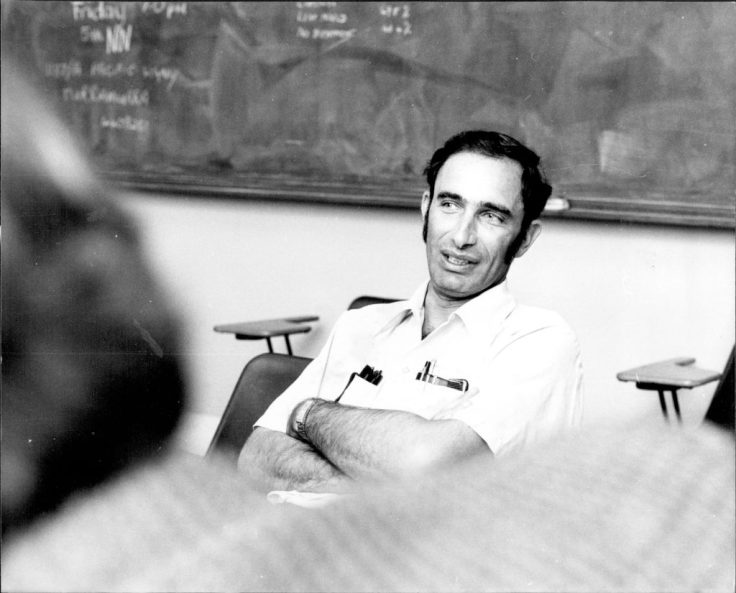
Dr. Paul Ralph Ehrlich (1932-2026), who passed away last week at the age of 93, was perhaps the world’s most famous opinionator on the population question since Reverend T.R. Malthus himself. An unabashed apostle of population control and prophet of impending worldwide demographic catastrophe, he preached a secular gospel of "overpopulation" and eco-apocalypse from his perch at Stanford University for over 50 years.
Apart from his wife and lifelong coauthor Anne Ehrlich (with whom he published nearly a dozen books or pamphlets and many hundreds of articles), perhaps no other voice or personality is so closely associated with the postwar moral panic over the "population explosion."
The Population Bomb, Ehrlich’s electrifying 1968 bestseller, made him an instant celebrity at age 36. Charismatic, self-confident, and funny—seemingly possessed of more zingers than Henny Youngman—he quickly became a television presence as well. So spellbinding that he was invited 20 times on The Tonight Show, Ehrlich proved to be one of Johnny Carson’s most popular guests. Over his long life, Ehrlich was also showered with awards and prizes, including a MacArthur Foundation "genius" grant, the U.N. Sasakawa Environment Prize, and the Royal Swedish Academy of Sciences Crafoord Prize (established to complement the Nobel Prize and awarded in fields the Nobel does not cover).
No less noteworthy than the fame and fortune he achieved was how shockingly, profoundly, and consistently wrong biologist Ehrlich was in predictions he made about human beings.
The Population Bomb opens with this arresting prophecy:
The battle to feed all of humanity is over. In the 1970's the world will undergo famines—hundreds of millions of people are going to starve to death in spite of any crash programs embarked upon now. At this late date nothing can prevent a substantial increase in the world death rate.
All these predictions were not just wrong: They were laugh-out-loud wrong, almost the precise opposite of what would actually occur over the following decades and generations.
There were no mass famines in the 1970s, nor have there been any since. Deadly hunger crises in our era are caused by killer governments (Cambodia’s Khmer Rouge; Ethiopia’s Derg; North Korea’s "Dear Leader"), never by Ehrlich’s "population overshoot."
But that is just a foretaste of how completely and utterly wrong Ehrlich got humanity’s future.
In the decades since The Population Bomb, human numbers have more than doubled—from about 3.6 billion in 1968 to around 8.2 billion today. Yet in spite of the scale and the tempo of this unprecedented surge of humanity, the world and all its regions are dramatically, incontestably more affluent today.
And despite decidedly more rapid population growth in poorer countries over the interim, global per capita GDP was over two-and-a-half times higher in 2024 than in 1968, according to World Bank estimates.
Far from suffering rising death rates, the world is healthier than ever before. By the reckoning of the U.N. Population Division, global life expectancy has leapt since 1968: from under 56 years to over 73 years. Indeed, worldwide life expectancy today is roughly three years higher than was America’s when The Population Bomb came out.
But then again, Ehrlich wasn’t great at forecasting the American future, either: Among his more memorable howlers was a 1969 conjecture that overuse of pesticides might drive down U.S. life expectancy at birth to just 42 years by 1980.
One of the reasons worldwide life expectancy has been rising over the postwar era is that food is becoming steadily more plentiful—so plentiful, in fact, that overnutrition is displacing undernutrition as the globe’s principal dietary problem. By 2021, indeed, more women of childbearing age in India were measured as overweight than underweight.
For its part, the marked rise in worldwide caloric availability per capita has been facilitated by dramatic long-term declines in the cost of food. By 2024, the inflation-adjusted prices of the main cereals—corn, rice, and wheat—were less than half as high as when The Population Bomb came out. This means that food is actually less scarce today than when our planetary population was four and a half billion smaller.
Ehrlich was never able to understand this paradox—or why his constant prognostications about the human future were so unfailingly erroneous. But the reason is really very simple. Professor Ehrlich was a genuine expert in population: It’s just that he studied butterflies.
His outstanding work on population dynamics of butterflies earned him early tenure in biology at Stanford (where he is still remembered for his pathbreaking research at the university’s nearby Jasper Ridge Biological Preserve). His failure as a social commentator came from, wittingly or otherwise, extrapolating his insights from lepidoptery onto homo sapiens.
It is a common human foible to "anthropomorphize": to attribute human characteristics to nonhuman creatures, the way affectionate owners sometimes do with their pets. Ehrlich’s celebrity rested on a far less common, but much more dangerous, intellectual flaw.
He offered a worldview that "insect-ified" humanity. It denied the unique traits of the human species that have allowed us to escape the Malthusian trap (adaptability, ingenuity, problem-solving), and imposed on us instead a presumed and unending over-breed/over-die cycle that he witnessed elsewhere in nature.
Denying humans their quintessential humanity is central to the notion of "overpopulation," Ehrlich’s all-purpose diagnosis for modern man’s afflictions, and likewise to his almost universal remedy for these ills, "population control."
Although "overpopulation" is a meaningless term demographically, insofar as it can never be defined by any given demographic indicator involving human beings, it does very nicely in conveying the impression of a faceless horde, heedlessly procreating.
Ehrlich described his epiphany about human "overpopulation" in his 1968 bestseller:
I came to understand it emotionally one stinking hot night in Delhi a couple of years ago. My wife and daughter and I were returning to our hotel in an ancient taxi. … [W]e entered a crowded slum area. … The streets seemed alive with people. People eating, people washing, people sleeping. People visiting, arguing, and screaming. People thrusting their hands through the taxi window, begging. … [T]he dust, noise, heat, and cooking fires gave the scene a hellish aspect. Would we ever get to our hotel? All three of us were, frankly, frightened … since that night I've known the feel of overpopulation.
The proper term for that human condition, of course, is poverty: But it requires empathy to see it as such.
Poverty is a problem that can be solved; human beings have a way of doing just that. Unimaginable as this would have been to population alarmists in the 1960s, India today has, by some estimates, reduced its nationwide prevalence of what the World Bank defines as "extreme poverty" to just 1 percent. Nor have Indians been heedlessly procreating of late, either: The most recent figures for Delhi indicate fertility is down to 1.2 births per woman—40 percent below the replacement level, far lower than the U.S. reproduction level today.
Be that as it may: Since Ehrlich posited that humans—like insects—are incapable of controlling their own fertility, it must be controlled for them by wiser authorities. Coercive, involuntary population control therefore figured centrally in Ehrlich’s vision for saving the planet.
In 1968 he proposed—for the United States—a Department of Population and Environment (DPE) "with the power to take whatever steps are necessary to establish a reasonable population size in the United States and to put an end to the steady deterioration of our environment."
That "reasonable" objective might require "development of mass sterilization agents," he wrote, since "many peoples lack the incentive to use the Pill":
We must have population control at home, hopefully through a system of incentives and penalties, but by compulsion if voluntary methods fail.
While Ehrlich favored coercive birth control in theory in America, he endorsed it in practice abroad. He cheered forced sterilization for India ("Coercion? Perhaps, but for a good cause"). And he approved of China’s monstrous One Child Policy to the bitter end. "China’s population control program has been the most successful on record," he wrote in 1990, although by then he felt the need to whitewash the ongoing campaign’s abuses:
The degree of voluntarism is a matter of some debate, and there is no doubt some sterilizations were coerced. It is difficult to evaluate…
By 2015, when Beijing finally suspended the ghastly social experiment, Ehrlich was seemingly its last defender. At the news of the program’s amendment, Ehrlich took to Twitter to shout (the caps are in the original):
China to End One-Child Policy, Allowing Families Two Children
http://nyti.ms/1kVju7L GIBBERING INSANITY - THE GROWTH-FOREVER GANG.

At the end of the day, he turned out to be a more enthusiastic population controller than the CCP itself.
Although Ehrlich never apologized for, or expressed any remorse about, his lifelong advocacy of forcible birth control, in later years he sometimes tried to obscure it. In a 2018 interview, for example, he claimed, "[what] I've always said is that the last thing you want to try is coercion and I’ve never supported coercive policies".
Just as problematic, at least for a tenured scientist, was his abandonment of the scientific method when the topic was human beings. Ehrlich’s writings are littered with failed predictions about disasters supposedly soon awaiting humanity due to "overpopulation" and inadequate "population control." Yet over his long career he almost never acknowledged that any of these many "hypotheses" had been tested—and falsified—by real world events.
Instead, he typically doubled down—insisting that any errors were marginal, that his fundamental assessments were sound, and that his analyses may even have helped avert worse global outcomes. In 2009, he asserted, "Perhaps the most serious flaw in The Bomb was that it was much too optimistic about the future". One journalist who interviewed Ehrlich in depth on several occasions described his pose this way: "Always admit that you got some inconsequential things wrong because that makes you look like a reasonable person open to being persuaded by the evidence, as opposed to the certainty-peddling dogmatist you are."
When the insect scientist was writing about human beings, there would be no rigorous framing of hypotheses, reexamining of theory in light of new evidence, or striving to hone and improve explanatory models. Instead, he adopted what philosopher Karl Popper termed "immunizing tactics or stratagems": protecting his doctrine against testability, and thus against possible falsification, with bold but vague warnings about "overshooting carrying capacity," "unsustainable overconsumption," and the like.
Ehrlich needed no proof to validate his convictions. For him and other true believers, the "population bomb" was a secular faith—albeit one masquerading as science.
The few occasions when Ehrlich the expert on human population agreed to unscripted encounters with empirical facts did not end well. One of them was his notorious bet with economist Julian Simon, author of The Ultimate Resource (1981). To Simon, that particular resource was human ingenuity, which he argued would bring abundance, not eco-doom, to the world’s population. (Before his untimely death in 1998, Julian and I were friends for almost two decades.)
In late 1980, Simon offered Ehrlich a public wager: $1,000, placed on the inflation-adjusted price of a basket of five commodities (all metals) 10 years hence. If their price went up between 1980 and 1990, as Ehrlich expected, Simon would pay him that difference; if they went down, Simon would win the differential instead. Ehrlich sneered that he would "accept Simon’s astonishing offer before other greedy people jump in."
Ten years later, the real price of the commodities in the bet had fallen by almost three fifths; Ehrlich owed Simon $576.07. Although the results of the bet were widely reported, Ehrlich never admitted to Simon that he had lost. Instead, Simon simply received the sum, and a scrap of paper with the five metal prices on it, in a letter posted from Palo Alto. No less revealing was Ehrlich’s public posture. After losing, Ehrlich dismissed the bet as "trivial," insisted it "didn’t mean anything," and unleashed stream after stream of angry ad hominem invectives against Simon: "Simple Simon"; "flat earther"; "the resource we will never run out of is imbeciles."
In retrospect, what may look most amazing about Ehrlich’s career is the company he managed to keep. Despite his harsh and jarring rhetoric, his strident ideology, and his proclivity for veering off toward pseudo-science, Ehrlich was embraced into the bosom of the American academy. At Stanford, one of his close friends and colleagues was Donald Kennedy, thanked in The Population Bomb for "wield[ing] his fine editorial pen over it, and express[ing] his endorsement of its contents." Kennedy went on to be Stanford’s president, and editor in chief of Science magazine thereafter. John Holdren—a protégé who joined Ehrlich in the Simon bet and coauthored a textbook devoting an entire section to options for "Involuntary Fertility Control"—would become science adviser for President Barack Obama and professor of environmental policy at Harvard.
But perhaps this shouldn’t surprise at all. Though polemical and extreme in so many of his formulations, Ehrlich’s pronouncements on the human condition were largely in consonance with the moral panic about the "population explosion" that swept through the American Establishment during the Cold War era. Prestigious organizations such as the Rockefeller Foundation and the Ford Foundation were committed to slowing world population growth by the 1960s, so too the World Bank by the 1970s. In 1965—three years before the Population Bomb—USAID would set up a population program, headed by an epidemiologist who proposed to address population growth as a 'disease.' In the early 1980s, the U.N. Population Fund would award its very first prizes to Indira Gandhi, the prime minister who promulgated involuntary sterilization in India during the "National Emergency" of the 1970s, and Qian Xinzhong, then head of China’s One Child Policy.
As the post-Cold War world grew ever more obviously prosperous, as birth rates around the globe steadily declined, and as depopulation began to emerge in one country after another, the moral panic about "overpopulation" subsided. Opinion about the "population crisis" changed. Some former enthusiasts for "population control" had second thoughts. Some even had regrets about the human harm the moral panic had caused its victims.
Not so Paul Ehrlich. To the very end, the insect man regarded human beings as an infestation on the face of the earth.
Nicholas Eberstadt holds the Wendt Chair in Political Economy at AEI.