




If you’ve never heard of Drew Nieporent, it’s okay, even if you’re something of a foodie. Stick with me to the end of this review, and there’s an excellent chance you’ll want to read this delicious memoir from a pioneering figure of the New York restaurant scene. Once you’ve read the book, it’s all but certain you’ll wish you could have dinner with him.
Nieporent is of a certain New York City type: a character of supreme and tireless ambition who has matched himself against the town and all its other strivers and came out on top. As the 20th century turned into the 21st in the top dining city in the United States, was he the top restaurateur? He’s certainly in the conversation, not only for the success of the properties he developed but also for the innovations he introduced.
His Montrachet burst on the scene with a three-star New York Times review in 1985. It opened way, way downtown on West Broadway just as TriBeCa was about to come alive. Cab drivers needed directions to find it. At the pinnacle of fine dining in New York at the time were the "Le’s and La’s"—the French haute cuisine of Le Cirque, La Grenouille, and a handful of others, at many of which Nieporent worked in his youth as waiter, captain, or manager. Montrachet’s minimalist decor (Nieporent didn’t have the money to fancy it up) and trendsetting chef David Bouley introduced a more relaxed feel to New York fine dining. Nieporent was 30 years old. It was the first of three three-star restaurants he opened at the property.
With Robert De Niro and other celebrities as partners and investors, he went on to create the massive Tribeca Grill in 1990. It lasted 35 years. Many other properties followed, but his greatest claim to fame is surely Nobu, the restaurant that brought the influence of high-end Japanese cuisine to New York and on to the world.
Growing up in a two-bedroom apartment in the massive Peter Cooper Village apartment complex on the city’s east side, young Drew ate out all the time. That’s because his father worked for the State Liquor Authority reviewing restaurant applications for alcohol licenses. This is a New York story, so don’t get judgmental about how dad "would make a buck on the side by taking a restaurant’s application from the bottom of the pile and moving it to the top." Restaurant gratitude for services rendered would subsequently manifest as invitations for dad to dine on the house. "I’m talking dozens and dozens of restaurants: good ones, bad ones, fancy ones, divey ones, you name it. I loved every second of it." Thus was born his ambition to own a restaurant.
"It’s tough to understand today, but back then, chefs were nothing. They rarely saw the light of day, let alone the spotlight." Nieporent did try his hand in the kitchen, but without great success. On the first day of his first job, at McDonald’s, "I was so nervous working the Filet-O-Fish station that I dropped an entire block of American cheese in the Fryolator. Somehow, I was not fired." He set his sights firmly on the front of the house.
In his off time from Cornell’s school of hospitality, he worked as a waiter on giant cruise ships. His first real job was as assistant restaurant director at the flamboyant Upper East Side phenomenon Maxwell’s Plum. It was "the perfect place for me to level up my skills after my basic training on the cruise ships." The best perk? The meal on the house at the end of each shift. "The buttery sole almondine, crisp with toasted breadcrumbs and served with lemon, and the calf’s liver with sage butter and bacon were my favorites."
Again, this is New York, so everybody is always on the make. The struggle over tip money between captains, waiters, runners, and bussers is a constant. So is the effort to secure the rest of a bottle of expensive wine from a table occupied only briefly by a couple in the process of breaking up. The glad-handing maître d’s all have eager palms. One at Maxwell’s was in the habit of holding back tables from the reservation book each night so he could personally make them available to walk-ins for the right price. In another exemplary case, "If a guest asked if he could have a window table, Ray would look them dead in the eye and respond, ‘That’s entirely up to you, sir.’"
Throughout his 20s, Nieporent is taking it all in, planning for the day when he can open his own place. As is always the case with high-achieving types, the arrival of the opportunity looks like a roll of the dice on a risky proposition. But success is no stroke of luck. It’s the product of hard work before and after the chance arises. He sees an ad for a "lower Manhattan" restaurant space, 1,500 square feet for a bargain-rate $1,500 a month, and signs a 10-year lease without a clear conception of where he’s going to get the money he needs to build it out from scratch. But he swings it. To create Montrachet in his own style of French-influenced fine dining, he resolves "to strip away every pretense. Out with the snooty maitre d’ who metered out access to ‘good’ tables, the dress codes for guests, waiters in white jackets, the wildly inflated price tag." Rather, the "food, first, had to be amazing. The service did, too, but not in the pretentious, exclusionary style of the Le’s and La’s. The menu would be written in English, not French, and unlike most French restaurants … I’d offer good value for the money." So he did.
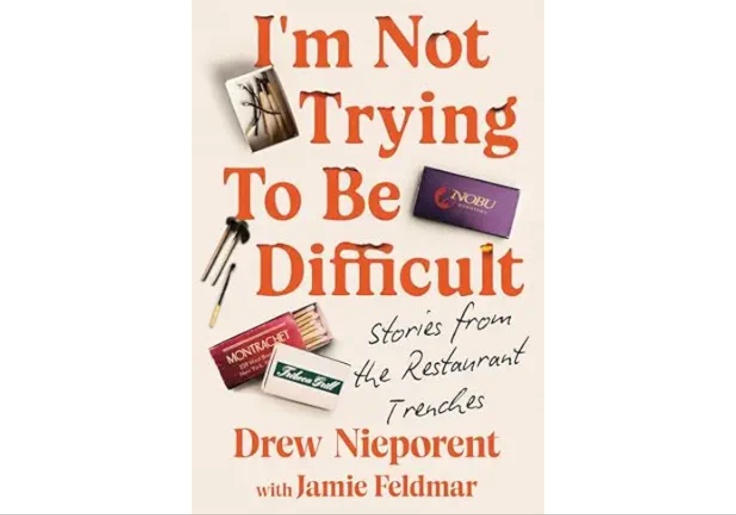
Forty years later comes I’m Not Trying To Be Difficult. Oddly, from the book itself, it's hard to know what to make of its title. Nieporent doesn’t present many scenes in which he comes off as all that difficult. That can’t be true to life, though. Strivers at his level of success are always difficult, and they always have a hard time seeing themselves as anything other than completely reasonable.
Still, the challenges were many, not all of them easily surmounted. The New York City marathon he ran in just over four hours in 1983 probably gave him a self-sense of fitness persisting long after it expired. On page 179 he’s "pushing three hundred pounds." By page 196, he’s up close to 335. A health reckoning is coming.
Having survived it, he pauses here to reflect on how he ever managed to reach such girth. His guileless answer is a measure of the largeness of the man: "The struggle is, simply put, that I love food more than arguably anything else on this earth."
I’m Not Trying To Be Difficult: Stories from the Restaurant Trenches
by Drew Nieporent with Jamie Feldmar
Grand Central, 296 pp., $30
Tod Lindberg is a senior fellow at the Hudson Institute.