

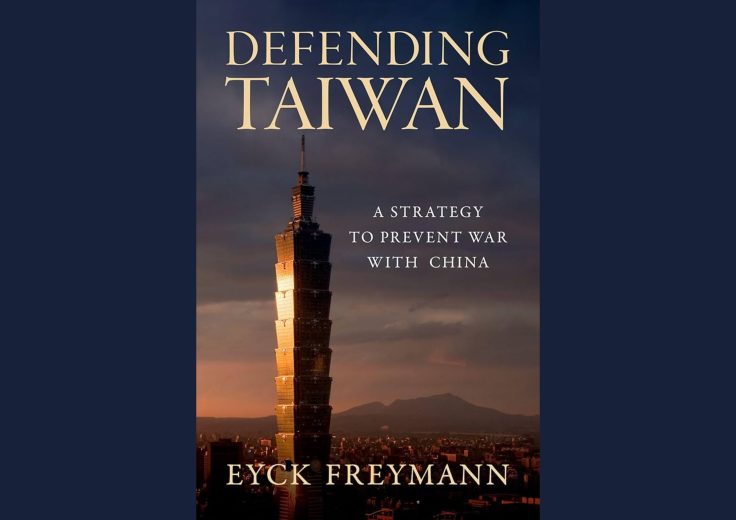
The tiny island nation of Taiwan finds itself at the center of a potential great power war between the United States and China. Such a conflict would be devastating beyond measure. But as Eyck Freymann argues in his new book Defending Taiwan: A Strategy to Prevent War with China, the conquest of Taiwan might not unfold as we'd expect.
Freymann, a Hoover fellow at Stanford University, has spent years examining how the Chinese might seize Taiwan, and it shows. He considers different scenarios and games them out to reach his conclusions.
Conventional wisdom has it that China is likely to take Taiwan via a military invasion. Chinese president Xi Jinping has called for his People's Liberation Army to be ready to seize it by 2027, and numerous top U.S. military officials have warned that the PLA is on track to do so.
The Chinese Communist Party has long coveted Taiwan. Shortly after winning the decades-long Chinese Civil War, the CCP and its then-leader, Mao Zedong, placed a high premium on taking the island. Mao died nearly 50 years ago, but his successors, Xi Jinping foremost among them, have held true to his vision.
Xi is the most powerful Chinese ruler since Mao. And the China that he oversees is infinitely more powerful than the impoverished nation the chairman presided over. With infamous initiatives like the Great Leap Forward and Cultural Revolution, Mao murdered tens of millions of his countrymen and retarded the country's growth and development.
Mao's successors have largely followed Deng Xiaoping's advice for China to hide its strength and bide its time. Now with Xi as the Great Helmsman, China is done waiting. He views the seizure of Taiwan as inseparable from his goal of "national rejuvenation."
Taiwan, Freymann observes, "occupies a unique position in Xi's grand strategy," viewing it as a "litmus test for U.S. resolve, a production hub for the world's most important technological hardware, and a gateway to regional and ultimately global dominance." Taiwan, he noted, is the place "where the uneasy peace between the United States and China could be tested—and possibly broken."
While many pundits and scholars have focused on the possibility of a full-scale military attack by the PLA on Taiwan, Freymann argues that other possibilities need to be considered.
An invasion, he notes, would be extraordinarily high-risk, requiring the PLA, which hasn't fought a major war since the late 1970s, to conduct one of the most difficult of all military operations: an amphibious invasion. And the PLA would "be using many untested technologies and would face weapons systems it may not fully understand."
Geography and weather could further complicate the attempt. Taiwan has few beaches that are wide enough for a landing force and the strait is prone to storms. Sustaining the required high-operational tempo could be tricky for even the most battle-hardened military. It is, Freymann suggests, a possibility that must be planned for and deterred, but it's far from China's only option.
Other possibilities, including a full-scale blockade and bombardment, are also explored. But there is, Freymann observes, a more likely scenario—one far less risky for China's cold-blooded and calculating ruler.
Xi would prefer to take Taiwan "for free" and "intact." He increasingly has the tools to do so. As Chinese power has grown, so has its willingness to use gray zone and pressure tactics to achieve its objective. It is in this fashion that China can, like a python, squeeze Taiwan into submission. It could use lawfare to coerce private entities to effectively accept its control over the island.
As the so-called factory of the world, Beijing could use its economic and industrial might as leverage, forcing multinational corporations—and eventually countries—to accept China's claims over Taiwan. And when presented with the choice between Taiwan's economy or China's, the temptation may prove overwhelming to choose the latter. This strategy would be indirect, but also more actionable—including in the near term.
Taiwan's widely lauded semiconductor industry, and its infrastructure, are less likely to be destroyed. China could perhaps avoid Russia's fate as an international pariah and the tremendous loss of life that could ensue from a military incursion. And should its efforts be challenged militarily, be it by the United States alone or a coalition, the PLA would still be able to escalate. Then China could be better positioned to escape blame for the casualties and chaos that would follow.
A similar quandary confronted President Abraham Lincoln with Fort Sumter, South Carolina, in 1861. Supplies at the beleaguered fort, under siege by Confederate forces, were running low. But the new commander in chief didn't want the weight of commencing a war to fall on his shoulders. Accordingly, instead of ordering military forces to battle or abandoning the fort and American prestige outright, he chose to resupply the fort, putting the onus for initiating military hostilities on the Confederates.
To the growing number of individuals worried about the PLA invading, blockading, or bombarding Taiwan, the scenario that Freymann sketches out might seem oddly reassuring. The potential for bloodshed might be less. Ditto for the cataclysm of great power war.
But the consequences would remain dire. By taking Taiwan, China would be positioned to gain mastery over the region that accounts for the majority of the world's GDP. America and its allies—those who don't jump ship or begin to hedge—would be forced to dramatically increase military spending.
Taiwan, General Douglas MacArthur once said, is an "unsinkable aircraft carrier." Seizing it, especially without a shot being fired, would be an immense gain for China in its quest to supplant the United States as the world's superpower.
To forestall this possibility, America and its allies must plan and prepare for every imaginable scenario and make clear to China that coercion, in any form, would be ruinous. The aim should be not just to deter a war, but to deter a crisis. Freymann's thoughtful volume, rife with counterexamples and lessons from history, is required reading on how to start.
Defending Taiwan: A Strategy to Prevent War with China
by Eyck Freymann
Oxford University Press, 432 pp., $29.99
Sean Durns is a Washington, D.C.-based foreign affairs analyst and the deputy commentary editor for the Washington Examiner.