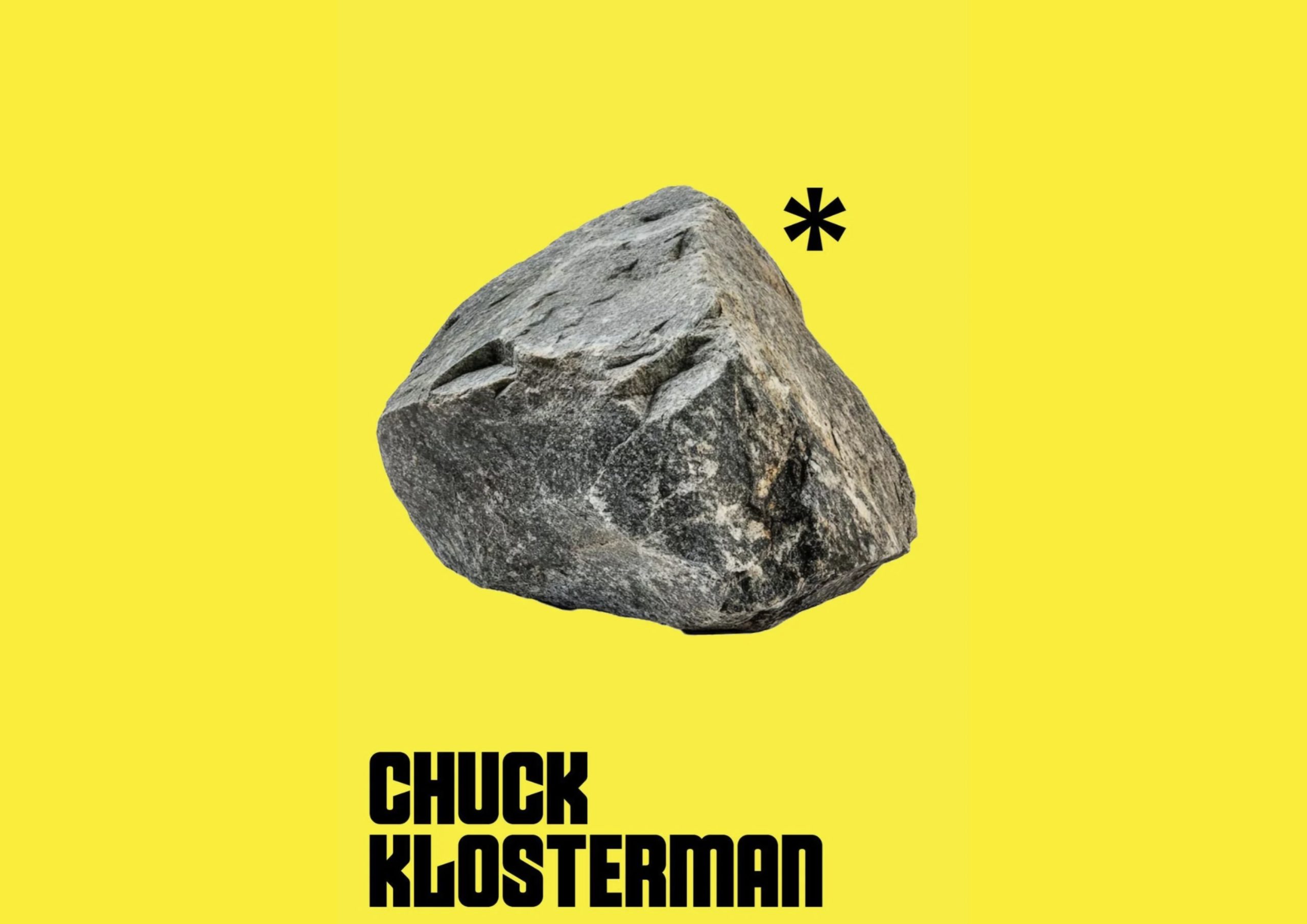


With all the subtlety of a punk song, I’ll get right to the point: Chuck Klosterman's Rock*: A Mainstream Alternative History of Alternative Mainstream Music is one of the strangest, funniest, and most entertaining books I've read in a long time, and the perfect book for anyone who loves talking about the pop culture of the past 60 years. Imagine a mix of the alternative history of Philip Roth's The Plot Against America, the rock absurdism of This Is Spinal Tap (or Monty Python's "Rock Notes"), and the jokes-per-minute rate of 30 Rock, and you have a good picture of this book.
Klosterman presents Rock* as the 2002 edition of a compendium of essays by various writers for the major (and fictional) music magazine Velveteen. Its central premise is that in 1967, the Velvet Underground became the most popular band in America. In fact, Brian Eno famously described the real legacy of that American band: "The first Velvet Underground record sold 30,000 copies in the first few years … but I think everyone who bought one of those started a band." Singer, guitarist, and songwriter Lou Reed, bassist Johny Cale, guitarist Sterling Mason, and drummer Maureen Tucker performed songs that were definitively anti-mainstream in their sound (detached vocals, droning violas, strangely tuned guitars) and subject matter (sadomasochism, heroin, seedy urban life). The band was performing in New York City when Andy Warhol took notice, became their manager, and made them his house band. He also added the German model and chanteuse Nico for vocals on several songs, designed the famous album cover (on which Klosterman's riffs), and even shares production credit for the debut LP, The Velvet Underground & Nico, though MGM's Tom Wilson is generally recognized as the real force at the soundboard. The album reached only #171 on the charts.
Klosterman envisions a very different fate. With tweaks to some elements of the Velvet Underground's management and debut, he has the band dethrone the Beatles (already wounded by their proximity to hippiedom, the disastrous Sgt. Pepper’s seals their fate) and dominate the charts. The album is such a success that the founder of a new rock magazine decides to change its name from a reference to a band that would (contrary to one of their singles) fade away to an allusion to the Velvet Underground—and so Rolling Stone became Velveteen. The Velvet Underground endures through the '70s while the Beatles recede into obscurity but stay together. With this reversal in fortunes comes a change in tragedies: John Lennon is never murdered but Lou Reed is.
The influence of the Velvet Underground is massive. Their popularity creates a more sophisticated and subversive sense of cool. An episode of All in the Family "address[es] transgender awakening in the 1974 episode 'Edith's Walk on the Wild Side.'" Heroin becomes America's drug of choice. Church attendance drops. Reed even helps President Ford win the 1976 presidential election. Here is a rare missed opportunity to toy with history: Klosterman might have played with the remarkable coincidence that Oliver Sipple, the man who helped disarm Ford's would-be assassin in 1975, had a long-term relationship with Joe Campbell, a friend of Andy Warhol's alluded to in Reed's "Walk on the Wild Side."
Meanwhile, bands that were in fact influenced by the Velvets make it even bigger in this book. REM immediately signs a lucrative contract with a major label in 1983. The deviant punk rocker GG Allin becomes one of the most important artists of his time. Because the Strokes represent the second-coming of the Velvet Underground, conspiracy mongers blame them for 9/11. There are also clever counterfactuals that are less directly related to the Velvet Underground's fame, but are fun to imagine nonetheless. Elvis Presley, not Johnny Cash, gets the Rick Rubin treatment with American Recordings. Bruce Springsteen is irrelevant, appearing only as an anonymous concertgoer from New Jersey raving to a reporter about the Rock and Roll Hall of Fame induction ceremony in—where else?—Syracuse, home of Reed's alma mater. Madonna is a devout Catholic whose hit single "Papa Don't Preach" helps bring about the reversal of Roe v. Wade in 1988. Alas, since then, "Madonna has retreated to the shadows. The attention was simply too much." Klosterman's delivery is as deadpan as Reed's.
The risk Klosterman runs with his abundance of allusions and jokes is that many of them will go over the reader's head. Consider Klosterman's reference to a fictional made-for-television movie produced by P-Funk called Dr. Funkenstein vs. the Pinocchio Theory, starring a college basketball player named Darrell Griffith. Readers may know that P-Funk had a single called "Dr. Funkenstein." They may also know that former P-Funk bassist Bootsy Collins had a single called "The Pinocchio Theory." But how many people are going to remember that Darrell Griffith was a real baller whose nickname was Dr. Dunkenstein? (I didn't.) It's generally advisable to keep your phone away from you when reading a good book. But with this one, it's wise to have it at hand for research and fact-checking purposes.
Alongside the Velvet Underground, the book's other main presence is the National Association of Rock Critics—or NARC, an acronym that hints at the role of heavy it plays. NARC has its roots in an actual 1973 convention of rock writers in Memphis that few people attended and at which nothing was accomplished. But in Klosterman's bizarro vision, 2,500 critics attend the event and NARC is born. NARC becomes the guardian of rock, and this book is their history of the music: Velveteen was founded by Jann Wenner, who long served as NARC's president.
The institution wields its influence by requiring all films to include rock and roll in their soundtracks—John Williams's score for Star Wars is supplanted by Steely Dan and Thin Lizzy songs. Disco is sabotaged. Rap is neutered as competition by being categorized as a version of country music. Rob Reiner's mockumentary This Is Spinal Tap must be silenced. NARC creates MTV, but seeing that music videos threaten the authority of music journalists, they change formats to include two-hour Jacques Derrida lectures and rename the channel ROCKSPAN.
NARC also works to ensure that rock music is blasted in all public spaces. This has an unexpected consequence: As influential rock god Lenny Kravitz observes, "Once people get used to music being free, their relationship to music is going to change. … They're just going to see it as something they're owed." That's a good description of the effects of file-sharing in the real world. In the world of Rock*, though, NARC manages to shut down file-sharing by attaching a virus to MP3 files.
Thanks to NARC, the world of rock writing is so important that Robert Caro writes for Spin. Lester Bangs, one of the most influential and ornery rock journalists, has mellowed out and contributes an introductory letter under the name L. Conway Bangs. But Klosterman also has fun mocking rock criticism with sentences like, "Its undefinable abstract qualities are difficult to define and somewhat abstract, in the same way the quietest parts of the album are inarguably not loud."
The role of NARC gets to another question the book is asking: not just What if the Velvet Underground made it big?, but also, What does it take to maintain a musical monoculture?
In Football, published earlier this year, Klosterman wrote about an institution whose popularity increased even as "the rest of the monoculture was burned to the ground." Think of NARC as the NFL of music, an authority that sets rules and limits on what can be done. A sports league can do that, but as the absurdities of NARC's influence demonstrate, the same is impossible with music. We are right to see the 1960s until the era of the internet and smartphones as more of a musical monoculture than we enjoy now (apologies to both Taylor Swift and "Choosin' Texas"), but it was not nearly as monocultural as the world created by NARC and VU. A true musical monoculture didn't exist then, and we wouldn't like what it would take to maintain one today.
Rock*: A Mainstream Alternative History of Alternative Mainstream Music
by Chuck Klosterman
Da Capo, 336 pp., $32.50
Christopher J. Scalia is a senior fellow at the American Enterprise Institute and the author of 13 Novels Conservatives Will Love (but Probably Haven't Read).