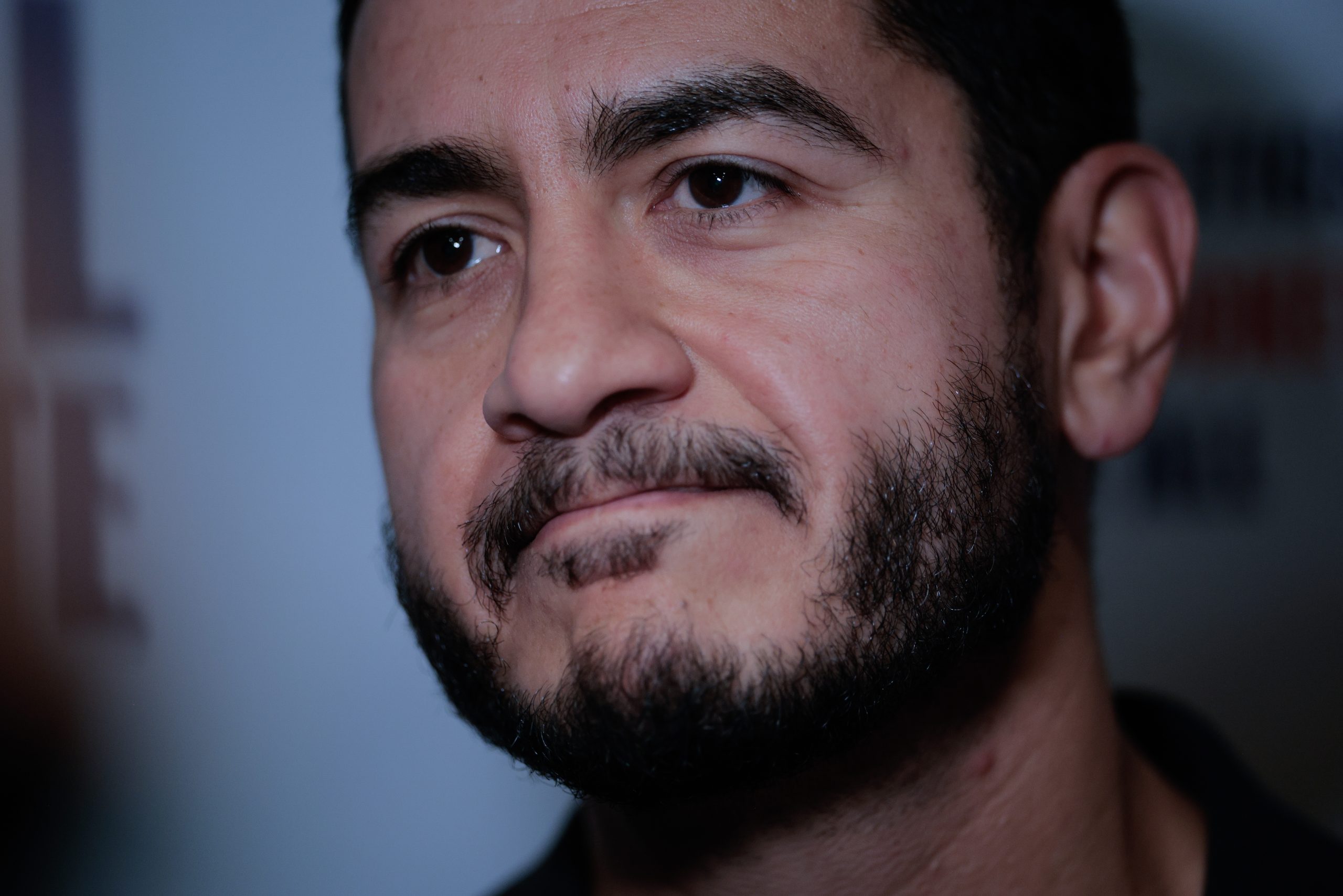


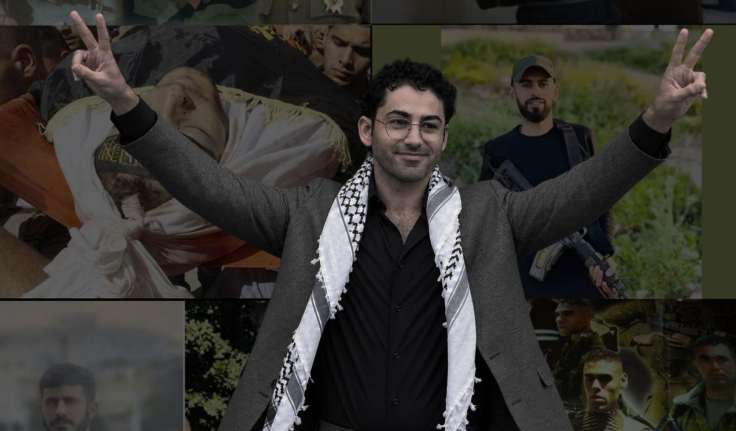
Mohsen Mahdawi, the Palestinian Columbia University student who is facing deportation over his central role in the anti-Israel campus protest movement, has a previously undocumented history of "support for terrorists, terrorist organisations, armed violence and those who carried it out," according to a comprehensive investigation published Wednesday by two investigative journalists.
The findings undermine Mahdawi's own claims—as well as those by sympathetic media outlets—that he is being targeted by the Trump administration over his peaceful advocacy for Palestinian rights and those living in Gaza. The 100-page investigation, authored by journalists David Collier and Rachel Feldman, unearthed previously unseen statements in which Mahdawi, who's from the West Bank, promised to "annihilate the Jews," praised Hamas, honored dead terrorists, and bragged that the Palestinians "have the capacity and conviction to resist, to kill and to wound."
Mohsen, who graduated last year from Columbia's highly selective undergraduate program and is now believed to be a graduate student at its left-wing international affairs school, was briefly in immigration detention but was released in April of last year. His case has been dragging out in the courts.
His violence-tinged postings, some of which were published as recently as 2024 while Mahdawi was on U.S. soil, tout "armed resistance in the West Bank or Gaza." They directly challenge the student provocateur's portrayal of himself as a reformed and now peaceful activist who long rejected the type of violence commonly endorsed by students who protested alongside Mahdawi at Columbia. The report provides additional evidence that some of Mahdawi's family members, who he casts as victims of indiscriminate Israeli violence, were actually affiliated with armed Palestinian factions.
"This is not a report about something Mahdawi said when he was young and later repudiated. The significance lies in the continuity to the current day," Collier and Feldman wrote in a press release upon publishing the report. "The report does not just raise questions about how some media coverage has continued to portray Mahdawi as a 'peace activist,' but also raises serious concerns about how someone with such an extensive history of supporting armed violence was able to obtain a U.S visa in the first place."
Mahdawi's ongoing deportation case is receiving widespread attention in the mainstream Western media, which often portray him as a moderate peace activist wrongly targeted by the Trump administration in its push to deport foreign students who engage in conduct deemed antisemitic or hateful toward the United States, often as part of their anti-Israel activism. The New York Times, for instance, published a glowing April 2025 profile that claimed Mahdawi abandoned Columbia's protest movement "because he wanted to engage in dialogue with supporters of Israel" and grew increasingly uncomfortable with the calls to violence that many students endorsed.
But the investigation by Collier and Feldman maintains these stories often "obscured or recast" Mahdawi's recent past and failed to properly authenticate his own tales of oppression at the hands of Israeli forces while living in a West Bank Palestinian refugee camp. At least seven of Mahdawi's family members examined in the report were found to have affiliations with armed factions.
"As Mahdawi built his public identity as a peace activist, troubling elements of his past were repeatedly obscured or recast. Armed fighters and members of terrorist organisations were presented by him simply as innocent Palestinian victims," the report states. "Terrorist connections within his own family were omitted from the stories he told about them. And important elements of the personal history he has presented to American audiences simply do not correlate with the contemporary historical record."
Mahdawi, 34, relocated to the United States in 2014 and, while an undergraduate, emerged as an early leader in Columbia's post-Oct. 7 protest movement. He was detained by ICE agents last year during an appointment to obtain U.S. citizenship, and deportation hearings soon commenced. An immigration judge ordered him to be removed from the country on June 3 of this year, but the case is being appealed.
Mahdawi's support for radicalism emerged as early as 2013, when he was a young adult with hopes of moving to America. It continued up until at least 2024, well after Mahdawi emerged as a leader in the campus anti-Israel movement.
In a December 2024 Facebook video that was restricted to "friends only," Mahdawi defiantly condemned an operation by Palestinian Authority security forces to root out terrorists in the Jenin refugee camp, describing it as "a slap in the face of the resistance, whether armed resistance in the West Bank or Gaza, or the popular resistance that we began and are still engaged in outside the homeland." Those West Bank refugee camps, he added, serve as the "heart of the resistance and the heart of the struggle," insisting that armed militants are actually "resistance fighters."
Just two days after Hamas's Oct. 7 terror spree, meanwhile, Mahdawi helped pen a joint statement from Palestinian activist groups at Columbia titled "Oppression Breeds Resistance." In it, the authors maintain that "occupied peoples have the right to resist the occupation of their land" and that "we should not be surprised when resistance and violence breaks out."
Two months later, Mahdawi penned a Facebook post mourning six "young men" who were killed in the West Bank refugee camp in which he grew up. "Israeli occupation forces killed six young men, including two of my neighbors," he wrote, claiming that at least five of those killed "were civilians." However, all of the individuals were later claimed by Hamas as "martyr heroes" who were killed while confronting Israeli forces, according to the report.
Mahdawi's support for such "martyrs" stretches back to 2013, just a year before he moved to Vermont. A Facebook post from January of that year showed Mahdawi on video advocating armed resistance to Israel.
"Every young man, and every person who thinks a little, has within him the ability, the capacity and the conviction to resist, to advance, to kill and to wound, whether on the military level, the political level, or the intellectual level," he said in the clip.
In a March 2014 Facebook post, Mahdawi posted a video "about the martyr Mu'tazz Washaha, which contains the infamous 'Khaybar' chant," widely seen as an antisemitic call to violence. Washaha was a terrorist with the Popular Front for the Liberation of Palestine and was killed around that time in an Israeli strike.
In another post just a few days later, Mahdawi lamented that a terrorist attack on a Jewish settlement didn't harm enough people.
"Brothers, if someone wants to do something, they should plan it. I'm not saying they shouldn't do something like this, but it's a shame to waste bullets and take the risk," he wrote in the Arabic-language post. "There is a great/easy possibility of doing bigger things if he really means/wants to."
Shortly after arriving in America in July 2014, Mahdawi praised Hamas and Palestinian Islamic Jihad in a Facebook post signed from "United States of America - Vermont."
"In all the forms of resistance that we seek outside the homeland, we remain dwarfs before the greatness of the lions of al-Qassam, al-Saraya and al-Kata'ib, and before the sacrifices of our brothers in Gaza," he wrote. "Congratulations to you, [people of] the purest land after Jenin camp; congratulations to you on [making] history and [winning] glory."
By 2015, Mahdawi was investigated by Vermont police after he applied for a job at a gun shop and allegedly told the staff he was experienced with modified submachine guns "to kill Jews while he was in Palestine," according to police reports reviewed as part of the investigation.
"Mahdawi allegedly said he had previously made guns for Hezbollah," Collier and Feldman discovered through contemporaneous police reports. "The gun-shop owner also told police that Mahdawi appeared genuinely knowledgeable about firearms," and that at a later date, he "allegedly said: 'I like to kill Jews,'" though he later denied to authorities ever having made that statement. The police report was provided to the U.S. Department of Homeland Security, and FBI agents ultimately interviewed Mahdawi before closing the investigation.
Throughout that time, Mahdawi continued to glorify terrorists on Facebook. In a September 2015 post, for instance, he mourned "Diaa Abdul Halim Talhama, a Palestinian Islamic Jihad terrorist, who was killed when an explosive device he was handling detonated prematurely," according to the report.
"Congratulations to you on martyrdom, and patience and consolation to all who knew him," he wrote.
Collier and Feldman conclude in their report that the image of Mahdawi that is being presented to Western audiences is in direct conflict with more than a decade of support for Palestinian terrorism.
"Mahdawi frequently speaks of justice. It is one of the central themes of the identity he presents to American audiences," they wrote. "But justice requires something more fundamental: truth. After almost one hundred pages examining his words, his history and the stories upon which his public identity was built, that is where the problem with Mohsen Mahdawi ultimately lies."