

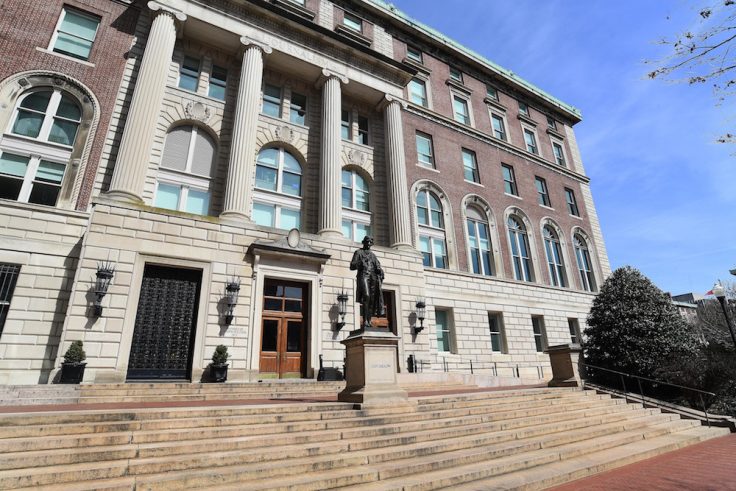
Columbia University’s architecture school partnered with a Lebanese research lab cofounded by a Hezbollah collaborator on a project aimed at studying housing access for refugees in Beirut. The Ivy League university received a $350,000 Ford Foundation grant to carry out the project, but claims it’s never held any "formal agreements" with the Lebanese lab.
Since its 2018 launch, Columbia’s Post Conflict Cities Lab—a project of the Graduate School of Architecture, Planning and Preservation that develops post-war reconstruction plans that avoid "exclusion of vulnerable populations and hardened religious, racial, and ethnic segregation"—has partnered with the Beirut Urban Lab at the American University of Beirut. The Beirut lab was cofounded by Ahmad Gharbieh, who leads its Critical Mapping team.
But before moving to academia, Gharbieh made "solidarity maps" for Samidoun (no relation to the Samidoun Palestinian Prisoner Solidarity Network), a group that provided Hezbollah with "unconditional but critical support for the armed resistance" in its fight against Israel during the Second Lebanon War, according to one of its organizers.
The revelations come at a time when Columbia is already on thin ice with the Trump administration over campus anti-Semitism. It only emerged from under President Donald Trump’s thumb after agreeing to pay $221 million and issuing a host of changes aimed at addressing the issue. Columbia's fourth and final anti-Semitism report, published Tuesday, showed that instructors smeared Jews and Israelis in their classes as occupiers and "murderers," and used unrelated lectures on topics like astronomy to rail against "genocide" in Gaza.
Columbia’s partnership with the Urban Lab involves studying "access to housing for low-income Lebanese and Syrian refugees in Beirut, Lebanon," according to an announcement in 2018 when the project started. It also "aims to engage local residents and urban practitioners as active participants in advocating for and shaping inclusive post-war reconstruction planning practices and policies."
Since at least 2019, Columbia has prominently listed the Urban Lab as a "collaborator" with its Post Conflict Cities Lab. When the Washington Free Beacon contacted Columbia about the collaboration and what it entails, the school removed the Beirut lab from that list. The Urban Lab is now referenced in a more obscure spot on Columbia's website that describes the Ford Foundation-funded project.
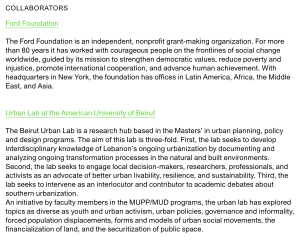

A Columbia spokesman said there's no formal agreement between the university and the terror-tied Gharbieh's lab.
"Ahmad Gharbieh is not and has never been affiliated with Columbia University," the spokesman told the Free Beacon. "There are no formal agreements with him or the Urban Lab at the American University of Beirut."
Columbia lists its project with the Urban Lab under "Current Projects" and notes that the work is "funded by a $350,000 grant from the Ford Foundation." A foundation spokesman told the Free Beacon that it hasn't funded the project for several years. "It seems as though this website is out of date," she said. A Ford Foundation webpage indicates the funding ended in 2023.
The Urban Lab has been upfront about Gharbieh’s work with Samidoun—and Samidoun’s organizers, Ghassan Makarem and Bassem Chit, have been candid about their group’s role as a Hezbollah collaborator.
"Our slogan was unconditional but critical support for the armed resistance, but full support for popular resistance," Makarem in 2023 told the Public Source, a Beirut-based anti-capitalism publication. "Our work was not humanitarian, or a bottom-up NGO work. We were part of the resistance against Israel’s war."
"We argued that we should be part of the popular resistance, part of a united front with Hezbollah and the Communist Party who were taking up arms," he added. "We had a common goal with them: resistance to Israel."
Chit, in 2009, said Samidoun secured Hezbollah’s support after meeting with the terror group’s Beirut military commander and "discussed how we could work together." If Samidoun supported Lebanese civilians, Hezbollah could "concentrate on fighting."
"[W]e told them that we saw ourselves as part of the popular resistance and that our task was to … mak[e] sure [people] are safe and have the resources they need," Chit said. "I think Hezbollah felt that if we did this kind of work, it meant they didn’t have to; they could concentrate on fighting — and their fighters would know that their families were being looked after in Beirut."
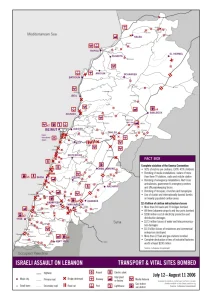
The Urban Lab, meanwhile, boasts that Gharbieh, while working for Samidoun, "produced daily maps of the Israeli assault on Lebanon, paving the way for the Lab's understanding of maps as powerful tools for media activism." His maps—littered with propaganda—showed "damage done by [Israel’s] aggression," according to the group’s website. It doesn’t mention that Israel’s assault against Hezbollah was a response to the terror group crossing the border and killing and kidnapping Israeli soldiers.
Gharbieh said the Lebanese government, of which Hezbollah held significant influence, provided data for his maps and used them as "reference documents." He routinely labeled Israel "Occupied Palestine" and called his maps "tools for activist media that challenged or filled the gap in the information diffused through mainstream international media."
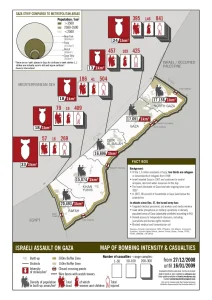
Gharbieh also created maps depicting the 2008 Israel-Gaza conflict with infographics alleging the Jewish state "[t]argeted medical personnel, aid workers and media workers."
He also made a map for a book coauthored by a fellow Urban Lab cofounder that cites "Hezbollah officials who want this media-savvy generation to be more politically involved," according to a description on the lab’s website.
A spokesman for the Urban Lab appeared to downplay Hezbollah’s role as a terrorist organization, saying the Beirut lab "does not collaborate with political parties or groups."
"The Beirut Urban Lab is a collaborative and interdisciplinary research space," she said. "It produces cutting edge scholarship on urbanization by documenting and analyzing ongoing transformation processes in Lebanon and its region's natural and built environments."
The Ford Foundation, for its part, has a long history of bankrolling anti-Israel groups and efforts, as the Free Beacon has repeatedly reported. It injected, for example, nearly $3.3 million into the Centre for Research on Multinational Corporations, a nonprofit known by its Dutch acronym SOMO, that promotes economic boycotts of Israel and U.S. companies that do business within the Jewish state.
And Gharbieh isn’t the only anti-Israel researcher tied to the Post Conflict Cities Lab. One of its in-house researchers, Hayes Buchanan, was cuffed last May for partaking in the violent raid of Columbia’s central library that injured two, distributed pro-Hamas flyers, and damaged university property. After finishing his master's in urban planning, Buchanan left for Lebanon to work full time at Gharbieh’s lab before returning to begin a doctoral program at Columbia, according to his LinkedIn profile.
Buchanan also said Hiba Bou Akar, the Post Conflict Cities Lab’s director, motivated him to pursue his graduate degree from Columbia’s architecture school. Bou Akar acted as security at Columbia’s second pro-Hamas encampment.
Architecture academia appears to be a surprising hub for anti-Israel sentiment. Though unrelated to Gharbieh’s former employer, the Samidoun Palestinian Prisoner Solidarity Network, a Canadian group under U.S. sanctions for providing financial support to terrorists, nonetheless has ties to Columbia’s architecture school. In March 2024, Sean Eren, a graduate student in the program, spoke during the solidarity network’s on-campus Resistance 101 event and applauded the success of "cellular warfare," saying it "has been implemented to great success throughout Al-Aqsa Flood," Hamas’s label for its Oct. 7 terror attack.
In April, the Free Beacon reported the entire board of a top architectural journal quit after its publisher refused to greenlight its forthcoming issue on the "ongoing Israeli genocidal campaign against Palestinians in Gaza." One of its editors, former Columbia architecture professor Nora Akawi, endorsed the Boycott, Divestment and Sanctions movement as "justice against [the] Israeli racist colonial regime."