





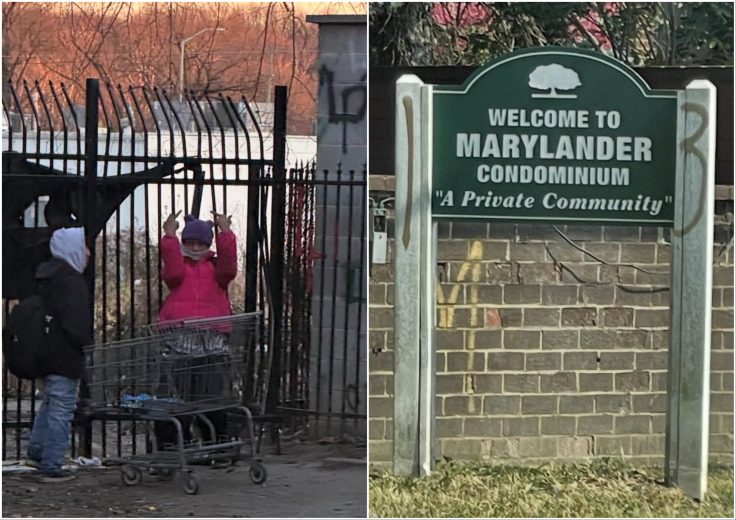
HYATTSVILLE, Md.—The sign outside the Marylander Condominiums, a 200-unit complex in Prince George’s County, Md., describes it as a "private community."
But for members of a homeless encampment in the condo’s backyard, the complex also serves as a crackhouse, a bathroom, and the entrance to an open-air drug market, which has become a magnet for organized crime and caused millions in property damage.
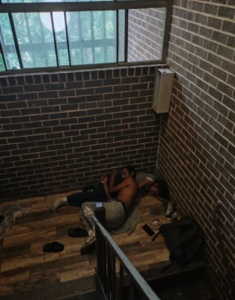
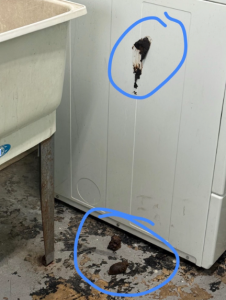
Transients break into buildings and smoke crack in the stairwells. Tenants traversing the property must navigate needles, feces, and sleeping bodies as addicts nap half-naked in the hallways and sprawl themselves like welcome mats outside residents’ doors.
Half of the complex has gone without heat since Thanksgiving after vagrants allegedly vandalized the boiler room, causing pipes to burst in several buildings. Some units have lost electricity, too, due to the overuse of space heaters. Though the county instructed those without heat to "vacate immediately" in December, most have defied the order and tried to weather the cold. They say they have nowhere else to go.
Outside the freezing halls, drug dealers drive high-end vehicles through a dilapidated parking lot—the Washington Free Beacon spotted a Cadillac on one nighttime visit—and park in the complex’s southeast corner. There they approach a hole in the property’s wrought iron fence, which separates the Marylander from what some residents call "the mountains": a homeless encampment that has encroached on its law-abiding neighbors since 2023, and which the county’s law enforcement officials have only recently sought to clear.
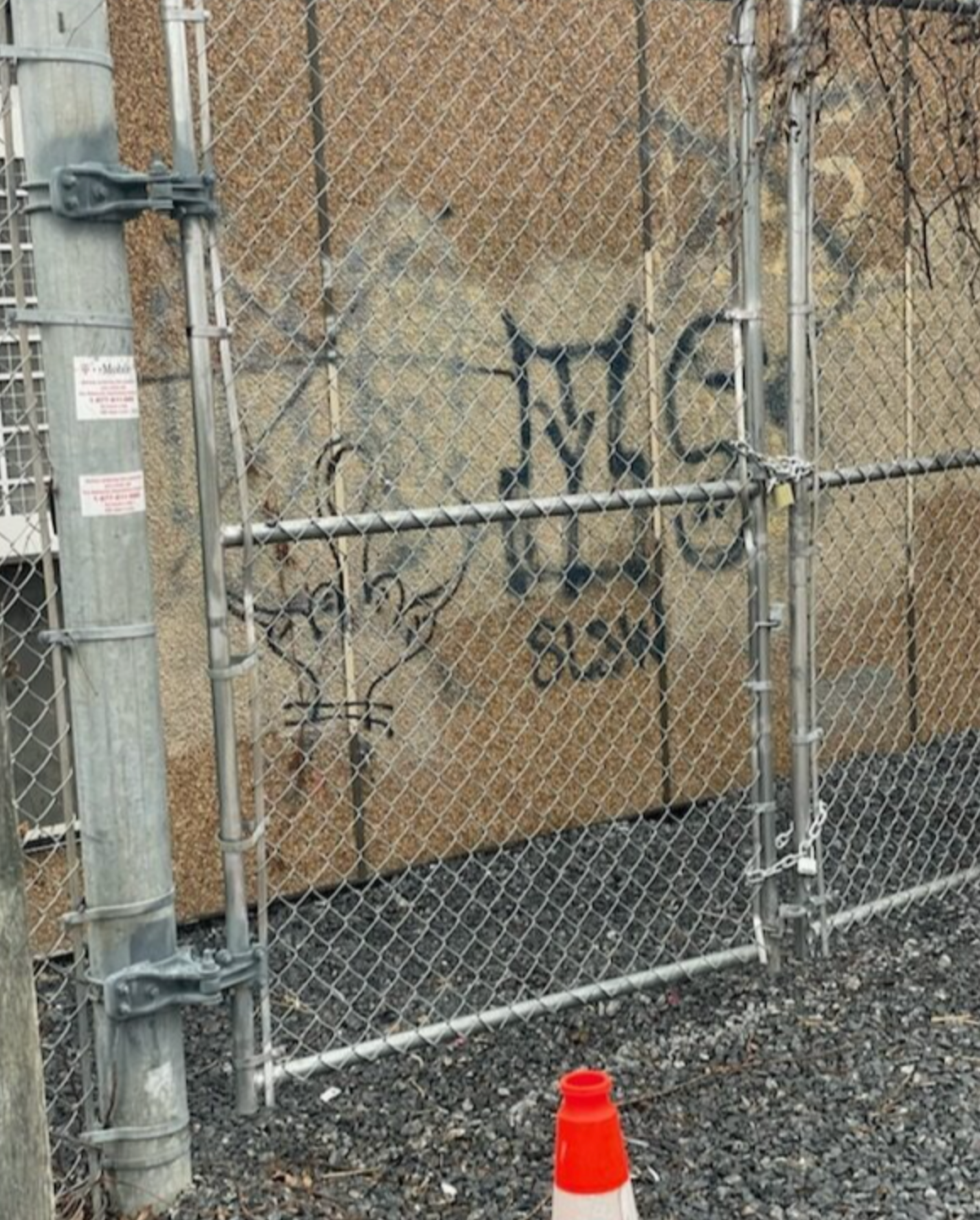
Patrolled by masked men who appear to be part of a local gang, the encampment has become a haven for prostitutes—one of whom solicited this reporter just outside the camp—and for the AK-47s police say have been found in wooded areas. While it is not clear who stashed those guns, graffiti on nearby structures includes signs for MS-13. County police declined to comment on gang activity in the area.
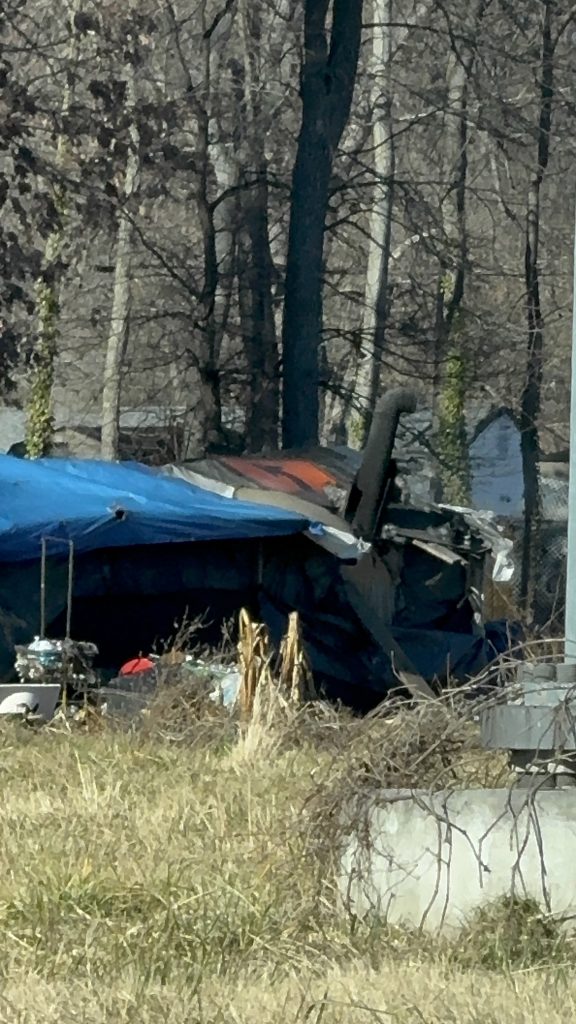
 The squalor has sparked a smattering of local headlines and belated, but minimal, political action. At a town hall on Jan. 22, officials said they had taken several measures over the past two weeks to address an encampment that had festered for more than two years, evolving from a collection of tents into something that more closely resembles a shantytown, as the camp’s residents have built increasingly elaborate structures with materials that appear to have been stolen from nearby stores. One recently demolished shack included a generator and a makeshift smokestack.
Billed as a "listening session" for condo-owners to air their grievances, the town hall featured a lengthy presentation on how the county was handling its "unhoused" residents.
"We have to be compassionate," the county’s deputy chief administrative officer for public safety and homeland security, Melvin Powell, said of the encampment, addressing the hundreds of residents who could soon be displaced because of it.
"We’re not criminalizing the unhoused," police major Thomas Boone added.
The situation shocked officials at Quasar Real Estate, a local investment firm, when it began managing the Marylander in April 2025. For months, they pleaded with police and county officials to address the open-air drug market that had effectively colonized the condo, which suffered so many break-ins that the company stopped repairing the locks.
But the county—which has the highest Democratic vote-share of any county in the United States, at 86 percent—didn’t clear the camp. Instead, it threatened to sue the condo, which was already tight on cash, for its failure to fix the nearly $5 million in property damage that has been caused by the drug den on its doorstep.
"Residents have made repeated requests for repairs and improved safety measures," a county official, Danielle Coates, told Quasar in an August email. "Failure to address these concerns promptly may result in further escalation, including referrals to the Department of Permitting, Inspections, and Enforcement (DPIE) Housing Enforcement, Landlord-Tenant Affairs, and the County Office of Law for formal action."
What followed was an onslaught of citations that decimated the condo’s finances and put hundreds of families at risk of eviction—all while county social workers were delivering food to the encampment that triggered the crisis.
"The dilapidation of this community was caused directly by the county," said Phil Dawit, Quasar’s managing director. "The reason it’s so bad now is that everyone let it fester."
This report is based on emails from county officials, interviews with residents of the Marylander, invoice records and maintenance logs, and dozens of hours of video footage, much of it from the body cameras that Quasar executives wore when they visited the condo.
It reveals a Kafkaesque battle between law-abiding citizens and the left-wing bureaucrats who abandoned them, as officials in a deep blue county vowed to be "compassionate" and avoid "criminalizing the unhoused."
The costs of that compassion fell predominantly on poor, non-white condo-owners who saw the value of their homes evaporate as vandalism from the encampment pushed the complex into disrepair. That in turn made banks unwilling to finance security upgrades—without which the condo was more susceptible to crime—and caused inspectors to deem many units "unfit for human habitation" after the heating system was vandalized.
The county is now taking the condo to court to enforce an evacuation order against those units. If a judge rules in the county’s favor on Thursday, the residents who for years were terrorized by a homeless encampment will become homeless themselves.
"The people working hard and following laws are on their way to being homeless," Dawit said. "Meanwhile, the homeless encampment gets to do whatever it wants."
At a time when some cities are taking a more permissive approach toward homelessness, the crisis at the Marylander illustrates the perverse incentives those policies can create. The county’s Department of Social Services, for example, delivered food to the camp even as police said that doing so would "incentivize the unhoused population to return," according to a Zoom call between Quasar and police officials. Meanwhile, the homeless camp’s own members say that the refusal to restore law and order enabled their addictions, allowing crack and fentanyl to flow in unabated.
When, after months of political pressure, police finally arrested some of the camp’s suppliers in January, a woman who was living there, "DC," implied that the county’s permissiveness until that point had made it harder for her homeless neighbors to get clean.
"Most of them are not [as] high as they usually [are]," she told Dawit, referring to camp regulars who could no longer rely on their dealers for crack and fentanyl. "Ever since they started getting everybody arrested, they’ve been weaning it off."
Prince George’s County Department of Social Services did not respond to a request for comment. The police department did not respond to a request for comment.
"Shoot me, motherfucker"
When Quasar took over the Marylander in April 2025, there was no fence separating the property from the encampment, and, thanks to $500,000 in alleged embezzlement by the previous management company, almost no money in the condominium’s bank account either, according to financial records reviewed by the Free Beacon.
Quasar used what little remained to build a $27,000 fence around the complex, hoping that it would keep the vagrants at bay.
But members of the camp promptly pried a hole in the fence and continued roaming the property, high on the drugs that were delivered each day by armed men, in sports cars, at around 10:00 p.m.
"The fence has made zero difference," said Scott Barber, who shares a condo at the Marylander with his brother, Chris. "They walk right in."
Once inside, members of the camp will assault residents, start fires, and relieve themselves in hallways, leaving some carpets with permanent urine stains. Work orders for the property’s maintenance staff show numerous requests to clean up human waste, which residents say has been exacerbated by the police’s refusal to arrest trespassers.



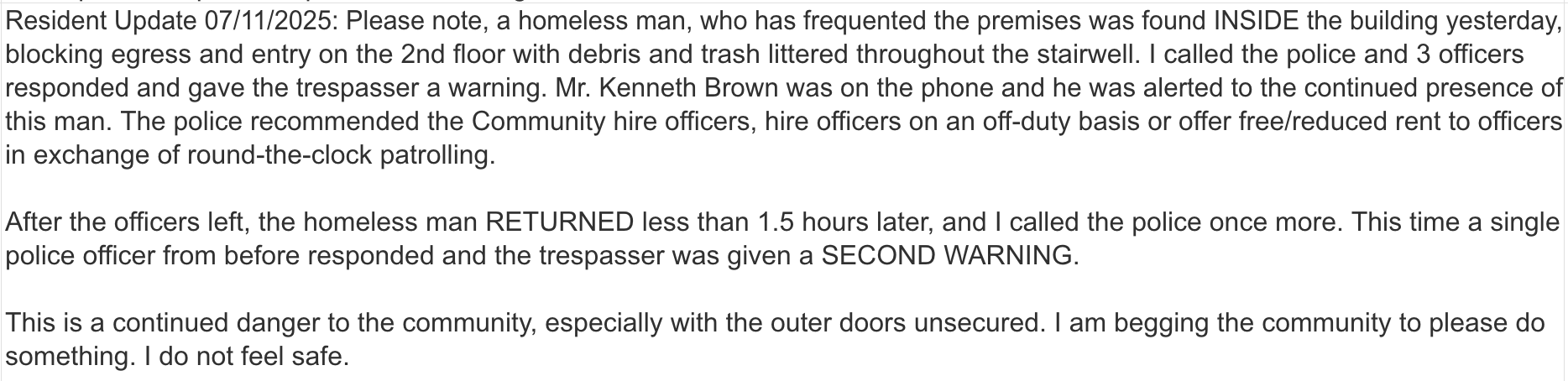
One tenant described how police had booted a homeless man from the stairwell only for him to return 90 minutes later, prompting the tenant to call 911 again.
"This time a single officer from before responded and the trespasser was given a SECOND WARNING," the tenant wrote in a note to management. "I am begging the community to please do something. I do not feel safe."
The unwillingness to make arrests meant that dangerous people kept reappearing. When Quasar CEO Kenneth Brown called police in June to report a homeless woman in the parking lot, the responding officer told him that she would "come right back" as soon as he left, adding that it is "kind of hard for us to … charge everyone with trespassing" given the constant "back and forth" through the fence.
Two months later, the same woman threatened Brown with a metal pole after he asked her to stop harassing maintenance workers. She only backed off when Brown drew his gun.
"Shoot me, motherfucker," the woman shouted. The confrontation, which Brown recorded with a body camera, was defused without injury.
Quasar had turned around seedy buildings before, including one with a prostitution problem, but none of them were being invaded by addicts or deluged with drug dealers.
Violent incidents spooked maintenance workers and delayed renovations as vendors hesitated to work on site. One contractor said in an email that it would not install laundry machines until the buildings were cleared of homeless people, citing the need to "ensure a safe environment for our team."
As conditions worsened, residents grew frustrated with Quasar, which had more than doubled their dues in order to stabilize the condo’s finances. A major sticking point was the company’s decision, in July 2025, to stop fixing the locks because of how frequently they were vandalized, with at least one building suffering multiple break-ins in the span of two weeks, according to invoices reviewed by the Free Beacon. Quasar said it couldn’t afford continued repairs until the root cause of the vandalism was addressed.
The problem, according to residents, is that without locks the complex became even more susceptible to crime. That in turn made vandalism more frequent and its financial toll more acute.
"The encampment has gotten worse because the buildings are unsecure," Barber said. "It’s a crime of opportunity."
"Irreparable Damage"
These sorts of catch-22s popped up again and again as Quasar sought help from county officials.
The company contacted a local councilmember, Wanika Fisher (D.), in June 2025 after outreach to the police went nowhere. It didn’t hear back until August when Fisher’s deputy, Danielle Coates, threatened to sic safety inspectors on the condo if it did not provide a timeline for repairing the locks.
She also demanded a series of measures, including security "patrol[s]," that would later be recommended by a police audit of the condo.
But when Quasar offered to pay off-duty officers to provide private security, it was told that no one would accept the detail due to the threat of gang violence.
"We see a lot of gang graffiti on the dumpsters and trees in the area for ms13," a police sergeant texted Brown, who had inquired about off-duty patrols in May at the request of a contractor. "I would just caution whoever is working there to call 911 if there’s any issues."
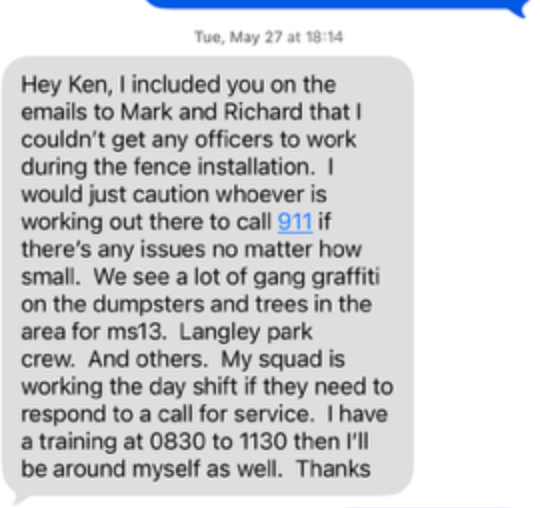
Brown said the sergeant told him by phone that officers were afraid for their safety. Another officer told Brown during a recorded conversation in August that "we’ve gotten guns out of these woods, like AK-47s."
Without private security, the condo was locked in a doom loop of crime and capital flight. A bank that had initially agreed to finance $2.5 million in renovations canceled the loan in December after the boiler room was vandalized, saying it would be difficult for the condo to repay given the "irreparable damage" to the heating system and the "Unfit for Habitation" notices.
As a result, the condo now has less than $650,000 in its bank account to pay for $4.7 million in pipe repairs. Residents have been forced to rely on space heaters amid a bitter cold spell, straining the property’s electric grid.
When the complex installed wires above ground to keep the power on, it was hit with yet another citation—fire watch—because the installation lacked the proper permits.
In a phone call with Brown explaining the issue, the county’s assistant fire chief, Aaron White, also noted that homeless people had been lighting fires in the parking lot.
"I mean, they set the dumpster on fire while we were all there," White said, according to audio of the call. "That’s crazy."
White told the Free Beacon that the fires started by encampment members were not a factor in the citation. Other officials have denied that the encampment was responsible for damaging the boiler room.
The condo also lost property insurance in August after a previous carrier canceled its policy, citing, among other things, "ongoing vandalism related to a nearby homeless encampment." More than 20 other carriers have declined to provide coverage—which the condo must purchase under state law—according to a letter from a brokerage firm.
"You literally have to take them into handcuffs"
With the code violations piling up—and with local news outlets, including the Washington Times, picking up the story—Quasar officials held a Zoom call with police on Jan. 17.
There, they were hit with yet another allegation: Residents of the Marylander, police captain Nicholas Collins said, had been spotted bringing food to the camp.
"You need to express to your residents that … they should not be delivering food to the unhoused population," said Collins, who declined to comment. "That's only going to incentivize the unhoused population to return and ask for more."
It was an oddly hard-headed argument for a county that claimed, in a 2024 application for federal housing aid, to "[m]inimize [the] use of law enforcement" against encampments. And it left out some awkward context: At the same time that police were warning about perverse incentives, the county itself was feeding the camp, thanks to a pair of social services programs ostensibly aimed at getting the homeless off the streets.
On Jan. 21, after a two-week operation that resulted in 18 arrests for drug and weapons offenses, police finally began clearing the tents under growing political pressure.
When Dawit, Quasar's managing director, asked what could be done to help the evicted campers, an officer told him about two county programs that had been delivering food to them for years. The officer said that a social worker, John Harrison, frequently "brings food" to the camp as part of a "street outreach" program.
"He comes here all the time," the officer said of Harrison, whose name was independently mentioned by camp members interviewed by Dawit.
That program is run by the county’s Department of Social Services, which says its outreach teams "build trust" with the homeless—and eventually get them off the streets—by "meeting them where they are."
But when police launched a similar program in 2023, they saw their no-strings-attached altruism derailed by the realities of addiction.
"We gave them food," the officer said, describing how his department had teamed up with a coterie of nonprofits, including Salvation Army, at a thrift store across the street from the encampment. "We were successful for a bit, but then it kind of stopped because you get the severe drug addicts."
Those addicts, the officer explained, preferred to camp behind the condo, where there was no curfew, plenty of drugs, and none of the rules and regulations of homeless shelters.
To get them off the street, he said, "you literally have to take them into handcuffs."
Handcuffs appear to have been the county’s last resort. Following the Jan. 22 town hall, the Free Beacon returned to the condo and saw several camp regulars—including the woman who threatened Brown—camped around a fire in the area that had been cleared a day earlier.
As the fire department arrived and began to shoo them away, Chris Barber, a Marylander resident, predicted they would come back. Asked how long that would take, Barber laughed.
"I give it about 10 minutes," he said.