




It is one of my favorite stories, told in Norman Podhoretz’s 2000 book My Love Affair with America—a tale for which I told my friend Norman, who died this week at the age of 95, I am eternally grateful, as it features so often in my sermons:
In 1950, Podhoretz, a student of English literature at Columbia University, was awarded the Kellett Fellowship, allowing him to continue his studies at Cambridge. Another awardee of the Kellett, heading to Oxford, "was someone named Emmanuel Chill, whom I had never met." Podhoretz’s mother, reading of the other Kellett fellow, suddenly recalled her journey to the United States from Eastern Europe decades before. "When I came to America," she reflected, "an older girl named Ida Chiel from my village was on the same ship, going to join her husband, who was the son of Mendel Chiel. She already knew a little English, and during the trip she taught me to say, ‘How do you do, my dear father,’ so I could greet him like a regular American when we landed. Anyway, I lost touch with her after a while, but I’ll bet Emmanuel Chill is her son, named after Mendel."
Podhoretz tells us he retorted impatiently, "For Godsakes, Mom, I don’t even know if the guy is Jewish. Anyway, it’s too crazy." Yet she was undeterred, and despite her son’s protestations, she phoned Emmanuel Chill’s mother and introduced herself: "Mrs. Chill, I’m the other mother and I’m calling to congratulate you."
We must pause to ponder the delicious way in which Mrs. Podhoretz identified herself. No name was necessary—these two mothers were bound by the pride in their two sons’ achievements. But that is not all. This woman who had fled the persecution of Eastern Europe was on to something:
After Mrs. Chill thanked her, my mother, not missing a beat, asked her if "by any chance" her name was Ida. And, of course it was, and of course this "other mother" was the very same Ida Chiel with whom mine had traveled to America. … America had found two of their sons there, plucked them up, and deposited them into a great university in which Jews were still only grudgingly welcomed. To top it all off, a mere thirty years after these two young girls from a tiny hamlet in East Europe had crossed the Atlantic in steerage, America was sending their two sons back across the same ocean, only now in grand style.
Podhoretz concludes his story by citing Harry Golden, who in the 1960s wrote a bestseller whose title unites this tale with thousands of others: Only in America.
There is so much to say about the legacy of Norman Podhoretz: premier conservative intellectual of the Cold War, stalwart defender of Israel and the Jewish people, one of the great literary critics of the 20th century. But it is the story above that comes to my mind as I ponder his life, and my own friendship with him. Only in America could Norman Podhoretz have come into being; only in America could I have had the privilege of knowing him, and learning from him; only in America would Norman, therefore, have devoted so much of his own efforts to reminding his fellow intellectuals—and his fellow Jews—the gratitude they owed this country.
Love of America, for Norman, was not synonymous with naivete; he did not assume that everyone in America was delighted the Podhoretzes had arrived there. His own grandmother encountered an anti-Semitic judge in her citizenship hearing, who maliciously asked this religious woman whether she believed in "bigamy." Having no idea what that meant, the civically sincere applicant immediately and stoutly replied, "Shooah, Judge," and had her application rejected (she reapplied). Yet Podhoretz understood that America was to be judged not by this judge, but by the sweep of history. His own studies of the Western canon at Columbia, he reflected, "left me with a reverence for Western civilization—and by extension for its great heir, defender, and new leader, America."
Many of Norman’s essays inveighed against the policies of particular administrations, but at his writings’ core was love of America itself, the knowledge that the ideas through which America was born has brought Americans "more freedom and more prosperity than any other people on the face of the earth, whether in the past or in the present." Surely, he argued, "this entitles the United States of America to a place among the very greatest of human societies. And even more surely, it entitles this country to the love and gratitude of all whom a benevolent providence has deposited on the shores of—yes, a thousand times yes—‘the land of the free and the home of the brave’ to live their lives and make their livings under the sublime beauty of its ‘spacious skies’ and ‘from sea to shining sea.’"
It is Norman Podhoretz’s love affair with America that explains his own political journey, as his ardent admiration for this country remained with him "all my life, including that part of it I spent in the camp of the radical Left." He came to understand that the Left’s aim was to ensure that students never repeated his own academic experience, that they leave college "feeling not reverence for Western civilization and/or America but hatred and contempt." As his patriotism fueled his own migration to the Right, he would admonish, in the 1990s, his now-fellow conservatives whenever he felt their frustration with American policies or American culture bordered on a rejection of America itself. Already retired from his position at Commentary, he described engagement in these admonishments as a blessing: "Being summoned from the reserves into active duty, and having to defend this country once more, served to remind me of why I loved it so much."
When I read My Love Affair with America as a young man, I could scarcely have imagined then that I would become friends with its author, nor how relevant his book would be to the particular moment in which he would pass away. America has offered Ilhan Omar the very same benevolence that was bestowed upon the Podhoretz family; yet gratitude to America, it is safe to say, does not lie at the heart of her political worldview. Meanwhile, the podcasting Right features the ravings of those who, in a strange and striking moral mirror of Norman’s Love Affair with America, join anti-Semitism with anti-Americanism, and hatred of the West in general. We are told the very freedom for which America fought was a mistake; that it might have been better had it allied itself with Hitler; and that the current problems of the Western world are the fault of figures such as Winston Churchill.
In the midst of all this, there is much to see that has vindicated the way in which Norman argued for our obligation to love this country, and how this was especially incumbent upon Jews. In his book, Norman noted Yogi Berra’s famous reflection upon hearing that the lord mayor of Dublin was Jewish: "Only in America." To understand the humor of the remark is also to intuit its profundity. There is no "Only in America" in Europe. In the past two years, as Hamas-praising mobs swept across college quads, Norman would mourn the way in which Jew-hate and anti-Americanism had overtaken his "beloved Columbia." But this difficult period for Jews also revealed how so many Americans opposed Jew-hate, and how many American leaders stood with Israel in its dark and difficult hour. I rejoice that Norman, at the end of his life, was able to see the United States lead in the neutralization of the Iranian nuclear threat, a policy for which he had long argued, and a fulfillment of the world leadership to which he believed this country was called.
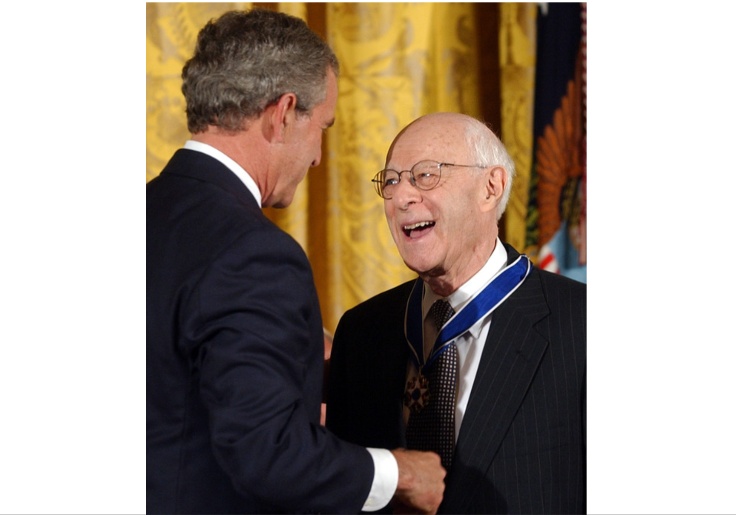
My favorite image of Norman Podhoretz is a photograph of him receiving the Presidential Medal of Freedom in 2004. This photo of Mrs. Podhoretz’s son would surely have stunned the young woman in steerage had she glimpsed this picture of her family’s future. And Norman himself understood this. One of the most beloved songs at the Passover Seder is "Dayenu," a long litany of events in Jewish history for which Jews express gratitude to God. Norman invoked this holiday hymn at the conclusion of My Love Affair with America, giving his own dayenu for all he owed this country.
This is exquisitely apt. The biblical name Judah—from which the word "Judaism" emerged—means gratitude, a name bestowed by the grateful matriarch Leah when her fourth child was born. To be a Jew, in other words, is to be grateful. To know Norman Podhoretz is to know his Jewish gratitude to America; and, I, in turn, will remain forever grateful for what he has given this country, for the blessing of spending time with him, and, therefore for the fact that his mother boarded a boat and sailed across the ocean over a century ago.
Meir Y. Soloveichik is the rabbi of Congregation Shearith Israel in New York City and the director of the Straus Center for Torah and Western Thought at Yeshiva University.