

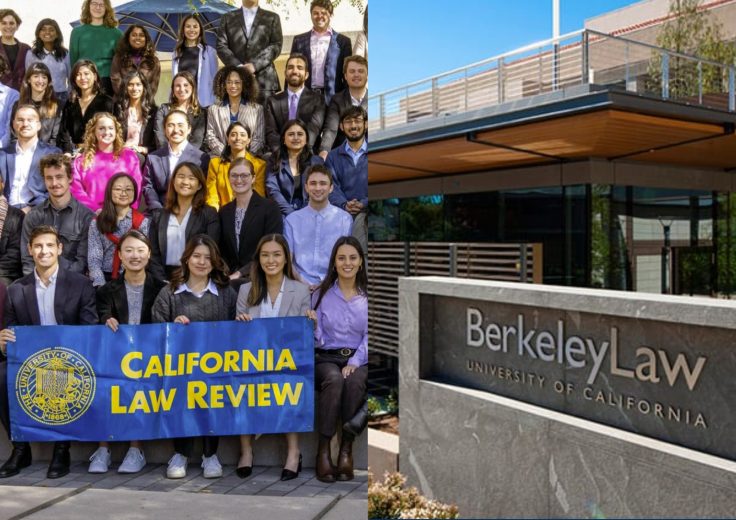
The flagship law review at the University of California, Berkeley, is poised to delete all internal application records after the Washington Free Beacon reported on the journal's use of personal statements to promote a "diverse membership," sparking concerns that the journal is attempting to destroy evidence that could be used against it in the event of a discrimination probe.
The California Law Review will vote tomorrow on a document retention policy that would require the journal to delete all "Write-On application materials following the conclusion of each year's Write-On process," as well as any materials related to the election of the journal's Holistic Review Committee, an eight-person body that grades applicants' personal statements, according to a source familiar with the situation.
Members of that committee have pledged in writing to "uplift Native voices," weigh "diverse life experience" against "technical editing abilities," and "integrate anti-racist sentiment" into the selection process, the Free Beacon reported in August. The proposed policy would eliminate any record of those pledges, making it harder to sue or investigate the journal for race discrimination.
At least one editor has argued that the move would raise legal concerns about the destruction of evidence and could expose students to criminal liability.
"[I]t seems that the provisions relating to designated communications and to candidate statements could be construed as being intended to avoid the creation of the kind of evidence that was recently leaked to the Washington Free Beacon, and to bar editors from reporting it," the editor wrote in an email to the law review on Tuesday. "If I were a federal prosecutor or immigration services officer, I might regard this as a system designed to enable violation of the civil rights laws by engaging in discrimination on racial and other grounds through the selection of [Holistic Review Committee] members that publicly stated their intent to do so."
The editor noted that the Justice Department issued a cease and desist letter to the Harvard Law Review last year after that journal ordered a student to delete documents he had allegedly shared with the Free Beacon, and which triggered a federal discrimination probe.
"Personally, I am an immigrant … so I have no interest in drawing negative attention from [federal] government or media, particularly under this administration," the editor wrote. "Thus, I would be very concerned, for myself and for anyone else, particularly anyone in a similar status, about participating in what may be construed as a criminal conspiracy to conceal and perpetuate the violation of the civil rights laws ... by voting 'yes' on this resolution."
The California Law Review did not respond to a request for comment.
The draft policy would require all application materials and article drafts to be password-protected. It would also bar the law review from retaining "any recordings of election forums" and require each editor to "delete all documents" relating to the law review "within two months of the conclusion of their membership."
Though the personal statement only accounts for 30 percent of an applicant's score, the California Law Review does not consider first-year grades, meaning it is often the deciding factor in admissions. In their applications for the holistic review committee, many editors said they planned to use this process to influence the racial composition of the journal. One former committee member, Clemencia Garcia-Kasimirowski, also derided "seemingly 'objective'" standards like standardized tests, which she claimed were "created by a eugenicist" in an effort to subjugate minorities.
"I am very passionate about being part of the Holistic Review Committee because it shows that CLR is committed to approaching an inequitable process through an equitable lens," Garcia-Kasimirowski wrote in her 2024 application to the committee. "This process not only takes a concrete step towards making CLR a more equitable journal, but we all know that a more diverse group of students in the CLR room makes us better, both substantively and through community."