



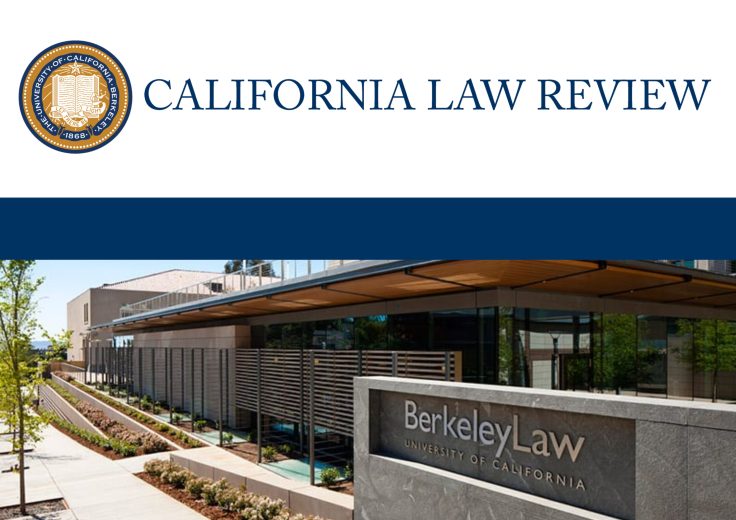
When Maya Parthasarathy, a student editor at the University of California, Berkeley's law journal, the California Law Review, applied for the journal's admissions committee in 2025, she knew exactly what her colleagues wanted to hear.
A former deputy at Politico, where she oversaw the hiring of entry-level journalists, Parthasarathy explained how her experience in media would help her promote "diversity, equity, and inclusion" at the University of California, Berkeley's flagship law journal, which selects eight editors each year to evaluate candidates for the law review.
"When I first joined [Politico], I realized that the newsroom lacked the diversity necessary to reduce bias and improve our content," Parthasarathy wrote in her application to the admissions committee. To fix the problem, she said, her team at Politico "did not consider grades," instead creating a "holistic" review process that included, among other things, an editing test.
"For candidates on the borderline of a passing score on our test, we considered strengths they showed in other parts of their applications, and experiences they would bring to the table," Parthasarathy said. "At the end of my tenure at Politico, our team had grown from just one person of color — me — to fifty percent hires from underrepresented backgrounds."
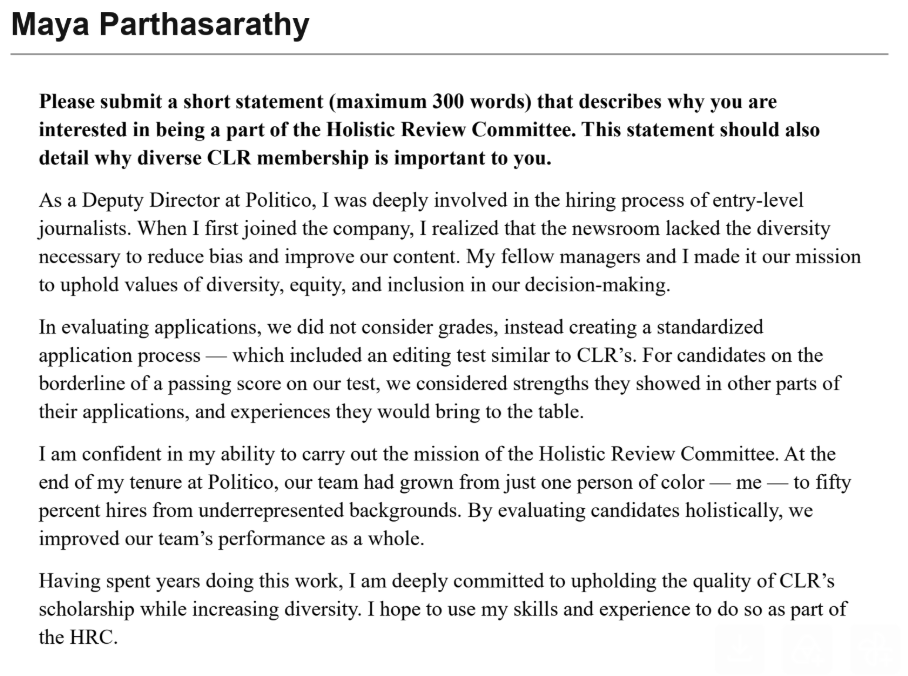
Parthasarathy's boasts were probably a legal liability for Politico, which did not respond to a request for comment, insofar as they described how the company sought to change the racial composition of its employees by de-emphasizing objective factors. But they were catnip for the California Law Review, which elected Parthasarathy to serve on the admissions committee in a journal-wide vote.
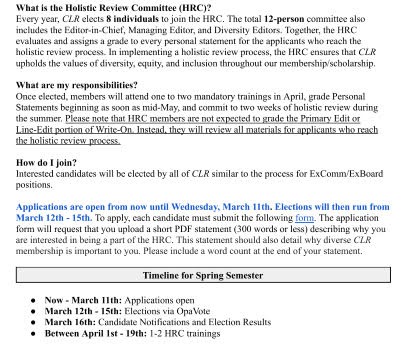
The committee grades the personal statement of every applicant who passes an initial editing test. The prompt for the statement, which accounts for 30 percent of an applicant's score, asks "how your background, life or work experiences, culture, or perspectives would contribute to the diversity" of the journal.
The journal claims that this process gives "each student an equal chance to display the skills necessary to be a California Law Review editor." But according to dozens of documents obtained by the Washington Free Beacon, those skills are at most an afterthought to many members of the admissions committee, who have pledged to "uplift Native voices," weigh "diverse life experience" against "technical editing abilities," and "integrate anti-racist sentiment" into the selection process.
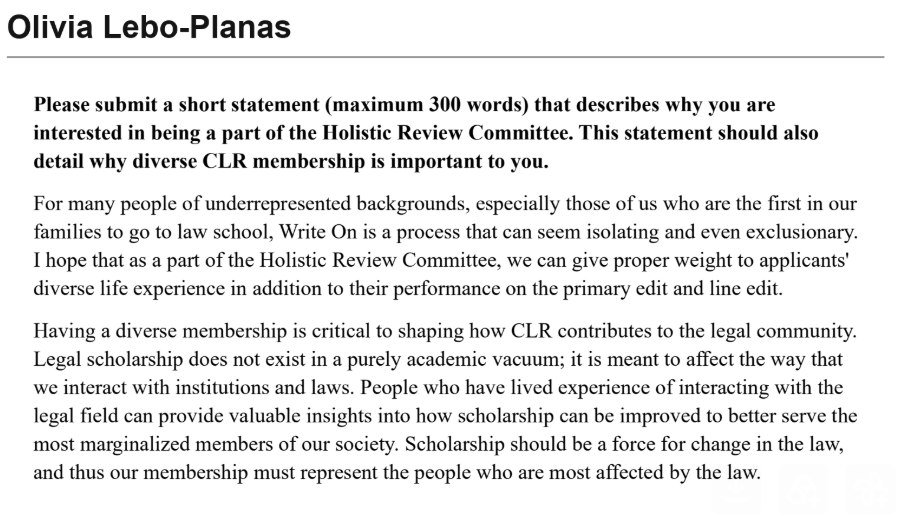
The Free Beacon reviewed 14 applications for the committee submitted between 2023 and 2026, as well as internal announcements showing which applications had been successful. The documents offer a window into how editors at a top law review—UC Berkeley School of Law was ranked 16th by U.S. News and World Report this year and its law review is among the top 10 in various rankings—are using personal statements to bypass bans on affirmative action, giving race as much weight or more than what one former committee member, Clemencia Garcia-Kasimirowski, dubbed "seemingly 'objective'" standards.
"I am very passionate about being part of the Holistic Review Committee because it shows that CLR is committed to approaching an inequitable process through an equitable lens," Garcia-Kasimirowski wrote in her 2024 application to the committee. "This process not only takes a concrete step towards making CLR a more equitable journal, but we all know that a more diverse group of students in the CLR room makes us better, both substantively and through community."
Garcia-Kasimirowski also said that "standardized testing … was created by a eugenicist" and that "large lectures … have been proven to disadvantage people of color."
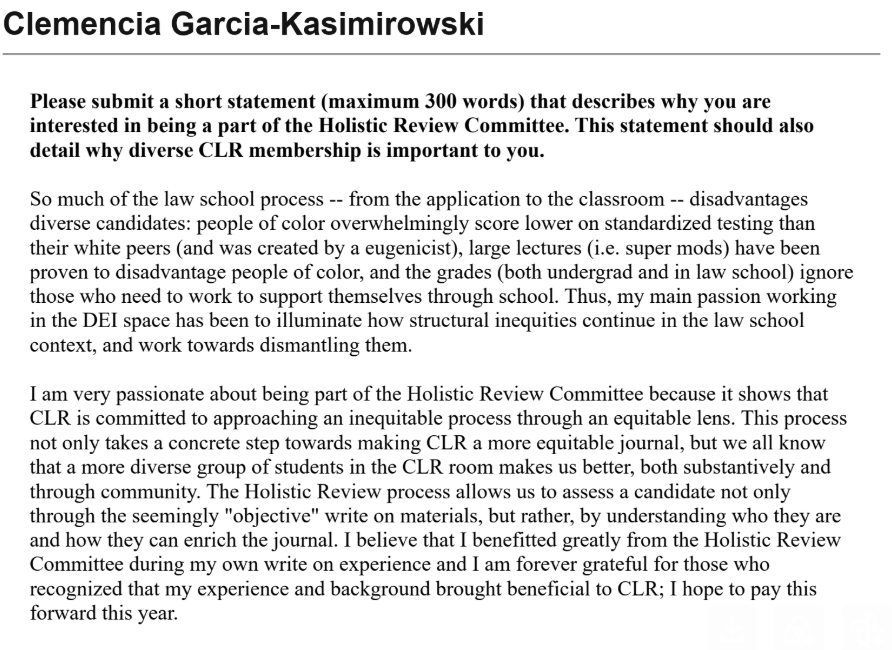
At least two separate editors said they wanted to join the committee so that they could give a boost to Native American applicants. Mackenzie Gettel, now an associate at Jenner & Block, wrote in her 2024 application that the "Holistic Review Committee will enhance my ability to uplift Native women whose voices are otherwise silenced by the inaccessibility of the law." Isabel Cooper, a current editor, pledged to ensure that "students like the girl from my tribe can look to law review journals and feel represented."
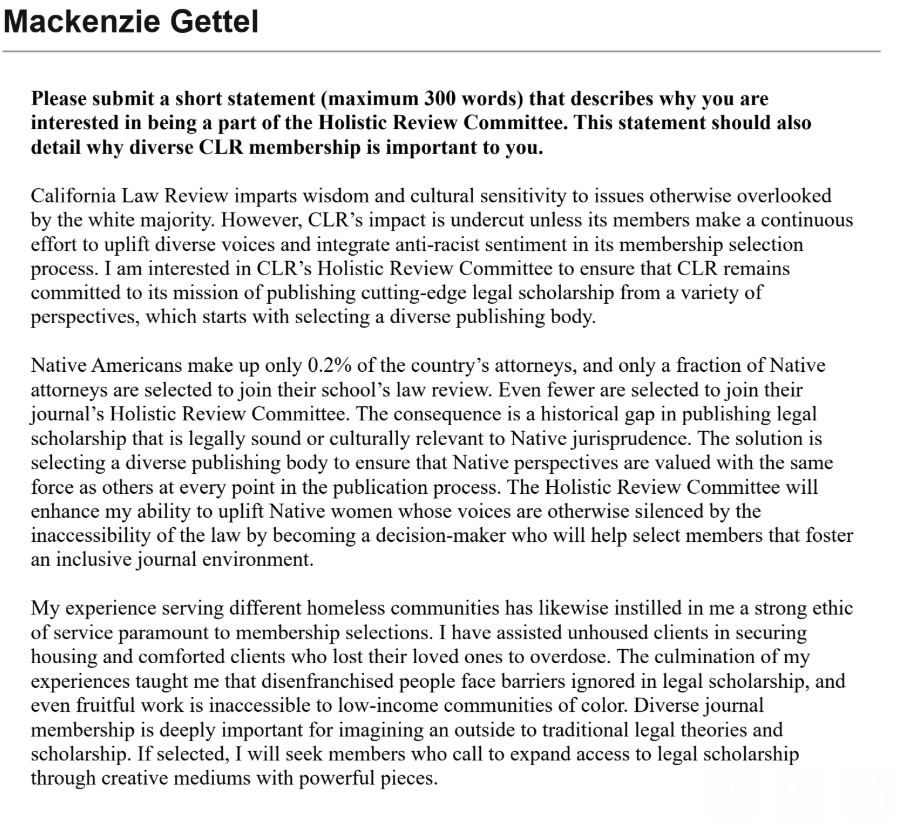
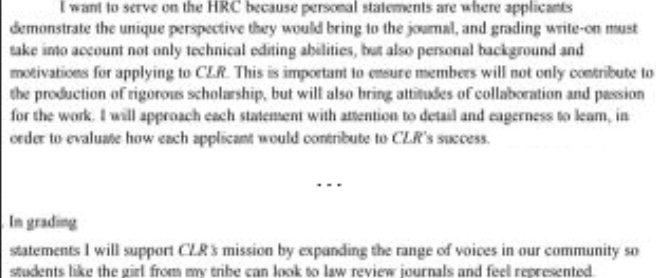
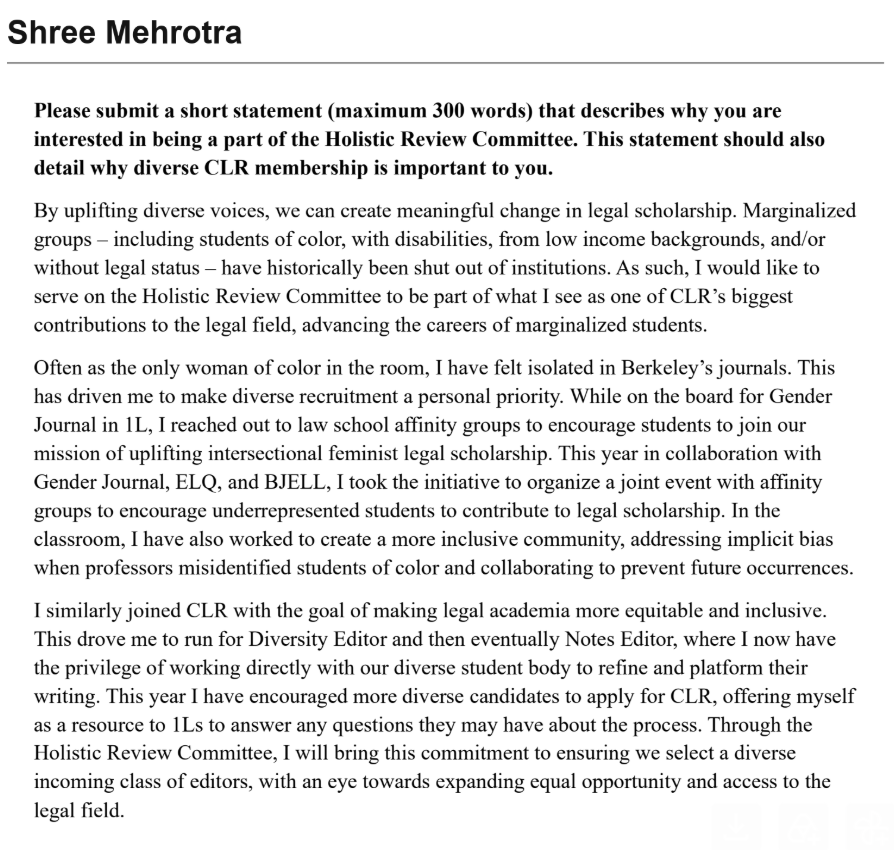
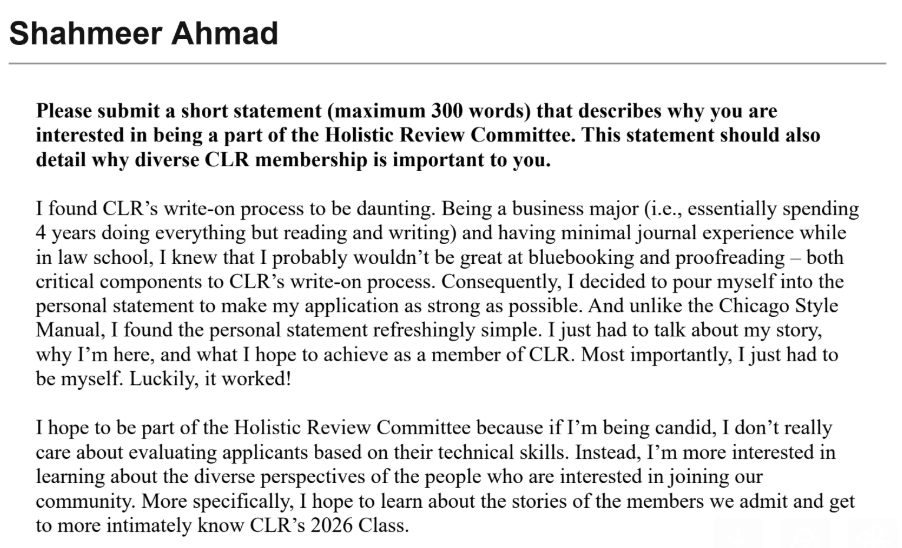
Both women were elected to the committee, which includes four ex officio members—the journal's editor in chief, managing editor, and two diversity editors—alongside the eight elected individuals. Other members have included Shree Mehrotra, who said in her 2025 application that "advancing the careers of marginalized students" was one of the journal's "biggest contributions to the legal field," and Shahmeer Ahmad, who said he wanted to join the committee because, "if I'm being candid, I don't really care about evaluating applicants based on their technical skills."
"While some people might not excel in the technical aspects of editing, their stories and perspectives might be their most valuable contribution to this journal," Georgiana Soo, a podcast editor, wrote in her 2023 application to the admissions committee. "[G]iving people—whose greatest strength may be their innovation and perspective—a chance to participate may go a long way toward changing the scholarship we publish." It is not clear whether she was ultimately offered a spot.
Though the personal statement accounts for just 30 percent of a candidate's score, it is often the deciding factor in the admissions process, which, unlike most law reviews, does not consider first-year grades. And the journal is not subtle about the purpose of this system, telling editors that the "holistic review process … ensures that CLR upholds the values of diversity, equity and inclusion throughout our membership/scholarship."
"A diverse membership is integral to California Law Review's achievement of excellence," the journal's website reads. "We define diversity as a 'variety of personal experiences, values, and world views that arise from differences of culture and circumstance,'" including "race, ethnicity, [and] gender."
The journal's editor in chief, Deksyos Damtew, did not respond to a request for comment about whether the journal considers protected characteristics in the admissions process.
Other law reviews have faced blowback for similar policies. The Trump administration launched a probe of Duke Law Journal last year after the Free Beacon reported that the journal had awarded extra points to applicants who mentioned race and gender in their personal statements. It also opened multiple probes of the Harvard Law Review, whose "holistic review committee" said in 2021 that the inclusion of "underrepresented groups" was its "first priority."
The journal's 2021 resolution, first reported by the Free Beacon, stated that the law review would consider "race, socioeconomic background, gender identity, sexual orientation, and disability," while "recognizing the importance of considering candidates' intersectional identities."
At the California Law Review, race is also considered during the orientation process. Damtew told all incoming editors this month to read "an article about whiteness at the California Law Review" before their first meeting, stating in an email that they would "discuss all these materials at orientation."
"I'm providing them to you now because our time together at orientation is limited and we recognize the article on whiteness is heavy and may require some time to process," Damtew wrote.
The article—"Imperial Identities: Reproductions of Whiteness at the California Law Review," by critical theorist Donna Maeda—claims that "assumptions about neutrality … universalize whiteness" by "marginalizing race-conscious perspectives to the point of erasing their significance."
While technically separate from UC Berkeley School of Law, the law review includes two professors at the law school, Saira Mohamed and José Argueta Funes, on its board of directors. It also has a dedicated administrator, Maria Eugenia Vidal-Manou, who works at the law school library.
As a public university, Berkeley is bound by multiple laws that ban discrimination based on race. Mohamed, Funes, and Vidal-Manou did not respond to a request for comment about whether they've exercised any oversight of the journal's admissions process.
The California Law Review is also one of the few top law journals to include a land acknowledgment on its website. "California Law Review recognizes that Berkeley sits on the territory of Xučyun, the ancestral and unceded land of the Chochenyo Ohlone, the successors of the historic and sovereign Verona Band of Alameda County," the land acknowledgment reads. "By offering this Land Acknowledgement, we affirm Indigenous sovereignty and will work to hold University of California, Berkeley, more accountable to the needs of American Indian and Indigenous peoples."