



"It's not easy to be on the vanguard of a new Republican Party or a new conservative movement," then-Ohio Senate candidate J.D. Vance told the "Restoring a Nation" conference in October 2022. "There is a risk that it gets folded into Fusionism 2.0," Vance warned.
The conference gathered academics and writers organizing to reorient American conservatism away from its sacred cows of individual rights, free markets, and limited government, typically referred to as "fusionism," and toward a more engaged federal government in the economy, rejection of atomized individualism, and an approach to social issues resembling Catholic social teaching.
This new conservatism, often referred to as the postliberal Right or "New Right," gained momentum during the post-2016 shakeup of the Right's intelligentsia, baked inside newly formed institutions during Trump's time in the wilderness after 2020, and stormed into Washington on Trump's coattails largely thanks to its closest political ally moving into the Naval Observatory.
But what is fusionism? Like most political monikers on the Right—like neoconservative (scary!) or paleoconservative or today's postliberals, which many of the conference attendees, including Vance, identify as—it tends to be defined by uncharitable definitions provided by opponents. (The term "fusionism" is intended to be pejorative, originally coined by Brent Bozell, its most passionate conservative opponent at its inception.)
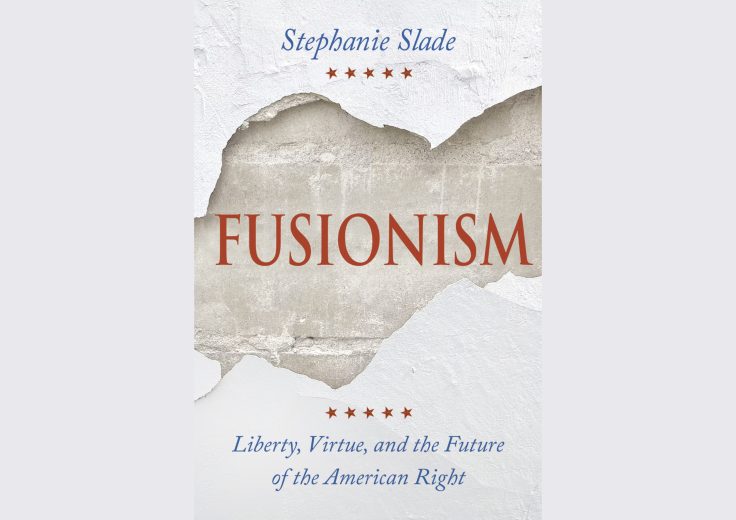
Stephanie Slade, a senior editor at the libertarian Reason magazine, sets the record straight. Fusionism: Liberty, Virtue, and the Future of the American Right defines fusionism in the words of its chief advocate, Frank Meyer, former senior editor of National Review and intellectual sidekick of William F. Buckley Jr., filling in the blanks in the story of the American conservative movement from Goldwater to Trump, answering the question: How did we get here, and what is next?
Slade begins by establishing the two poles of the postwar conservative movement, initially united by their opposition to the New Deal. Austrian economist F.A. Hayek represented the classically liberal pole—individualistic, weary of the growing size and scope of government, deferential to market forces, and viciously anti-bureaucratic. Hayek's The Road to Serfdom (1944) was a bestseller, connecting the crimes of 20th-century fascism and communism to a shared collectivist impulse that degrades the dignity of men at the expense of a growing state.
The other pole was represented by the philosopher Russell Kirk, an admirer of the 18th-century English statesman Edmund Burke, whose conservatism underscored the need to establish order, foster a thicker form of community, and believe in an objective and transcendent moral order.
Kirk's traditionalism and Hayek's libertarianism formed the scaffolding of the Right at this time, often clashing with each other, but, as Slade writes, "neither of these views would manage to establish itself as the dominant philosophy of American conservatism." It took a former communist in Frank Meyer to do that.
Meyer spent his early years recruiting for the American Communist Party, before shifting rightward after reading F.A. Hayek and Richard Weaver's Ideas Have Consequences. He was intense. He rarely slept, opting to chain-smoke, drink liquor, and argue through the night at his home in Woodstock, New York. He was at National Review from its inception in 1955 until he died in 1972. (Much of Meyer's life story is known thanks to Daniel J. Flynn's excellent biography of Frank Meyer, The Man Who Invented Conservatism, published last year.)
Meyer's most famous work, a 1962 collection of essays titled In Defense of Freedom: A Conservative Credo, proved to be his magnum opus, though it did not fly off the shelves. The title hints toward Meyer's north star: freedom.
Fusionism, as it would become known, though Meyer hated the name, describes his attempt to "fuse" the seemingly disparate camps of libertarian prioritization of liberty and traditionalist prioritization of virtue; not for politically advantageous reasons, but because freedom and virtue depend on each other, or as Slade writes, "the two pillars on which a good society rests."
Freedom cannot be enjoyed without the temper of virtue, nor can virtue be pursued without the space—freedom—to pursue it. Thus, as I have written elsewhere, Meyer's thesis could better be described as a tension, not a fusion. Meyer's synthesis "became the intellectual foundation on which the conservative movement was built," Slade writes.
One may say it "rhymes" with the patterns of our American constitutional order. That's by design. Meyer:
At the source to which American conservatism inevitably returns—the Declaration of Independence, the Constitution, and the debates at the time of its adoption—this simultaneous belief in objectively existing moral value and in the freedom of the individual person was promulgated in uncompromising terms. From that source it irradiates the active present scene of American conservatism.
By Slade's telling, fusionist conservatism peaked during the Reagan revolution, what Slade calls its "apex movement." Reagan was particularly interested in the ideas of the right, not just courting the vote of warring factions. He read Hayek and Kirk—and Meyer.
In 1982, after a decade had passed since Meyer's death, Reagan remarked to the Knights of Columbus in Hartford, Connecticut: "There can be no freedom without order, and there is no order without virtue."
A year prior, at the Conservative Political Action Conference—an organization Meyer helped create—the Gipper tipped the hat to Meyer's journey from communist to conservative luminary: "[Meyer] pulled himself from the clutches of 'The God That Failed,' and then in his writing fashioned a vigorous new synthesis of traditional and libertarian thought—a synthesis that is today recognized by many as modern conservatism."
But did Reagan govern as a fusionist? He cut taxes, but the deficit exploded. His promise to shut down the Department of Education went undelivered; government did not shrink. And much of the New Right is quick to point out that Reagan endorsed no-fault divorce and balked on abortion.
But herein lies the incongruence with much of fusionism's critics. It is not a policy manual, nor a political project to unite libertarians and traditionalists under one party. It is "a coherent framework for thinking about how to tackle the challenge of building a good society and creating conditions under which people are likely to thrive," Slade writes. "The claim is not that it offers a path to heaven on earth."
The reminder about what true fusionism is, and also what it is not, is prescient, but does it matter? Slade ends the book with a reminder: Ideas matter. "The idea, not the nomenclature, is what needs saving."
The zeal with which the New Right has formed institutions, credentialed young conservatives, and mentored rising stars, such as Vice President Vance, with the stated intention of cleansing the Right of its fusionist roots mirrors how the insurgent conservatives of the 1960s and '70s—Meyer among them—successfully waged war against the tepid Rockefeller Republicans of old.
History will tell if Slade's revival of the fusionist conservative ethos coincided with its death or its revival. But perhaps the greatest irony is that while the New Right might eventually prevail over the old conservative consensus, it will face the same impossible dilemma: How can a free and virtuous society flourish?
They would be smart to ask the fusionists.
Fusionism: Liberty, Virtue, and the Future of the American Right
by Stephanie Slade
University of Notre Dame Press, 304 pp., $30
Tanner Nau is a reporting fellow at National Review, based in Washington, D.C.