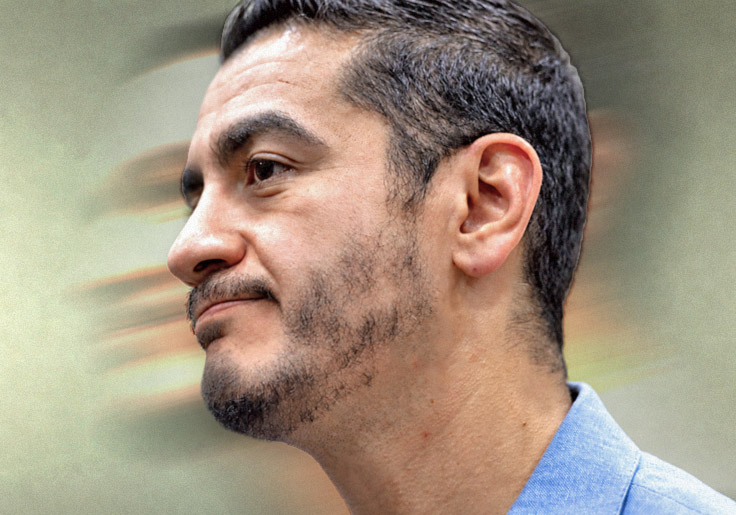



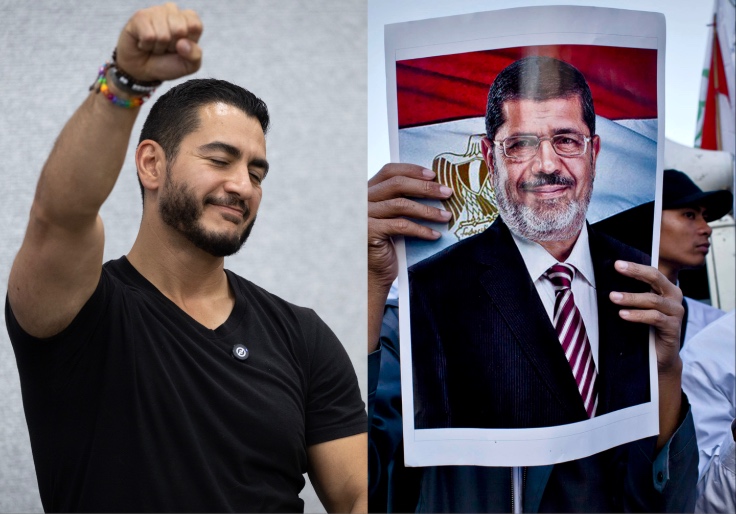
Michigan Senate candidate Abdul El-Sayed demanded in 2012 that the repressive Muslim Brotherhood "purge" media and police in Egypt after the radical Islamic group seized control of the country. A brutal religious crackdown on the press was soon to follow.
The demand was made in an Arabic-language statement on Al-Ahram Gate, an Egyptian news portal, and was signed by 46 "leaders of the Egyptian community" in the United States, one of whom was El-Sayed, who was born in Michigan to Egyptian immigrants.
The November 2012 statement came just days after the country's Islamist then-president, Mohamad Morsi, granted himself broad new powers in an effort to quell growing unrest. Morsi had five months earlier become Egypt's first elected president after longtime strongman Hosni Mubarak was toppled in the Arab Spring. But Morsi himself was starting to act like a strongman.
"Statement by Morsi Supporters in America Backs His Decisions and Calls on Him to 'Purge the Media and Police,'" blares the headline published on Nov. 25, 2012.
"We, leaders of the Egyptian community, support the revolutionary decisions taken by the president, and we call on him to purge the media and the police as quickly as possible," the letter reads.
"We affirm, as Egyptian Americans, that we strongly reject those voices that are courting America and Europe to take a position against the Egyptian regime," the letter adds.
"Dr. Abdul Rahman El-Sayed" of New York was the 33rd signature affixed to the letter, the publication of which coincides with the future candidate's time attending medical school at Columbia University.
Sources familiar with Arab-language media confirmed to the Washington Free Beacon that Abdul El-Sayed, the Democratic political candidate, is the same "Dr. Abdul Rahman El-Sayed" who signed the letter. El-Sayed's campaign did not respond to requests for comment regarding the letter and the candidate's current position on the Muslim Brotherhood. The original declaration, in Arabic, remains online to this day and has already made the rounds in Arabic-language social media.
Morsi had been elected president in June 2012 with just over 51 percent of the vote, ending six decades of military rule in the country. He was openly allied with the fundamentalist Muslim Brotherhood political movement, elements of which are now considered a terrorist organization by the United States. The brotherhood has a stated goal of implementing Sharia law.
While El-Sayed and his friends lauded Morsi's power grab, the move faced many critics.
"An absolute presidential tyranny," Amr Hamzawy, a liberal member of the country's defunct parliament, told the New York Times at the time. "Egypt is facing a horrifying coup against legitimacy and the rule of law and a complete assassination of the democratic transition."
Even Human Rights Watch—known for its tolerance of Islamic extremism—condemned the move, saying Morsi's actions "undermines the rule of law."
The press "purge" that El-Sayed and his allies demanded soon followed in the form of a ruthless crackdown on Egyptian journalists. In the succeeding months, at least six news reporters were hauled into court on charges of "insulting Islam" and "insulting the president." Critical coverage of Morsi was yanked from Egyptian websites, according to the Committee to Protect Journalists—a considerably more credible organization at that time.
Morsi's power grab didn't work, and by June 2013 protests had again engulfed the country. Morsi was ousted in a military coup by Egyptian general Abdel Fattah el-Sisi, who remains president to this day. Egypt's military rulers banned the Muslim Brotherhood, calling it a terrorist organization.
El-Sayed, however, was a longtime supporter of the brotherhood going back to the Arab Spring, before Morsi's election. El-Sayed backed the Muslim Brotherhood in an article for the Huffington Post in January 2011. At the time, the rise of the Muslim Brotherhood was a source of concern among Western foreign policy thinkers who considered it an extremist group and the intellectual architect of both al Qaeda and Hamas.
But in his 2011 piece, "Why the U.S. Should Support the Protesters in Egypt," El-Sayed told Americans they had nothing to fear from the brotherhood and offered a lengthy defense of the organization.
"Even if the Muslim Brotherhood were to take power, there are several reasons why the ensuing state would look nothing like Iran," El-Sayed insisted, adding that Muslim Brotherhood definitely would not resemble Hamas, a sister Islamist group, citing the "differing contexts" of their polities.
He made much the same argument in a direct appeal to then-president Barack Obama in the Guardian that same month.
"This should raise serious questions about El-Sayed's worldview," Mariam Wahba, an analyst at the Foundation for Defense of Democracies, told the Free Beacon. "How could someone looking at the Muslim Brotherhood in 2012 see it as a movement worthy of support, rather than as an Islamist movement whose ideology and networks have served as a gateway to terrorism, sectarian violence, and instability?"
In addition to El-Sayed, the letter was signed by a rogues' gallery of Islamic extremists and conspiracy theorists in the United States. Among the signatories were Khaled Lamada, a former chairman of the U.S. branch of the Islamic Relief charity. In social media posts, Lamada has offered praise for Hamas and Jihad and disseminated claims that the United States is controlled by Zionists and that Sisi is secretly Jewish, the Middle East Forum reported in 2017. During his leadership the charity also hosted a speaker who called the Holocaust a "hoax."
U.S.-based Muslim Brotherhood allies Akram Elzend and Sameh Elhennawy also both signed the letter, the Free Beacon reported back in March 2014.
Both Elzend and Elhennawy have been tied to Egypt's Muslim Brotherhood and were listed as U.S.-based cells of the group, according to a report in Egypt's El Watan newspaper.
El-Sayed's support of the Muslim Brotherhood crackdown in Egypt is just the latest datapoint in a long history of ties to radical Islam.
El-Sayed's father-in-law, Tayeb Jukaku, is among the top leaders of an Islamic organization identified by the federal government as a public facing group for the Muslim Brotherhood. Jukaku is also a top donor to a super PAC supporting El-Sayed.
El-Sayed has also headlined luxury yacht fundraisers on behalf of an Islamic group tied to the brotherhood.