





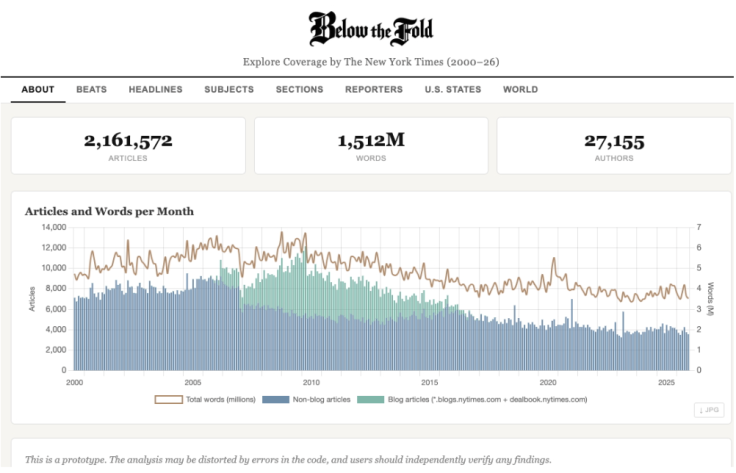
A new database of all the New York Times articles published in the past 25 years provides empirical evidence of some of the biases that many of the newspaper’s critics have long suspected.
The developer of the database, Ted Alcorn, is not a media critic but a former policy analyst for New York Mayor Michael Bloomberg. He’s a freelance journalist who does some work for the Times and also teaches at Columbia and NYU. Alcorn this week launched "Below The Fold," a dashboard that allows readers to parse and sort a database of 25 years' worth of New York Times articles in ways that concretely quantify the paper’s quirks and record the way the coverage has changed over time.
For example, the dashboard allows for sorting coverage by country and sorting that by population, to get a Moneyball-style statistic called articles/million residents/year, or AMRY. The tiny Pacific island of Nauru is tops because of climate change coverage, but Gaza is next with an AMRY of 104.4, followed by Israel at 55.7 and the West Bank at 41.14. Countries that the Times is less obsessed with include Japan, with an AMRY of 1.32, Germany, with an AMRY of 2.78, and Singapore, with an AMRY of 2.33. In raw number of articles, the Times tagged 14,483 with coverage of "Israel" over the quarter century from 2000 to 2025. India, with a vastly larger population, generated 10,678 Times stories.
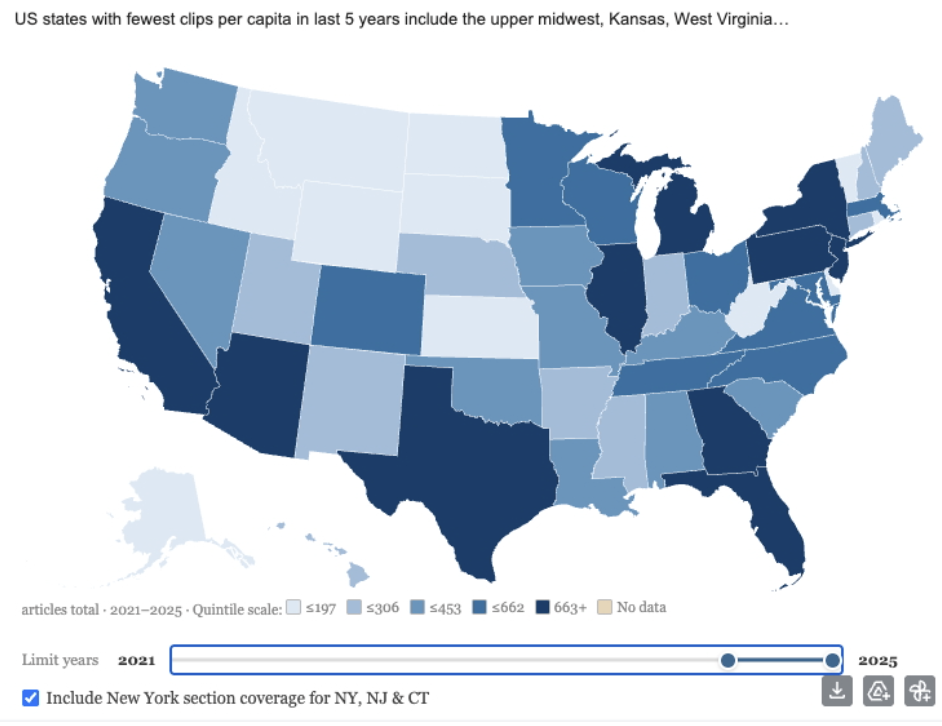
The dashboard also allows a similar sorting of states by how much attention they get from the Times, adjusted by population. The early presidential primary and caucus states of Iowa and New Hampshire attract a lot of Times coverage, as does the District of Columbia. Sparsely populated Times summer vacation destinations like Vermont and Maine also do well. The states that get the least attention from the Times relative to their populations include Alabama, Connecticut, Indiana, New Jersey, and Arkansas. What Times reporter wants to use an Ochs-Sulzberger expense account to go to Indiana, New Jersey, or Arkansas when they could be in Vermont or Maine?
Sections are trackable; one can see the decline in Times book coverage, from a peak of 2,852 articles in 2006 to a low of 1,312 articles in 2025. One can also track the decline in New York coverage, from 19,742 articles in 2006 to the years from 2019 to 2025, when the Times has published fewer than 3,000 articles about New York each year. The New York Sun, of which I was an owner and managing editor, published from 2002 to 2008.
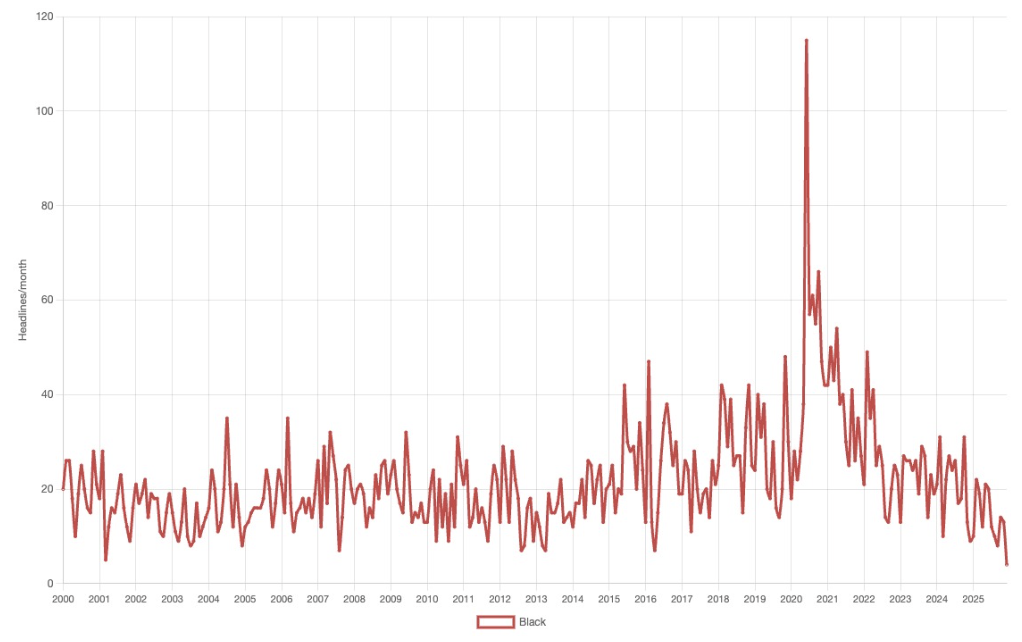
You can also search the frequency of words appearing in article headlines. Here’s a visualization of the Black Lives Matter movement as measured by the word "Black" appearing in New York Times headlines.
Some of the trends the database reveals are not even ideological or substantive, but probably relate more to the transition to online from paper. The number of articles the Times publishes each year, for example, declined to 47,793 in 2025 from 65,497 in 2016. Words published declined too, but not as much, so the average article length increased, to a prolix 973 average words an article in 2025 from 768 average words an article in 2016. Online, there’s no paper or ink cost associated with a longer article.
— 2016: 65,497 articles, 50.3M words, 768 avg words/article
— 2017: 59,967 articles, 47.8M words, 796 avg words/article
— 2018: 58,832 articles, 50.1M words, 851 avg words/article
— 2019: 53,255 articles, 49.7M words, 933 avg words/article
— 2020: 55,479 articles, 54.6M words, 983 avg words/article
— 2021: 54,514 articles, 47.6M words, 873 avg words/article
— 2022: 48,705 articles, 45.9M words, 942 avg words/article
— 2023: 46,043 articles, 42.6M words, 925 avg words/article
— 2024: 48,693 articles, 44.5M words, 914 avg words/article
— 2025: 47,793 articles, 46.5M words, 973 avg words/article
Times staffing has ballooned in recent years. In 2019 the paper reported, "Last year the company added 120 newsroom employees, bringing the total number of journalists at The Times to 1,600, the largest count in its history." In 2026 publisher and chairman AG Sulzberger said, "Here’s the number we should be proudest of: 2,300. That’s the current size of the newsroom — 50 percent larger than a decade ago. Across all our products The Times now employs more than 3,000 journalists." While most businesses are trying to be more productive, the Below the Fold analysis suggests that the Times is using either double or 50 percent more journalists to produce fewer words, and fewer articles. And while the Times also discloses subscription revenue (increasingly bundled with cooking and games), it does not disclose how many people are reading these words. A lot of what the new journalists are producing isn’t written words but podcasts, vertical videos, or Instagram or other "off platform" social media content. The cost to get the print paper delivered or to buy one at the newsstand (if you can find one), meanwhile, has also soared, even as the number of words or articles in the paper has declined.
Alcorn told the Washington Free Beacon that while he is long-time freelancer for the New York Times, having written for the Health, New York, National, and World desks since 2018, he built the project relying "entirely on public data from the New York Times developer portal; I had no access to internal Times systems or unpublished data. I did this entirely as a personal project."
He said public feedback has been supportive. "A number of Times reporters reached out to me to identify little bugs, or to suggest features, or to thank me for making it," he said. No one there has offered to buy it or asked him to take it down.