



Antonin Scalia's jurisprudential legacy has flourished far beyond what anyone might have reasonably imagined at the time of his death 10 years ago. By keeping his Supreme Court seat open through the 2016 presidential election, Senate Republican leader Mitch McConnell gave lots of conservatives who were leery of Donald Trump one strong reason to vote for him. Trump won a close election that he would otherwise have lost. Trump in turn appointed three justices—all admirers of Scalia—and created a conservative majority on the Court for the first time in nearly a century.
On case after case—most notably, in its 2022 ruling overturning Roe v. Wade—the Court has turned Scalia dissents into majority rulings. More broadly, it has adopted his principle of interpreting constitutional provisions according to the meaning they bore when they were enacted, and it has even more consistently abided by his twin textualist tenet for interpreting statutes.
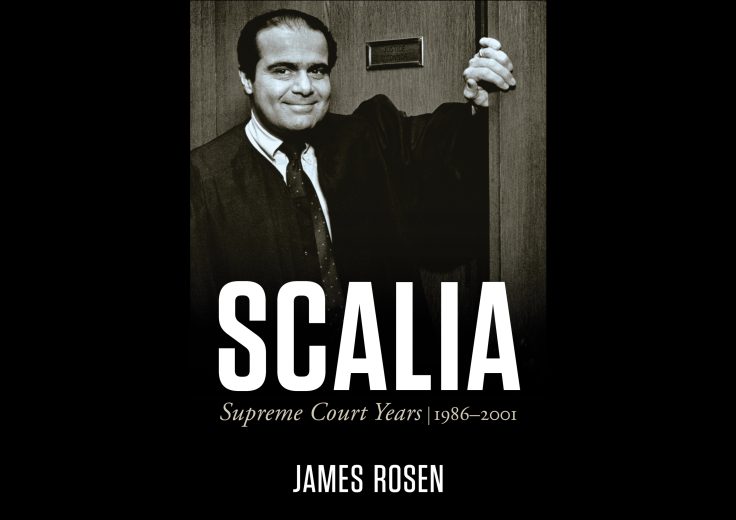
Amid such success, it's easy to forget how distressing Scalia's own years as a justice were. Among its many virtues, James Rosen's excellent second volume of his monumental three-part biography of Scalia ought to remind the reader of how far the Court has come.
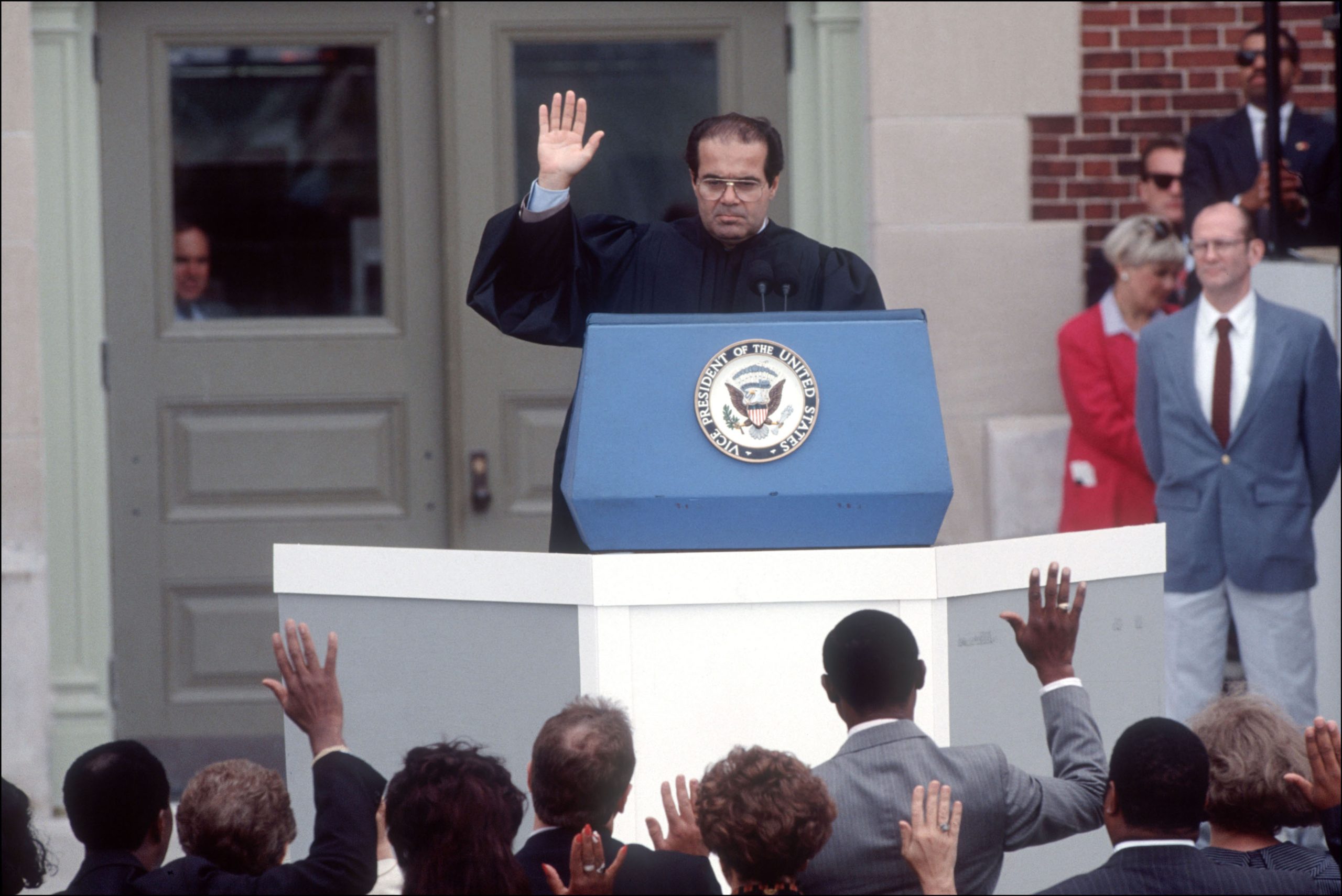
As Warren Burger wrapped up his 17-year tenure as chief justice in 1986, the Court had its oldest set of five justices ever: Burger himself was 79, and four of his colleagues—William J. Brennan Jr., Lewis F. Powell Jr., Thurgood Marshall, and Harry Blackmun—ranged in age from 80 to 77. Only Ronald Reagan's first appointee, Sandra Day O'Connor, was younger than 60.
When Reagan elevated William H. Rehnquist to succeed Burger as chief justice, he appointed Scalia, 50 years young, to the associate justice position that Rehnquist had occupied. Scalia was aghast to discover the moribund intellectual culture of the Court. The justices were set in their ways: They asked very few questions at oral argument, they didn't talk through issues at conference, they had little interest in the craft of opinion writing, and they largely kept to themselves.
Scalia was not content to spend the rest of his career in a geriatric ward. He had loved the collegiality of the D.C. Circuit, where he would drop in on fellow judges to talk about cases and would send and receive detailed comments on draft opinions. The vibrant intellectual give-and-take among the judges reflected a widespread commitment to try to get the law right. The Supreme Court, by contrast, "is terrible," he complained to a former D.C. Circuit colleague: "No one discusses the cases. All they do is vote, vote, vote!" The old-timers resented Scalia's vigorous questioning during oral argument, and they bristled at his suggestions on how to improve their drafts.
Scalia quickly learned that Rehnquist, jaded by his years on the Court, was much more interested in getting opinions issued promptly than in getting them decided correctly. Scalia proposed a process in which no justice would join a draft majority opinion until a dissent had been circulated. That way, no one would lock onto the majority draft without having considered a dissenter's criticisms of it. He got nowhere with his proposal.
Powell and the two liberal icons, Brennan and Marshall, retired during Scalia's first five years on the Court. Reagan and George H.W. Bush had the opportunity to give him outstanding new conservative colleagues, but they batted only one for three. After the Democrat-controlled Senate defeated Reagan's nomination of Robert Bork, Reagan settled for the vainglorious Anthony Kennedy. The Bush White House persuaded itself that David Souter was a stealth conservative, but Souter quickly showed himself to be a disciple of Brennan. Only Bush's appointment of Clarence Thomas provided an outstanding judicial conservative.
Scalia's dismay over how the Court operated was surpassed by his intense disagreement with so many of its major decisions in his early years. As one of his first clerks told Rosen, "I remember losing mostly everything that was important."
In just his second year on the Court, Scalia issued his booming solo dissent in Morrison v. Olson (1988). Rehnquist's majority opinion ruled that Congress permissibly authorized a panel of judges to appoint an "independent counsel" to investigate and prosecute executive-branch officials. Scalia famously observed that separation-of-powers issues often "will come before the Court clad, so to speak, in sheep's clothing. … But this wolf comes as a wolf."
In an abortion case one year later, Scalia was exasperated by O'Connor's unwillingness to address whether to overturn the Court's 1973 ruling in Roe v. Wade that concocted a constitutional right to abortion. Far worse, in 1992 (during the term I was a law clerk for Scalia), O'Connor, Kennedy, and Souter joined forces with Blackmun and Stevens in Planned Parenthood v. Casey to form a majority that reaffirmed Roe.
That same year, Scalia dissented vigorously from an opinion by Kennedy for the same five-justice bloc that held that the Establishment Clause prohibits nonsectarian invocations and benedictions at public-school graduation ceremonies. Scalia objected that Kennedy "invent[ed] a boundless, and boundlessly manipulable, test of psychological coercion." It is "a sufficient embarrassment," he observed,
that our Establishment Clause jurisprudence regarding holiday displays has come [quoting one judge] to "require scrutiny more commonly associated with interior decorators than with the judiciary." But interior decorating is a rock-hard science compared to psychology practiced by amateurs.
Given the range of alternatives available to Bill Clinton, Scalia was delighted that his dear friend and former D.C. Circuit colleague Ruth Bader Ginsburg joined the Court in 1993. But by replacing Byron White, she moved the Court further left. Clinton's next appointment of Stephen Breyer (in place of Blackmun) meant that the seats of the six oldest justices in 1986 had all been filled by much younger justices. The Court's composition would remain unchanged for the next 11 years, the longest stretch in its near two centuries as a nine-member body.
With the new Court, Kennedy and O'Connor would both be needed for a conservative majority. Although that happened occasionally—most famously, in the Bush v. Gore ruling in December 2000 that put an end to Al Gore's effort to win Florida’s electoral votes and the presidency—it was much more common for Scalia to suffer searing losses. As he lamented in one dissent, "Day by day, case by case, [the Court] is busy designing a Constitution for a country I do not recognize."
Rosen addresses all of this, and much more, in his new book. Rosen's first volume (which I also favorably reviewed) explores Scalia's life from his childhood right up to his appointment to the Court. This second volume covers roughly the first half of Scalia's tenure on the Court, from 1986 through Bush v. Gore. (The end year in the book's subtitle really should be 2000.) As with the first volume, Rosen has done exhaustive research. He has pored through case files, listened to and read transcripts of oral arguments, conducted 150 or so interviews (including—disclosure—of me), and learned all that he could about Scalia.
Rosen weaves everything together in two dozen brisk chapters that present momentous cases, revisit confirmation battles, and follow Scalia around the country and the world. Rosen also explores Scalia's complicated relations with colleagues.
Scalia loved vigorous argument, not just for the fun of it but because he believed that it could change minds, including his own. He argued with his colleagues as he wanted them to argue with him. If he were on the verge of gravely messing up the law, he would want someone to sound the alarm and explain to him how wrong he was. Alas, Scalia's Golden Rule of treating his colleagues as he would want to be treated might not have been the best method of dealing with those who had less intellectual confidence or thinner skin than he did. Rosen presents compelling evidence that Scalia alienated O'Connor. But he also recounts how deeply moved O'Connor was by Scalia's friendship and support when she was recovering from cancer surgery. "He is the only justice," O'Connor's husband wrote in his diary, "to whom SOC really unloaded her emotions when she was most devastated."
I'm less persuaded by Rosen's account of Scalia's interaction with Brennan. Rosen documents Scalia's warm feelings for Brennan and says Scalia "considered Brennan an uncle who had his back." But Scalia's reference to Brennan as "an uncle [who] would not steer me wrong" occurred in the narrow context (as Brennan's biographers put it) of "advice about questions such as whether to accept a particular speaking engagement." Rosen gives the impression that Scalia was unaware that Brennan believed Scalia was "on a sustained mission to undo Brennan's legacy." But Scalia made no secret of that mission, so why wouldn't he expect Brennan to be unhappy with it? I'd submit instead that Scalia was able to separate his personal fondness for Brennan from their obvious ideological disagreements.
Rosen closes this second volume with an interesting discussion of the dramatic litigation over Florida's vote count in the 2000 presidential election. This crescendo ending, with Scalia part of the majority in Bush v. Gore, might seem to augur a rosier future for him. Spoiler alert for volume three: It would be Scalia's great curse that Kennedy would remain a pivotal vote on the Court for the rest of Scalia's tenure.
Scalia: Supreme Court Years 1986-2001
by James Rosen
Regnery Publishing, 509 pp., $45
Ed Whelan holds the Antonin Scalia Chair in Constitutional Studies at the Ethics and Public Policy Center and writes frequently for National Review's Bench Memos blog.