




A small town outside of Boston has quietly emerged as a central battleground in nationwide efforts by anti-Israel activists to force divestment from Israel under the guise of so-called Values-Aligned Local Investments laws.
In Medford, Mass., where one of these divestment initiatives is being challenged in court, a network of anti-Israel lawyers has jumped into the case, seeking to ensure the measure stays in place, an outcome that could supercharge similar schemes nationwide.
But Jewish groups have joined the battle, seeking to stop the thinly disguised divestment measure. In February, attorneys with the National Jewish Advocacy Center (NJAC) filed an injunction to stop Medford from implementing its "Values-Aligned Local Investments Ordinance," a far left, DEI-tinged local law which would bar the city from investing in "weapons manufacturers, fossil fuel companies, private prison operators, and entities alleged to engage in 'human rights violations,'" according to copies of the legal filings obtained by the Washington Free Beacon.
The law, which targets Israel in every way but name, is one of several similar divestment measures being pushed in cities nationwide by supporters of the antisemitic Boycott, Divestment, and Sanctions (BDS) movement. Medford is the first municipality to be hit with a complaint over its divestment initiative, making the case a litmus test for the many other towns nationwide contemplating similar divestment laws.
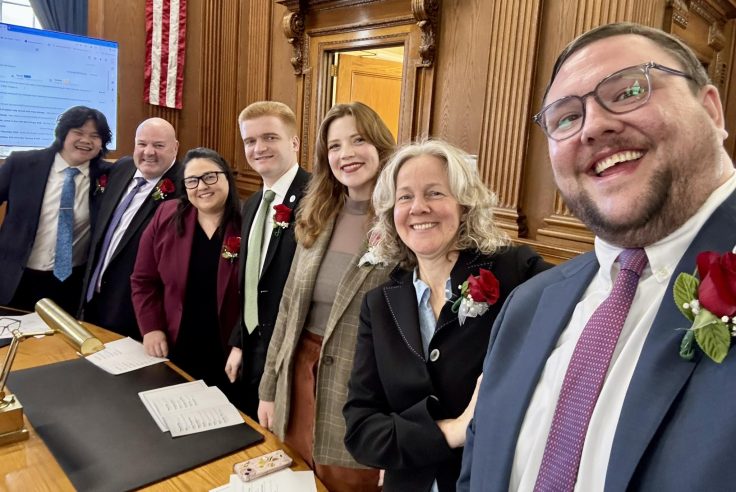
Medford city officials, including Mayor Breanna Lungo-Koehn—who had vetoed the law but was overridden by the city council—agreed in late April to pause the divestment law while a U.S. district court ruled on its legality, filings show. But just prior to that decision, a coalition of lawyers tied to the American-Arab Anti-Discrimination Committee (ADC)—an advocacy group that has been accused of platforming "pro-terror views" and embracing BDS as "a constitutional right"—filed a third-party motion to intervene in the case and keep the ordinance in place. In a move NJAC described as "an egregious breach of ethics," the ADC's lawyers cited support from three Medford city council members in their petition, even though third parties are generally prohibited from approaching individuals who are already represented in a case.
"It is an egregious breach of ethics rules for the proposed intervenors to reach out to city council members to attempt to curry support for the proposed intervenors' baseless attempt to push their way into this litigation," Rachel Sebbag, NJAC's litigation counsel, told the Free Beacon. "The Town of Medford, including the Mayor and the City Council, is represented by counsel in this matter, and it is impermissible to communicate with represented parties to an action without their counsel present. That the proposed intervenors would actually publicly file evidence of their attempts to collude with city council on this matter only highlights their legal illiteracy and smacks of desperation."
The proposed intervenors, a legal designation for those seeking to enter a case they are not party to, are represented by ADC attorneys Malak Afaneh and Jenin Younes. Prior to joining the ADC, Afaneh was a law clerk at the Council on American-Islamic Relations's Bay Area office and helmed the Berkeley Law chapter of Students for Justice in Palestine (SJP), the extremist, anti-Israel campus group that organized pro-Hamas protests across the country. Afaneh gained notoriety in 2024 when she hijacked a private dinner at Berkeley law dean Erwin Chemerinsky's home.
The third attorney on the case, Micah-Shalom Kesselman, is a Medford resident who supported the City Council's November 2025 decision to override Mayor Lungo-Koehn's veto and pass the divestment ordinance into law.
In their April 28 motion, the three attorneys argue that there is "reasonable and articulable fear" that the city of Medford will not adequately defend the divestment initiative with "all due diligence and competency," warranting outside intervention. The ADC touted its effort in a press release, writing that the "case will resonate across Arab American communities and beyond, particularly for communities concerned with global human rights issues, including those related to Palestine and Sudan."
"If the challenge succeeds," the advocacy organization said, "it could set a precedent threatening similar values-aligned investment policies nationwide."
Afaneh and Kesselman told the Free Beacon in a statement that they are "seeking to defend a duly enacted municipal ordinance after the City declined to meaningfully defend or enforce it in response to the lawsuit." They disputed NJAC's "suggestion that any ethical rule was violated" when they garnered support for their legal intervention from the three City Council members.
NJAC, in a subsequent motion to block the intervention, said the ADC and its allies are engaged in a legal "ploy to disrupt the forward momentum of the case" by "tying up the court's resources with a wave of unnecessary and baseless motions." The legal group's initial complaint argued that the divestment ordinance is illegal under the Constitution, as it interferes with the federal government's right to handle foreign policy matters. In 2000, they note, the Supreme Court struck down a Massachusetts statute that restricted state purchases from companies doing business with Burma.
Notably, in one filing, the ADC lawyers acknowledged the strength of this argument, writing that the Supreme Court case "hurts us [because] it struck down an ordinance that divested from Burma."
The court has yet to rule on the ADC's effort, and NJAC says it is prepared to litigate the case for as long as necessary.
"We look forward to vigorously pursuing relief for our clients in our active cases challenging invalid municipal divestment ordinances," said NJAC's Sebbag. "And any town considering a similarly invalid regulation should consider itself on notice that it is opening itself up to a lawsuit."