

Iran has spent the past several months fortifying two nuclear sites against an aerial strike and excavating areas the United States and Israel destroyed last June, according to recent satellite imagery analyzed by the Institute for Science and International Security.
The Islamic Republic has been burying its new Taleghan 2 facility at its Parchin military complex, under construction since May 2025, since at least September 2025. The activity has continued through February, with crews "visibly pouring fresh concrete" around the area and piling soil on top of a structure that likely contains sensitive equipment. Similar efforts are underway at the Esfahan nuclear complex, which the United States and Israel badly damaged in their strikes against the regime's nuclear program last year. Satellite photos from the end of January show the Islamic Republic "re-burying the southernmost and the middle entrances with soil."
The movement around these locations suggests that Iran is making preparations for another conflict with the United States and seeking to protect whatever remains of its nuclear sites after the U.S.-Israeli campaign last year. The evidence also indicates that Tehran's hardline regime has not scaled back its nuclear pursuits, defying President Donald Trump's statement that a good deal with Iran would mean "no nuclear weapons, no missiles."
"Collectively, these activities may cross President Trump's red line: that Iran must abandon uranium enrichment and nuclear weapons ambitions," Andrea Stricker, deputy director of the non-proliferation program at the Foundation for Defense of Democracies, told the Washington Free Beacon. "Combined with Tehran's ongoing failure to address its missile program, support for terror, and domestic pressure, they could trigger new military strikes."
Though the United States and Iran have engaged in indirect talks over the past several weeks, there is little to indicate that the hardline regime is willing to compromise on Trump's key demands. In the meantime, the United States has sent a large array of military assets into the region, including two aircraft carriers and more than 50 fighter jets, in its largest buildup in the Middle East since the invasion of Iraq in 2003. The uptick in activity at Esfahan and the Taleghan 2 facility could be a sign that Iran expects war when diplomacy hits a dead end.
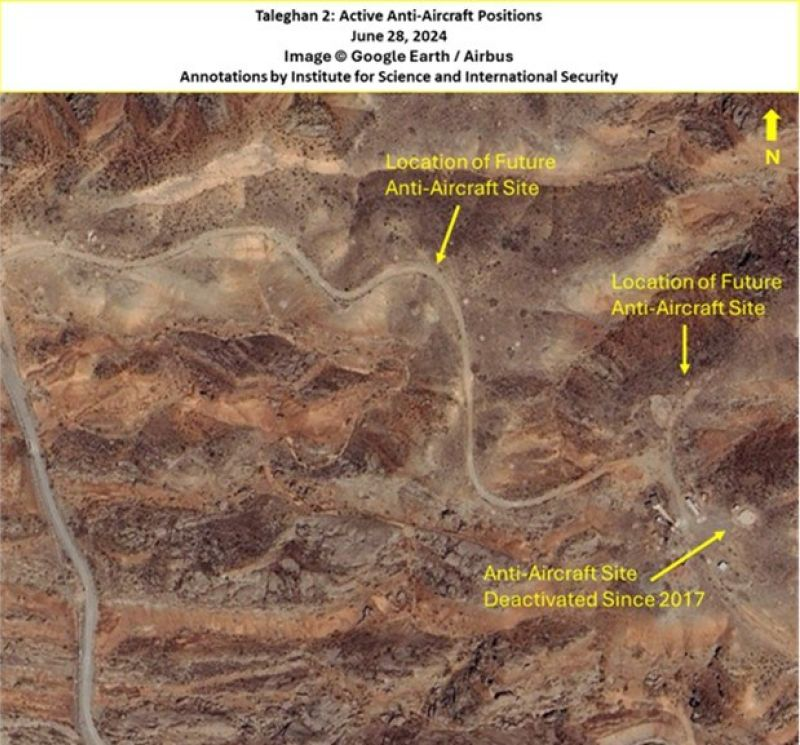
Israel bombed the Taleghan 2 facility in October 2024 during a round of strikes against Iran, but the Islamic Republic has been attempting to rebuild it since last fall. Separate satellite images show Iran fortifying a concrete sarcophagus built around the site, suggesting that Taleghan 2 "may soon become a fully unrecognizable bunker, providing significant protection from aerial strikes," the institute determined.

Photos from December, before Iran completed the concrete construction, depict what the institute called a "cylindrical chamber resembling a high explosive test chamber," which may indicate that the regime plans to use it for nuclear tests.

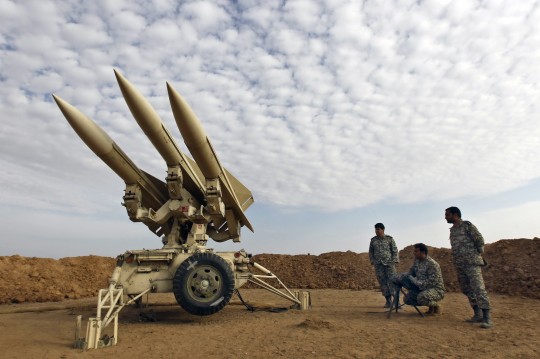
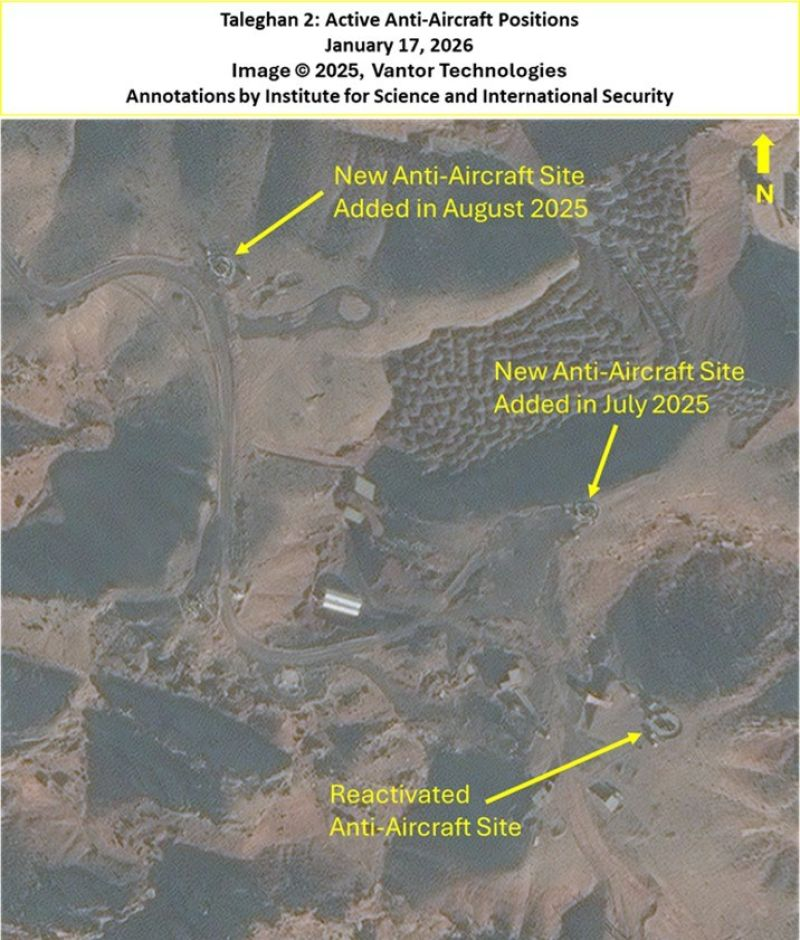
Iran has also made upgrades "to the active defense capabilities at the site," the institute added. Shortly after the 12-day war and the U.S. strikes on the Iranian nuclear program, the Islamic Republic reactivated anti-aircraft artillery that had been dormant since 2017 and built "two new additional active anti-aircraft positions" that can be seen in satellite images.
The Islamic Republic has also conducted construction projects at the Esfahan site, which the United States and Israel hit in June. Until recently, Iran's activities at Esfahan's "above-ground site appeared largely related to sorting and salvaging of rubble," according to the institute. New photos, though, show that "Iran recently constructed a new roof on top of the surviving steel framework of a destroyed building."

Efforts to rebuild any part of the site may mean that the Islamic Republic "assessed the remaining structure is worth preserving," particularly because it is believed to house the equipment used to enrich uranium to levels needed for a bomb.
Stricker further noted that Tehran "is actively strengthening entrances at damaged facilities—including the Esfahan tunnel complex—where it likely stores enough highly enriched uranium for several bombs and had been building a new enrichment plant before the June strikes." The regime, Stricker told the Free Beacon, is likely trying to assess whether any of its stockpiles survived last year's attack.
Satellite imagery from late January tells a similar story, showing crews burying several entrances with soil.

"The burial efforts indicate a preparation for additional military strikes, as was previously seen before American strikes were carried out during the 12 day war," according to the institute.
Stricker also mentioned the Natanz facility, another contested site hit in June, as well. While information about activity at the new Pickaxe Mountain site Natanz—a suspected uranium enrichment facility—is less clear, Stricker said a newly established security perimeter at the facility means the Islamic Republic is focused on preserving its remaining capabilities.
"The site remains a prime candidate for future bunker-busting strikes should the president decide to deploy U.S. B-2 bombers to finish the mission," she told the Free Beacon.