


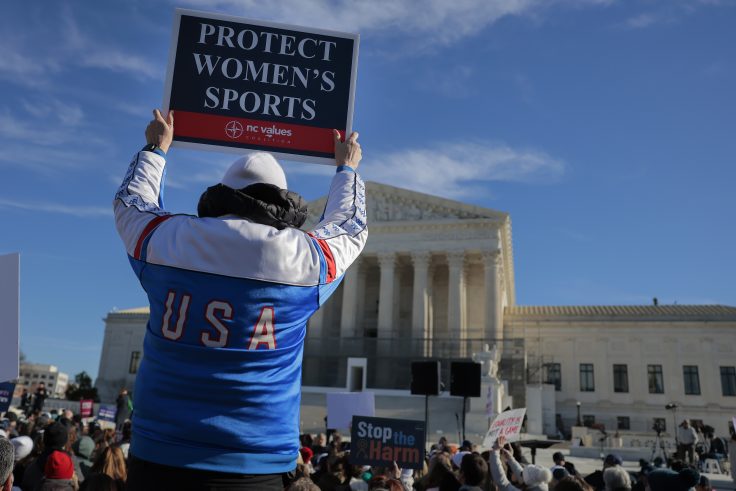
The Supreme Court’s conservative majority on Tuesday signaled it is likely to uphold state laws barring biological men from competing in girls’ and women’s sports, showing little desire to strike down restrictions adopted by multiple states in recent years.
During more than three hours of oral argument in cases from West Virginia and Idaho, conservative justices emphasized that federal law has long permitted sex-separated sports teams to ensure fair competition and questioned whether courts should impose a national rule amid widespread debates.
Lawyers for the states and the Trump administration argued that allowing biological males to compete in female sports would undermine Title IX, the civil rights law barring sex discrimination in education.
Justice Brett Kavanaugh asked why the court should "constitutionalize a rule for the whole country" while there remains "uncertainty and debate," echoing Chief Justice John Roberts’s past view that such questions should be resolved through the democratic process, according to the New York Times.
Kavanaugh also indicated a desire to protect women’s sports, noting organizations like the NCAA "think that allowing transgender women and girls to participate will undermine or reverse that amazing success, and will create unfairness."
"Obviously, one of the great successes in America over the last 50 years has been the growth of women’s and girls’ sports. And it’s inspiring," he added.
The justices also debated whether a past decision preventing transgender discrimination in the workplace applied to athletics. Roberts, who joined the court’s 2020 ruling extending workplace protections to transgender employees, suggested that decision might not apply in the context of athletics, where distinctions between male and female athletes raise concerns about fairness.
Attorneys for the transgender athletes urged the justices to allow individualized challenges rather than blanket bans, arguing that certain transgender athletes do not possess an unfair advantage.
Justice Samuel Alito pressed lawyers advocating against the bans on whether girls who object to competing against biological male athletes were "bigots" or "deluded." At one point, Alito asked an attorney for the ACLU, who was arguing against the bans, what it means to be a man or a woman. The attorney said she had no definition. "How can a court determine whether there's no discrimination on the basis of sex without knowing what sex means?" Alito retorted.
The cases could affect at least two dozen states with similar laws and follow the Court’s decision in June to uphold Tennessee’s ban on certain medical treatments for transgender minors. That ruling, backed by all six conservative justices and opposed by the three liberal justices, allowed Tennessee to prohibit the use of puberty blockers and hormone therapy for gender transition in minors, while permitting those same drugs to be used for other medical conditions.
The Trump administration has moved swiftly to limit transgender procedures in children. Last month, the Department of Health and Human Services moved to cut off all federal funding from hospitals that perform transgender medical procedures on minors, barring those hospitals from participating in Medicare and Medicaid.
President Donald Trump has also repeatedly railed against allowing biological males in women’s sports and to end the "transgender lunacy." The issue, though, has received bipartisan attention. A New York Times and Ipsos poll from 2025 found that nearly 79 percent of Americans oppose biological men competing in women’s sports, including nearly 67 percent of Democrats.