


Beyond all the moral and geopolitical reasons that divesting from Israel is a bad idea is the reality that even strictly on economic terms, the concept is a money-loser.
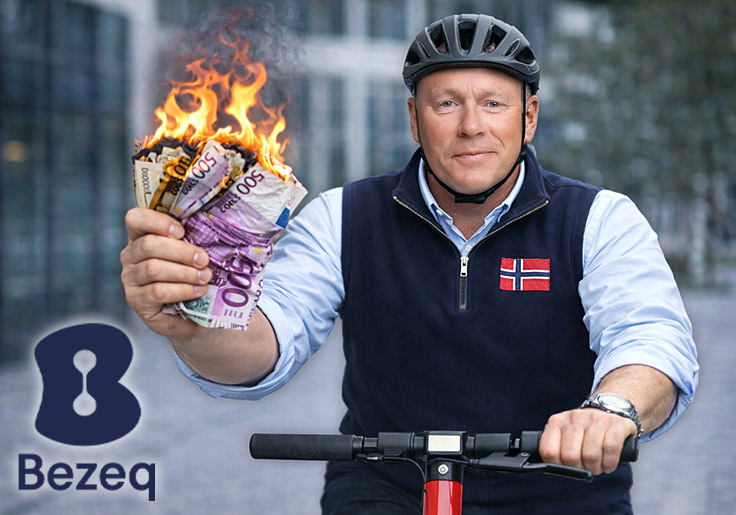
In early December 2024, the Norwegian government pension fund announced it would divest from Bezeq, Israel’s largest telecommunications company, "due to an unacceptable risk that the company contributes to serious violations of the rights of individuals in situations of war and conflict."
The Norwegian fund owned 0.76 percent of the company’s shares in June 2024, worth 252 million Norwegian krone (about $26.1 million at current exchange rates). On Dec. 3, 2024, when the Norges Bank Executive Board announced the divestment decision, BEZQ.TA closed at $538, according to Yahoo Finance. A little more than two months later, the stock closed at $601.60. I noted a year ago that "the Norwegians missed out on an 11.8 percent gain in about two months."
Fast forward another year, and yesterday, Feb. 3, 2026, BEZQ.TA closed at $809 a share, meaning it’s up more than 50 percent in the 14 months since the Norwegians decided to sell.
Nor is that the only dramatic gain that Norway has lost out on as a result of its anti-Israel investment policies. On Aug. 25, 2025, the Norges Bank Executive Board decided to dump its $2.1 billion worth of shares in Caterpillar Inc., the Texas-based construction giant. The ethics board reportedly declared that "bulldozers manufactured by Caterpillar are being used by Israeli authorities in the widespread unlawful destruction of Palestinian property." Caterpillar stock closed at $702.89 a share on Feb. 3, 2026, up from its $432.30 close on the day of the divestment announcement, according to Yahoo Finance. That’s a 62.6-percent gain, handily outperforming the 8.3-percent return of the S&P 500 index.
A New York Times profile last month described the $2.1 trillion Norwegian fund as "the world’s biggest" and depicts its chief executive, Nicolai Tangen, "riding an electric scooter to work after his morning sauna and swim." Another photo that ran with the piece shows Tangen, bare-shouldered, in the water for his "morning dip." Even the Times, which is not exactly an ardent defender of Israel, quoted a finance professor at NHH Norwegian School of Economics and the Wharton School, Karin S. Thorburn, who called the moves to divest from Caterpillar and the Israeli companies "a worrying precedent." Reported the Times, "Professor Thorburn said the controversy threatened to undercut the fund’s model as a nonpolitical investor." It could also damage the returns.
Sometimes just the fact of forced selling owing to divestment for non-economic reasons creates an opportunity for shrewd buyers to swoop in. It does not have to be Israel-related. For example, on Sept. 9, 2021, Harvard announced, "For some time now, Harvard Management Company (HMC) has been reducing its exposure to fossil fuels. As we reported last February, HMC has no direct investments in companies that explore for or develop further reserves of fossil fuels. Moreover, HMC does not intend to make such investments in the future. Given the need to decarbonize the economy and our responsibility as fiduciaries to make long-term investment decisions that support our teaching and research mission, we do not believe such investments are prudent."
Other sophisticated buyers have been buying while Harvard was "reducing." On March 4, 2022, investor Warren Buffett’s Berkshire Hathaway disclosed a $5.1 billion stake in Occidental Petroleum. Buffett’s Berkshire Hathaway has also accumulated a $21.5 billion stake in Chevron, another petroleum company. The Harvard endowment has underperformed its peers and the S&P 500 index, while Buffett and Berkshire have been long-term outperformers.
Meanwhile, Israel’s economy is booming, contradicting the "pariah state" narrative pushed by the New York Times. Israeli startups raised $1 billion in January, Calcalist reported, "making it the strongest January for Israeli tech since 2022." On top of that, Apple in January 2026 acquired Israeli artificial intelligence startup Q.ai, reportedly for close to $2 billion.