


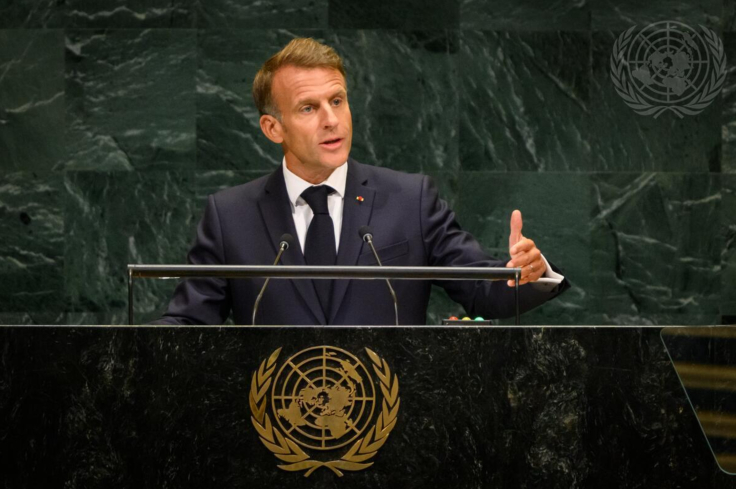
Of all the speeches that hit the headlines during the U.N. General Assembly—President Trump's, Iranian president Pezeshkian's, Prime Minister Netanyahu's, the Jordanian king's—the one that was most stunning came from the president of France, Emmanuel Macron.
There was a kerfuffle of press attention around Macron's false claim that the Hamas terrorist group was not active in the West Bank. The American ambassador to Israel, Mike Huckabee, set the record straight on that one. "Hard to imagine a more out of touch with reality speech than Macron at UN," Huckabee said, reposting a response by an Israeli minister, Amichai Chikli. "Since 1990, Hamas has carried out more than 80 lethal terrorist attacks originating in or directed from Judea and Samaria, murdering more than 350 Israeli civilians," Chikli said. The French anonymously claimed that Macron's remarks had been mistranslated, but that claim is not credible.
Macron's Hamas blunder was a symptom of a French speech that was out of touch with reality in a much bigger way.
Start with the main framing, as Macron put it: "The question we must answer is very simple. The question is, do we want to live under this state of affairs with a return to the law of the jungle? Or do we want to live in a civilized international society?"
That the president of France, of all places, would pose as the spokesman for civilized international society without even a parenthetical pause to acknowledge his own nation's shortcomings demonstrated a breathtaking lack of humility. Where was the self-awareness?
Before lecturing America and Israel about the need to avoid the "law of the jungle," Macron—if he had a shred of decency—might have taken a moment or two, or more, to reflect on the damage wrought over the years by the gorillas in Gaul itself.
The French Revolution, in marked distinction to America's founding war, was characterized by brutal excesses. Robespierre's guillotines operated against class enemies with bloody efficiency yet without due process. A standard European history textbook, R.R. Palmer and Joel Colton's A History of the Modern World, reports that 40,000 people died in the Terror of 1793-1794; at Nantes, "2,000 persons were loaded on barges and deliberately drowned."
For France, bloodthirst was an export good, spread worldwide via colonial rule.
In 1945 in Algeria, a French "brutal and massive campaign of repression" in the Constantine area—Setif, Guelma—"resulted in 45,000 deaths, according to official Algerian estimates; according to historians, the toll is between 8,000 and 30,000 deaths," Le Monde reported 50 years later. The paper referred to a memorial site at "the bridge where the French army shot hundreds of Algerians in May 1945 and threw them, sometimes still alive, into the deep ravines of the area's gorges."
In 1947 in Madagascar, a French expeditionary force massacred tens of thousands of natives. Le Monde reported 50 years later, "According to the General Staff reports, which Father Tronchon uses as the basis of his figures, the so-called pacification led to 89,000 deaths, not to mention torture, summary executions and villages forcibly evacuated and torched. At the National Assembly, the French high commissioner gave a more comprehensive estimate: 90,000-100,000 dead. Many Malagasies say the slaughter was even more extensive."
French police killed at least eight people, perhaps as many as 200, in Guadeloupe in 1967. French anti-riot police killed another three people in Martinique in 1959 and two more in 1974. The entire Vietnam war fought by the U.S., with all its American and local casualties in the 1960s and 1970s, can be understood partly as a costly U.S. effort to attempt to cope with the aftereffects of a failed French colonial project; a French naval bombardment of Haiphong on November 23, 1946 "killed an estimated 6000 Vietnamese civilians," according to an overview available at the website of the British Modern Military History Society.
No record of jungle rule in France would be complete without an account of how the country's Jews have been persecuted. In Blois on May 26, 1171, the entire Jewish community was destroyed—31 of them burned at the stake—on the basis of a false accusation of murdering a Christian child, even though no Christian child had died. As Robert Chazan described it in a 1968 article, "Ephraim of Bonn indicates a Jewish community, prior to the tragedy, of approximately forty adults. Of these thirty-one were burned, a number imprisoned, and a number of the young forcibly converted. In effect, a total community was destroyed. It was unquestionably this monstrous concatenation of circumstances that so indelibly seared the Blois incident into the consciousness of Ashkenazic Jewry."
More recent history is no better, from the Dreyfus affair to the concrete-floored, barbed-wire-ringed Holocaust detention camp at Drancy, in a Paris suburb. The U.S. Holocaust Memorial Museum's Holocaust Encyclopedia reports, "In all, some 77,000 Jews living on French territory perished in concentration camps and killing centers—the overwhelming majority of them at Auschwitz—or died in detention on French soil."
The USC Shoah Foundation has an article recounting, based on survivor testimony, how, "On July 16 -17, 1942, over 13,000 Jews from Paris and its suburbs were rounded up by French police in the early morning hours and forcefully taken from their homes to both the Vélodrome d’Hiver, a winter cycling stadium in Paris, and to the Drancy internment camp. For five days, these men, women, and children – including the elderly, sick, expectant, and even newborns – were held in the most deplorable conditions, deprived of food, water and adequate toilet. They were later deported to Nazi concentration camps, including Auschwitz, with only 811 ultimately surviving the war."
The USC doctoral student who analyzed "45 relevant survivor testimonials" detected several overarching themes, including "a compelling amount of anger expressed toward the French, in general, as several interviewees point out that after the war ended, the French wanted to forget their actions during the war period and, thus, there was a prevalent culture of national denial that collaborationism had existed in France."
In 2006, a young French Jew, Ilan Halimi, was kidnapped in Paris and tortured to death by an antisemitic gang that held him for ransom because it believed all Jews are rich. As an American Jewish Committee account put it, "On February 13, 2006, Halimi was found naked, handcuffed, and barely alive, at a Paris train station. More than 80% of his body was covered with burns, an ear and a toe had been cut off, and his genitals had been mutilated. He died while being transported to the hospital."
In 2017, a Jewish woman in Paris, Sarah Halimi, was killed by a neighbor angered by the mezuzah on her doorpost. Her assailant beat her up while shouting "Allahu akbar." Then he threw the 65-year-old retired doctor out the window of her third-floor apartment. France's high court ruled the killer couldn't stand trial on the grounds that he was high on pot when he did the crime. A New York Times article quoted Francis Kalifat, the president of the Representative Council of Jewish Institutions in France, who said, "From now on in our country, we can torture and kill Jews with complete impunity." The Times article noted, "French Jews have been repeatedly targeted by jihadists over the past decade. In 2012, an Islamist gunman, Mohammed Merah, shot dead three children and a teacher at a Jewish school in the southern city of Toulouse. In 2015, Amedy Coulibaly identified customers as Jews at a kosher Paris supermarket before killing four of them."
In his U.N. speech, Macron demonized Israel ("War crimes have been industrialised. ... a new era of barbaric acts"), called for multilateral control of artificial intelligence, went on about climate change, and talked about how "we must learn the lessons of the 20th century." Among those lessons of the 20th century is that it was a mistake to give France, a minor and declining power, a permanent seat on the U.N. Security Council. What has that nation done to earn it? There was a moment when the French were grateful to America for liberating their country from the Nazis in World War II. If Macron and his countrymen want a rescue again the next time around, they will need to begin behaving like allies instead of annoyances.