

CAMBRIDGE, Mass. — Loud, activist student protests directly adjacent to classroom buildings are once again interfering with teaching and learning at Harvard.
Thursday afternoon in Harvard Yard, about 15 Harvard graduate students marched in a circle, banging on drums and obstructing the main entrance to Emerson Hall, a classroom building that also houses Harvard’s philosophy department. They held signs—"No contract, no peace," and "UAW on Strike," a reference to the United Auto Workers union of which the Harvard Graduate Student Union is an affiliate.
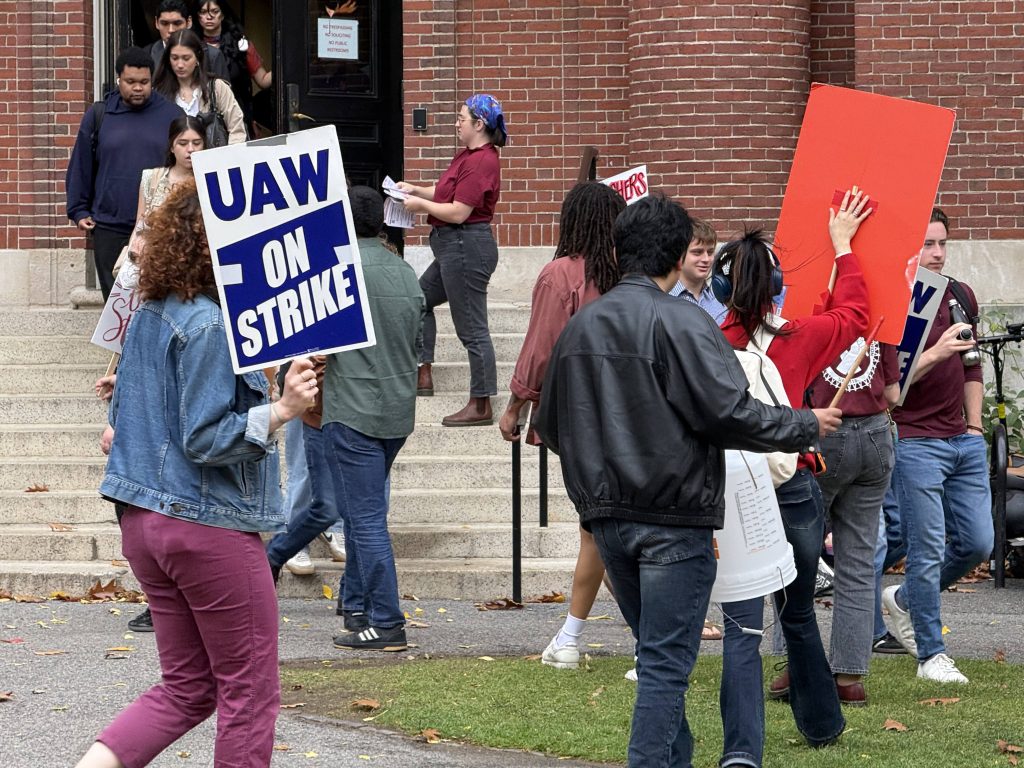
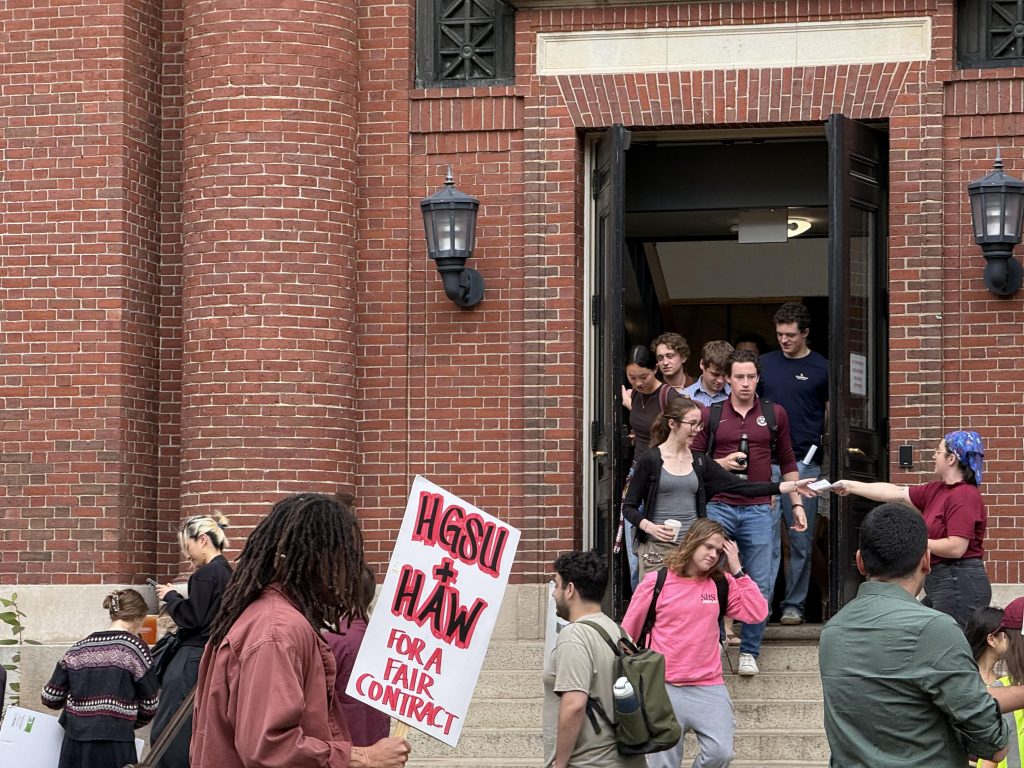
The protesters chanted rhyming slogans referring to Harvard’s endowment. "$60 billion with a ‘B,’ now is there enough for me?" "You’ve got $60 billion bucks. Union busting really sucks." (Much of the endowment is in private equity, allowing Harvard’s managers and the protesters both to pretend it’s still worth $60 billion notwithstanding Thursday’s stock market slide in publicly traded companies.) They also chanted "If we don’t get it, shut it down," a threat also favored by the anti-Israel protesters.
Students, parents, Harvard administrators, and alumni privately described to the Washington Free Beacon a situation that sharply contrasts with the story that the university is publicly presenting in the press and in court filings and oral arguments. By that account, the disruptive campus protests that made national headlines and contributed to toppling Harvard President Claudine Gay are a thing of the past, and Harvard has implemented and enforced new policies and priorities emphasizing teaching and learning instead of protests and activism. The Wall Street Journal even ran a widely shared front-page news article by Pamela Paul glowingly depicting a Harvard humanities class limited to 90 students as something like a cross between the Sanhedrin and St. John’s College in Annapolis.
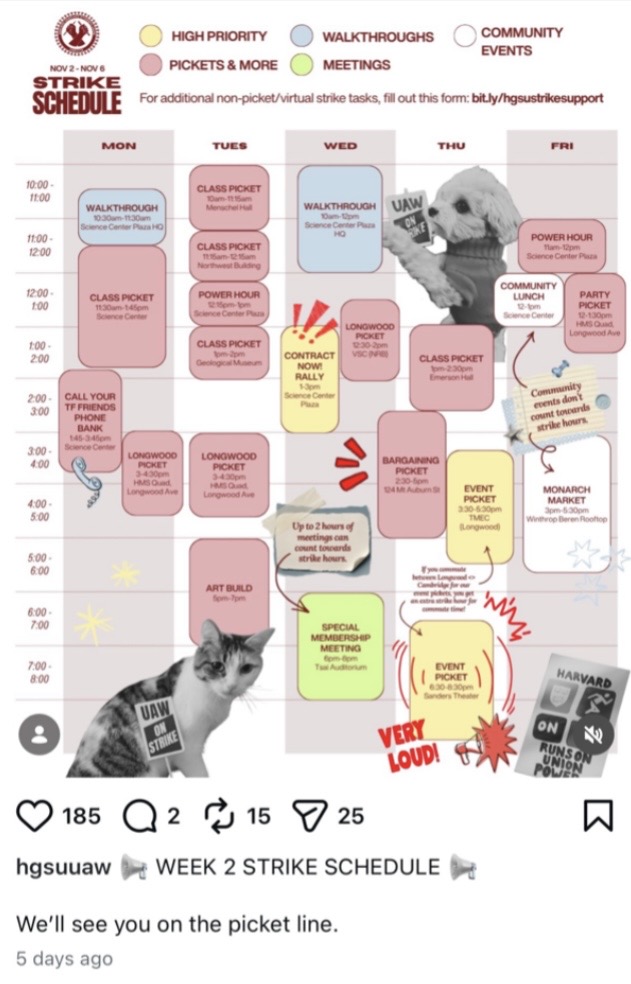
Among the impacts of the strike, which began on October 27:
— Harvard classes known as "sections"—smaller discussion groups led by graduate student instructors—have been widely canceled, with undergraduates in the classes provided no tuition refund or alternative educational experience. Among the courses where section meetings have been canceled, the Free Beacon has learned, are Humanities 10, or "Hum 10," the course admiringly depicted in the Wall Street Journal article as "distinctly old school." Would a genuinely "old school" class let a strike cancel learning for students? Other classes with sections canceled include Gov 30, a class in Harvard’s government department taught by Stephen Ansolabehere, who was one of the professors Claudine Gay was accused of having plagiarized. Other classes that have had sections canceled include Philosophy 14: Morality and the Good Life: An Introduction to Ethics. If the class had met perhaps the students could have discussed the ethics of a professor leaving tuition-paying students in the lurch with less educational time because of a strike. Also canceled were sections in History of Science 100, an introductory course in the history of science.
— In some classes where the sections weren’t completely canceled, like math or economics, sections were merged together because some of the instructors were graduate students, so what are supposed to be smaller classes are now large and full of new students.
— Midterm exams that students took haven’t been returned with grades or comments.
— In some classes where graduate student instructors had office hours for students with questions, those office hours have been scaled back.
— Some professors have moved classes from in-person to zoom at the request of the union when the union sets up picket lines outside classroom buildings.
— An author and video personality, John Green, who was scheduled to deliver the 2026 George W. Gay Lecture on Medical Ethics, decided to appear virtually instead of in person after the union wrote to him asking him not to cross their picket line. A Harvard Medical School spokeswoman declined to reply to my question about whether he’d be paid his full honorarium for the appearance. Such speaking fees can be lucrative; Harvard’s English and history departments paid a $35,000 honorarium and $7,500 in travel expenses "for a 5 star hotel" to have Ta-Nehisi Coates appear on campus on September 24, 2025, the second day of Rosh Hashana, and "read from his chapter on Palestine." Green’s representatives did not reply to my emails seeking comment. Harvard describes the Gay lecture as "the oldest endowed lectureship at Harvard Medical School, and quite possibly the oldest medical ethics lectureship in the United States."
— A midterm exam in GenEd 1116, "Medical Ethics and History," was targeted by such a loud student protest that the professor distributed 100 pairs of earplugs, the Harvard Crimson reported.
A Harvard spokesman, Jason Newton, sent me a copy of a November 4 letter from a Harvard labor relations official, Paul Curran, warning that the strike activity that targeted the GenEd 1116 midterm "is in direct conflict with multiple University policies, including the University-wide Statement on Rights and Responsibilities (USRR) and the Anti-Bullying Policy." It went on, "Our teachers have a right to teach our students, and our students have a right to learn. … In violation of University policy, the picket activity on Thursday outside Emerson Hall interfered with students’ and employees' rights and obstructed community members from performing their normal duties and activities. This serves as notice that student workers who exercise their right to strike in a manner that violates University policy will be subject to employment disciplinary action."
The mildly phrased letter—"Thank you for ensuring that the union will conduct all picket activity in accordance with University policies. If you have any questions regarding the relevant policies and expectations for picket activity moving forward, please let us know"—didn’t seem to have discouraged the union activists from a loud protest outside the same classroom building this afternoon.
Newton also sent along an October 26 letter from Harvard’s provost, John Manning, and its executive vice president, Meredith Weenick, claiming, "If a strike occurs, we will continue to fulfill our obligations to our students and researchers." That letter also notes, "The University provides over $425,000 in financial support to all PhD students over a five-year period, including grants to cover tuition, fully subsidized health insurance premiums, fully subsidized dental insurance, living expense support, parental accommodation support, and a parental benefit stipend, among other benefits."
The Harvard graduate student union is virulently anti-Israel and voted in November 2023 to back the boycott, divestment, and sanctions movement to wipe Israel off the map. "We categorically reject U.S. support of the murderous Israeli regime in its ongoing genocide of Palestinians," the statement "in support of Palestinian liberation" said. "As members of the labor movement, we call on U.S. labor unions to cut all ties with Israeli unions." The anti-Israel protests that wracked the Harvard campus in 2023 and 2024 frequently featured UAW signs so that if Harvard did anything to quash the protests it could be accused of labor rights violations as well as infringing on the free speech and assembly of the protesters.