





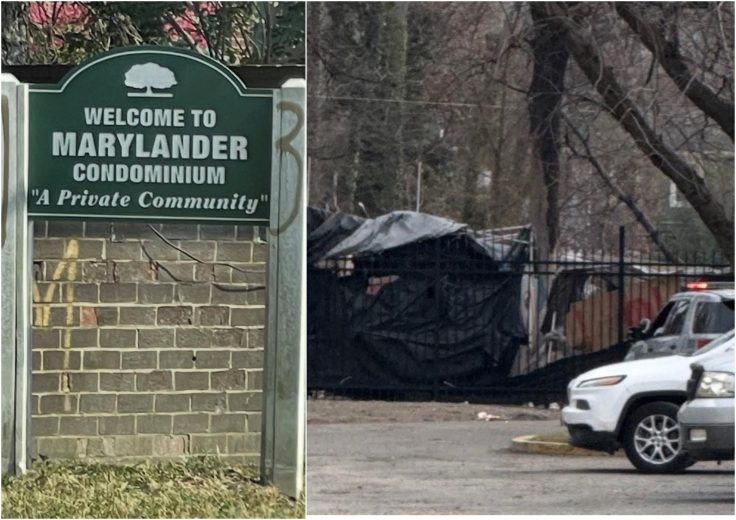
Prince George’s County, Md., was planning to evict hundreds of residents from the Marylander Condominiums on Thursday after vandalism from a nearby homeless encampment plunged the property into disrepair. Those plans were briefly put on hold at an emergency court hearing on Wednesday morning, when Maryland district court judge Bryon Bereano declined to sign an order authorizing the evictions.
The county requested Wednesday’s hearing at the last minute in order to obtain a final sign off to remove residents, less than 24 hours before it planned to post eviction notices on 100 units, according to Beverley Habada, a member of the condominium’s board. It did so without notifying residents or property managers.
As the hearing got underway, county officials told property managers they planned to post the notices later that day and asked them to open the gates of the Marylander. But when Bereano didn’t sign the order on the spot, the county postponed the postings, giving the condo a 24-hour reprieve.
Bereano did say at the hearing that he planned to let the evictions go forward. On Thursday, following the publication of this story, he signed an order authorizing the police to "take all action necessary" to vacate the 100 units. It is not clear when that evacuation will take place.
The brief delay came after the Washington Free Beacon published a series of reports about the condominium, which has struggled for years with the encampment on its doorstep. Property managers say the county’s failure to clear the camp resulted in nonstop crime and vandalism, culminating in irreversible damage to the heating system after residents of the encampment allegedly vandalized the boiler room.
Some 100 units were left without heat amid one of the worst cold spells in the area’s history. The conditions prompted the county to deem those units "unfit for human habitation" in December and ordered their residents to leave, touching off months of litigation as residents defied the order and weathered the cold.
At the same time, the county refused to guarantee a loan for the complex to install a new heating system. The result was a Catch-22 that iced the condo out of credit lines and caused some residents to suspect that the county—the most Democratic-leaning in the nation—is attempting to destroy a largely minority, low-income community that is paying the price for its toleration of disorder.
"They are going above and beyond what they need to be doing here in terms of trying to shut this place down," Habada said of county officials’ conduct toward the condominium and its residents. County officials did not immediately respond to a request for comment.
A spokeswoman for the county’s Department of Permitting, Inspections, and Enforcement, Avis Thomas-Lester, said the agency had requested the hearing to determine who would bear the costs of evicting residents.
"We don’t believe the county should bear the cost," Thomas Lester said.
Even if the evictions are postponed indefinitely, residents say some units have become truly uninhabitable thanks to severe damage from the encampment. At least one building without heat also lost electricity after space heaters fried its circuits, and several units flooded when their pipes burst due to the cold weather.
Some residents have fled to hotels but cannot afford to stay there much longer. A few say that their only source of shelter may soon be the encampment that displaced them.
"They’ve been living better than us," Jason Van Horne, who shared a condo with his 73-year-old mother, told the Free Beacon earlier this month.
Adding insult to injury was the decision of top county officials to spend more than $43,000 in taxpayer funds to stay at a luxury hotel during January’s snowstorm. In an interview with local news, county executive Aisha Braveboy justified the stay by saying that "a lot of decisions … had to be made in real time" amid the storm.
A few days before the snow, county officials said they were aware of the encampment but wanted to ensure that any law enforcement response was "compassionate."
"We’re not criminalizing the unhoused," police major Thomas Boone said at a town hall.
UPDATE Feb. 18, 10:09 p.m.: This piece was updated to include a comment from a spokeswoman for the county's Department of Permitting, Inspections, and Enforcement.
CORRECTION Feb. 20, 5:30 p.m.: A previous version of this piece stated that the judge forestalled the evictions. It did not mention that he indicated at the hearing that he would allow them to proceed, even though he did not sign the order that day.