





"In Israel, in order to be a realist, you must believe in miracles," Israel’s first prime minister, David Ben-Gurion, once quipped.
At some point later in his career, perhaps he muttered to himself, "In order to survive a full term as prime minister, you need way more than the ability to split a sea and have God give you two inscribed tablets on a mountaintop."
We’ll never know.
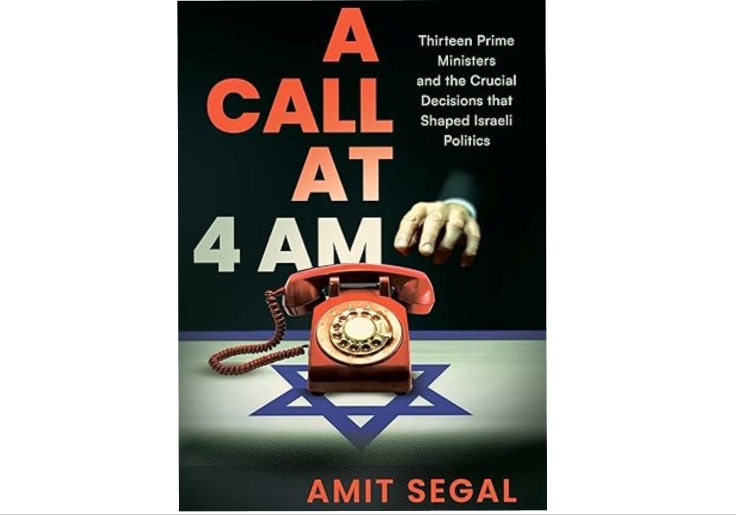
But as Amit Segal’s A Call at 4 AM: Thirteen Prime Ministers and the Crucial Decisions That Shaped Israeli Politics demonstrates, one seems to need divine intervention to survive years at the head of the world’s only Jewish state and emerge unscathed by public opinion, war, or scandal.
That, ironically, is partially the fault of Ben-Gurion himself. As Segal, one of Israel’s most renowned journalists, documents in his riveting political history, the country since its inception has had to operate by the seat of its sand-swept pants. Besieged by Arab countries seeking its destruction from the day of its birth, and already welcoming Jews from all over the world (including thousands forced to flee from those same Arab countries), the Israeli leader channeled the ancient Jewish habit of free debate, honed over centuries in the beit midrash (house of study). "In the absence of a democratic tradition and under the specter of a deadly national conflict," Segal writes, "there was a genuine fear that any minority who felt unrepresented would try to storm the parliament building with tanks."
Israel’s notoriously complex coalition-based parliament, the Knesset, has proved more stable than originally expected. Its model, despite its seemingly ever-dramatic daily headlines, stands head and shoulders above its neighbors. No doubt millions of viewers in Israel and America chuckled when President Donald Trump got up to deliver his remarks celebrating the successful release of the remaining living hostages taken by Hamas, following Prime Minister Benjamin Netanyahu’s opening address and remarks from the Knesset's speaker, only to have POTUS realize it wasn’t his turn yet because the leader of the opposition to the ruling coalition, Yair Lapid, had his turn to speak first.
"Even on the Knesset's stormiest days," Segal notes with characteristic humor and insight, "it is worth remembering that the opposition leader in Egypt is in jail, the opposition leader in Syria drives around in an armored personnel carrier, the opposition leader in Lebanon lies six feet under, and the opposition leader in Israel meets the prime minister once a month for a friendly conversation over coffee and bagels."
Israel’s parliamentary system, unlike America’s, is not representative of districts. (Segal notes the Netherlands and Slovakia are the only ones with similar electoral systems.) You don’t even vote for individuals to lead the country, as you do for president of the United States. You vote for parties that tag-team to box out the other teams and take the reigns as a majority with a prime minister emerging from the winning team. Forget American-style "separation of powers" ensuring baseline stability despite constant disagreement—Israel doesn’t even have a constitution! Segal compares the now 77-year-old set up to that flat bread-like substance eaten on the holiday of Passover:
The Israeli electoral system, like matzah, is only half-baked. The people who came up with it kneaded it into Israel's national ethos, the Jewish character, their deep worry for the young country's stability, and short-term practical concerns. Never mind, they consoled themselves, we'll try it out once, and if it doesn't work—we'll just change it! This is probably also what the Israelites thought when they escaped from Egypt, but we are still eating their matzah recipe over three thousand years later. Ben-Gurion, eat your heart out.
He adds that had Trump been Israeli, he would have delayed the 2020 elections "by just a month, until the start of the COVID-19 vaccination campaign, and won in a landslide. But he is American, and therefore elections were held on time, and he lost the presidency because of a few thousand votes in swing states."
While observers might scoff that in contrast to a set four-year term for presidents, an Israeli prime minister can call elections or be booted on a random Monday if the political winds move, it’s important to remember the United States is about to celebrate the half-way point of its third century. The modern state of Israel hasn’t even hit its first yet. And each day has been hard-earned. While many take the country’s tech prowess for granted, and it’s merited its nickname as the "start-up nation," it remains smack in the middle of a tough neighborhood. As one young mom recently noted on Instagram, "Israel’s the only Western country in the world in which, when you’re awoken at 2 a.m. by a siren signaling a rocket is heading your way, you ask ‘which of five possible countries shot it?’" Segal recalls the DJ on his favorite radio station, during a 2014 skirmish with Hamas, telling listeners, "Next up, Beyoncé’s new hit single. But first, an update. There’s heavy traffic on Route 6 heading south because of convoys of tank transporters." Even New York’s George Washington Bridge has never had to deal with that.
The middle-of-the-night call in the book’s title refers to the one placed to Prime Minister Golda Meir in 1973. She had chosen not to strike a threatening Syria and Egypt preemptively, only to now be told the countries had attacked on the holiest day of the year, Yom Kippur. Israel recovered from significant initial losses during that war and emerged victorious, but Meir would later resign in disgrace.
Despite the recent similar recovery and subsequent victory of Israel after the Oct. 7 surprise attack by Hamas, which Segal discusses in the book’s last chapter, "Israelis are, in many respects, just another frightened Jewish community in a two-thousand-year-long chain of frightened Jewish communities." Two years after my family and I moved to Israel, my then 11-year-old had his Little League game canceled on account of gun-toting terrorists lurking around the neighborhood where the field was (thankfully, they were apprehended).
The country is constantly beset by danger, and societal division often seems just as intractable. The following anecdote about Netanyahu is representative:
Like the religious Zionist community, Netanyahu also looks at Israel from a historical lens spanning millennia, but unlike them, he is painfully anti-messianic. He sees eye-to-eye with the religious Zionists about the dangers of the Palestinian national movement but is appalled by their vision of annexation, which includes the whole of Judea and Samaria; he completely shares their nationalist values but utterly disputes the religious values that they represent. One day, as the leader of the opposition in 2007, Netanyahu visited Judea and Samaria. "See these hills?" he told his bureau chief, Naftali Bennett, as his retinue observed the Tel Aviv skyline from a lookout point. "From here, you could fire rockets straight at Ben Gurion Airport." Bennett, a kippah on his head, replied: "See these hills? This is where our forefather Abraham walked."
Bennett, mind you, named one of his sons after Netanyahu’s brother Yoni, who died rescuing hostages in Entebbe in 1976. Bennett, in 2021, defeated Netanyahu and became prime minister, only to have his coalition fall apart and see Netanyahu return to the premiership (again) in the next election. Bennett recently announced his intention to run for Netanyahu’s seat again.
Such a complex cast of political characters amid a constantly threatening geographical context might give the impression Israelis are depressed, but the country consistently rates among the happiest on the globe. More and more American and European Jews are moving there, regardless of the danger. Despite its flaws, both realists and believers in miracles have faith that the country will not only continue to survive, but will thrive, well into its first century and beyond. And maybe, just maybe, it will get around to writing a constitution.
A Call at 4 AM: Thirteen Prime Ministers and the Crucial Decisions that Shaped Israeli Politics
by Amit Segal
Wicked Son, 248 pp., $32
Stuart Halpern, senior adviser to the provost and deputy director of the Straus Center for Torah and Western Thought at Yeshiva University, is the author, with Wilfred M. McClay, of Jewish Roots of American Liberty: The Impact of Hebraic Ideas on the American Story (Encounter).