




One remaining sign of life was also a call for death: A tattered demolition permit clung to a fence cordoning off the driveway to Grossinger's, formerly a 1,200-acre resort that made the Catskill Mountains worth the trip. The permit, hanging on in 2021, approved the destruction of the hotel's most upscale building, dreamed up during the retreat's 1960s heyday.
Everything else around it had yellowed or rotted away—the grass, the hotel stairwells where crowds once clogged the steps, and on nearby farms, the chicken coops. The hotel's surviving walls became canvases for graffitists and the backdrop to photoshoots for high schoolers playing hooky, testing how many friends could fit on one of its last couple pool chairs before its ancient webbing finally surrendered.
Most of Grossinger's structures were demolished by the time I reached ninth grade, so stories of these midday excursions comprised the cool kids' lore at my high school—roughly 20 miles away from the hotel—where I was one of about four Jewish kids, including my brother.
Alas, the Borscht Belt, a summer getaway for Jews barred from gentile-owned vacation spots and a rural refuge for Holocaust survivors to start again, was nearly dead.
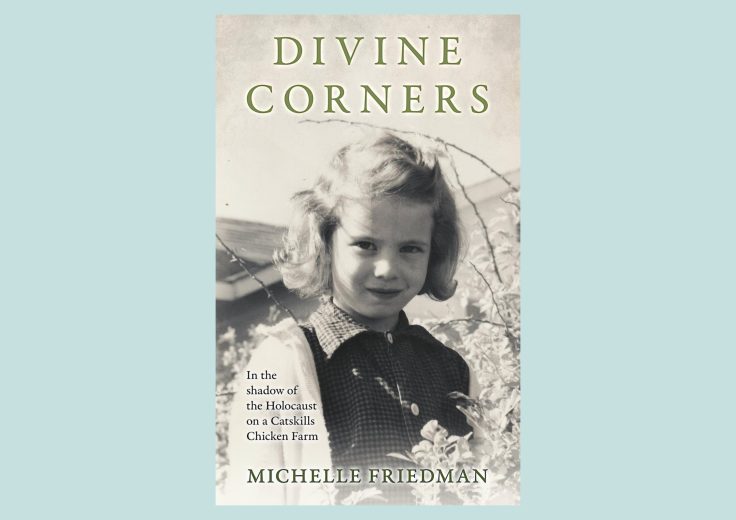
But Michelle Friedman, who grew up on a Catskills farm alongside 20,000 chickens, has a few stories left to tell. Her memoir chronicles her upbringing in the hamlet of Divine Corners as the child of Polish Holocaust survivors, both of whom witnessed the Warsaw Ghetto. Friedman animates each character with their skill for inflicting pain, unpacking decades of trauma in a household where sentimentality was shunned.
The passing of her abusive father, Arnold, who "crackled with tension like the electrified wire cattle fences," but also saved his sister and mother after persuading a Polish woman to hide them in her attic after the Nazi occupation, "liberated [her] curiosity" to hunt for the origin of her family's troubles and the higher familial dynamics that dictated her childhood.
Arnold's rage pervaded Friedman's house. And once his beatings began, any intervention was "like gasoline thrown to a fire." Her mother, Regina, watched motionless, while her youngest and only son, Jay, endured his lashings. Decades later, when Arnold died shortly after his 96th birthday, Friedman was the sole child to attend his funeral. "Thanks for the update," replied Jay to an email informing him of his father's death.
But divorce would have separated Regina from the one person who kept her past alive; everyone else she knew had been killed. Arnold could describe "the smell of the countryside" and "the local landmarks" in Wegrow, Regina's hometown where her husband had briefly lived. To Regina, that may have been enough of a reason to stay. Few others would understand.
To Friedman, the tales of Regina's escape from Nazi-occupied Poland made her the heroine of her own story. She leapt off a deportation truck headed to Treblinka into a bush, and, when Regina's father never came to meet her and her mother in the designated hideout, the pair secured false documents from a forger and set off into the Nazi-occupied capital of Warsaw. After supplies depleted while she hid with her extended family in a makeshift bunker, Regina volunteered to forage for food but was stopped by a Ukrainian soldier.
"You are a Jew," he said, raising his rifle to shoot her. She rejected the soldier's accusation and, following her recitation of the Pater Noster, he lowered his gun, pulled a chocolate bar from his pocket, leisurely unwrapping it while holding his stare. She led him to a potato farm, where miraculously a school friend was digging. After the friend's sister began flirting with the soldier, he shelved his Jew-killing quest for enough time to let Regina blend in with the others.
Her parents' "survival saga[s]" even pervaded the author's bus rides to school. "I scanned the landscape for hideouts and escape routes in case another war or Holocaust broke out," she wrote. "Would that porch be a safe place?" It even fed into her desire to be a Girl Scout, deciding that she, too, needed to learn to survive in the woods.
The uniqueness of these experiences heightened the insularity Friedman felt, a somewhat secular Jew who disliked the mud almost as much as the rednecks from which she felt disconnected, and the Hasidim, the orthodox (I can confirm those demographics remain the same). But she struggled with a longing to connect to locals of all stripes, especially to her siblings, who gradually slipped away.
Her older sister, Lisa, left for Israel and limited contact. Meanwhile, Jay, a Boo Radley type, departed for Seattle. "Don't call me," he told Friedman after he fell ill with pancreatic cancer. When she finally was permitted visitation, she remarked how quickly the disease had eaten at his body, turning it into "that of a concentration-camp prisoner." Jay wanted his money to go to Planned Parenthood—a possible signal to Friedman that he wished he was never born. And if he could be born again, he would pray for it to be with different people.
His one wish was to be cremated. Friedman obliged her younger brother, defying Jewish law's prohibition and submitting to the situation's morbid irony. She zipped up his body in a duvet from Divine Corners, hand-sewn by their mother years ago. While Friedman's intrafamilial issues were left tangled, she took solace knowing that she was beside Jay as he passed.
Friedman's account details the various strains of erasure—of bloodlines, siblinghood, and friendships. The Nazi genocide overshadowed her life on a farm meant to offer a fresh start. But her musings of the Holocaust ensnared her, "like some black hole of dense gravity." When Friedman traveled back to Wegrow with her father years later, she was struck by the semblance of the landscape to Divine Corners, where just a few miles away was another small farm, tucked into a different countryside.
Back in America, Friedman traveled upstate only to find the site of her first life had disappeared. Both her childhood home and the coops were wiped out as though they'd never existed.
In 2022, one year after I graduated high school, a fire incinerated the rest of Grossinger's, with the structures of lesser-known hotels also on their way out, leaving the memory of the Borscht Belt relegated to its aging former patrons and the youth's desire to keep telling its stories.
Divine Corners: In the Shadow of the Holocaust on a Catskills Chicken Farm
by Michelle Friedman
Amsterdam Publishers, 290 pp., $24.95
Jessica Schwalb is a broadcast associate at 60 Minutes and a native of Jeffersonville, New York.