





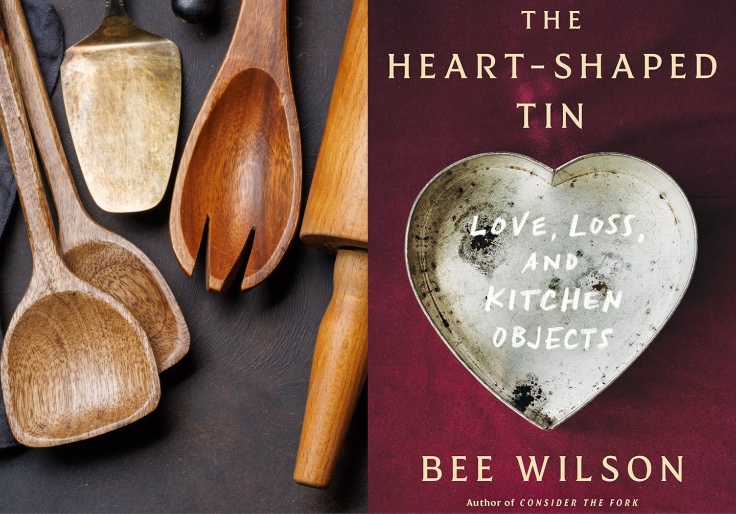
Between remembering and forgetting, treasuring and tossing out, feeling without sentimentalizing… These are the spaces Bee Wilson navigates with the precision of a drafting pen in her collection of memento stories, The Heart-Shaped Tin.
The blurbs on its book jacket—a rare line-up absent of hyperbole—reflect the fact that the British author has become something of a cherished object herself: an award-winning food writer of eloquence, who explores the subject as it pertains to humanity and not merely sustenance.
One can't help but think that some of her previous works, Consider the Fork (2012), The Way We Eat Now (2019), and First Bite: How We Learn to Eat (2015), provided useful backroads for this book. Here, Wilson trains a journalist's eye on her own life even as she discovers the ways people personify their pressure cookers, platters, and corkscrews.
Her interviews and referenced readings yield aha moments large and small. The things we surround ourselves with give meaning to our lives. But the meaning of those objects can change. In quoting the academic Russell W. Belk, she affirms that it is crucial to recognize "that every single one of us … regards our possessions as part of ourselves."
Through kitchen devices in particular, "humans extend their powers," she writes. In 2002, Venezuelans banged on pots and pans to express outrage at the policies of their leader Hugo Chávez. Known as a cacerolazo or casserole protest, it became a globally adopted form of dissent. Surprisingly, the practice has roots in medieval Europe.
Pressure-cooker technology goes way back, too, invented by a French physician in the late 1600s who called it "A New Digestor or Engine for Softening Bones." Home cooks had to wait until the 20th century for a commercial model. Wilson delved into its history after hearing that a friend's acquaintance, Paola White, had used a pressure cooker for 66 years to make her ragus and beans.
It becomes a tale not only of the Italian immigrant's cookery but also the way she found comfort in employing the steam-powered pot as White moved from Senegal to India and eventually back to England, where she had first met her husband, and, sadly, lost both him and her 26-year-old son in the same year. She cooks with remembrance.
Can you picture those toadstool-décor kitchen canisters of the '70s? They were dreamed up by a housewares buyer at Sears who was looking to buck the usual pretty designs. The set of four, appearing inconspicuously in the company's 1973 summer catalog, launched a Merry Mushroom line that became wildly popular for more than a decade, recycling into sought-out, Cottagecore kitsch today.
A spoon is the most universal of eating utensils, Wilson says. Perhaps the tenderest of her chapters focuses on the meticulously crafted one made by tailor Jacob Chaim, a Polish Jew in his early 30s imprisoned to work at the underground missile factory in Dora-Mittelbau, a sub-camp of Buchenwald during World War II. (A photo illustration of the object accompanies; thoughtfully, the same goes for most chapters.) Conditions were beyond inhumane. Prisoners were forced to eat like animals and vilified for it by their Nazi captors.
Wilson notes prisoners' inherent need to harbor their own collections of rocks or combs "because they are a way to claim something back, however small, from the system you find yourself in." The bit of metal Chaim stole to fashion his own spoon became "a beautiful, subversive, and self-loving act—a quiet act of defiance." After the war, he never used it again. Chaim married and moved to Canada, where he resumed tailoring with a perfectionist's intent. He donated his secret spoon to the Montreal Holocaust Museum.
Not everything deserves to be kept, the author admits. Mass-produced dinnerware washed daily and dutifully by a husband who leaves you can be replaced. China that no longer sparks Marie Kondo joy can be transferred to a willing party. The author's musings about both are relatable without being bathetic.
In the end, Wilson knows how to craft one true narrative out of many. As the book's title suggests, her heart-shaped cake tin serves as the catalyst for her own remembering and letting go. It set off her quest to see whether common kitchenalia engendered "magical" feelings akin to hers. Yep, they seem to be universal. This reviewer's culinary output has been supervised by a cupboard kitchen witch for decades.
By weaving memories of her marriage, familial Wedgwood, and her mother's detachment from reality among the stories of others, Wilson manages to leave the reader at a place of contentment. In parlance perhaps an ocean away from where the author resides: She has been through it, and has come out the other side.
The Heart-Shaped Tin: Love, Loss, and Kitchen Objects
By Bee Wilson
W.W. Norton, 312 pp., $32
Bonnie S. Benwick, formerly of the Washington Post Food section, is a freelance editor and recipe tester. You can find her Instagram and Threads: @bbenwick.