





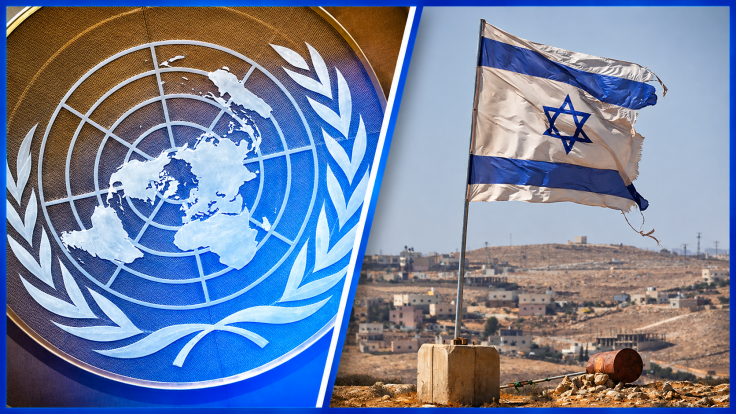
The Israeli government is pressing the United Nations to sharply increase the flow of its humanitarian aid into the Gaza Strip, saying that the international community's failure to come up with the supplies it promised is largely responsible for a potential winter-season shortfall that is falsely being pinned on a bottleneck caused by Israel, according to a private letter sent late last week to the United Nations and obtained by the Washington Free Beacon.
The United Nations and its international partners have been peddling claims that Gaza is on the precipice of a fresh humanitarian crisis ahead of winter, accusing Israel of interfering with aid deliveries into the Gaza Strip. "Incoming supplies face multiple approval requirements, limited crossing capacity and unpredictable or narrow delivery windows that delay their entry," the United Nations said on Nov. 13.
But Israel's Ministry of Defense refuted these allegations in the letter, sent Friday to multiple U.N. organizations. The data provided by Israel say that authorities fast-track 75 percent of U.N. aid shipments, but that only 60 percent of this aid is actually reaching Gaza.
"Only approximately 60% of the approved humanitarian aid has actually entered the Strip," even though Israel has cleared the U.N. aid to cross the border, according to the Israeli government's letter, which is also circulating on Capitol Hill. Israel said the aid appears to be slowed due to logistical and budget problems on the U.N. side.
Major General Yoram Halevy, Israel's coordinator of government activities in the territories—known as COGAT—wrote in the Nov. 19 missive that there is a "gap between the volume of winter supplies approved by COGAT and the quantities actually brought into the Gaza Strip by the international organizations." The figures undermine recent U.N. claims that "Israeli policies continue to obstruct the entry of critical items," an allegation echoed by humanitarian groups and their press allies.
Israel strenuously objects to allegations by the United Nations and other anti-Israel groups that it's slow-walking or blocking legitimate aid shipments. In fact, Israel says it puts 75 percent of humanitarian shipments it approves through a "fast-track" process meant to accelerate the speed at which aid reaches Gaza. Those supplies, which include tents and other winterization tools, have not been delivered by the United Nations, according to Halevy.
"Among other things, the entry of nearly 65,000 additional tents was approved at the request of UNICEF, IOM, and other organizations, yet these tents have not entered the Strip despite the approval granted," he wrote. "Recent allegations that Israel is blocking the entry of winter supplies and humanitarian aid contradict the figures presented above, which demonstrate a gap between the volume of supplies approved and the volume actually brought into the Gaza Strip in recent months."
Israel says it blocks about 25 percent of aid shipments. These shipments are believed to include things like concrete, steel, and insulation materials, so-called dual-use items that Hamas could use to build or repair its tunnels. In the years leading up to Oct. 7, Hamas diverted massive amounts of concrete donated to Gaza for civilian construction projects to its tunnel operation.
A senior Trump administration official familiar with the situation told the Free Beacon that "the U.N.'s reflexive 'blame Israel first' posture concerning delivery of humanitarian aid in Gaza needs to change now."
"It is no secret," the official said, "that Hamas terrorists have sought to divert, obstruct, and violently interfere with humanitarian goods transported into Gaza. Hamas needs to be called out as a major part of the problem, even if politically inconvenient."
The U.N. Humanitarian Country Team (HCT) in the Occupied Palestinian Territory claimed in an "urgent appeal" earlier this month that Israel, as the "occupying power," is failing to meet "the basic needs of Gaza's population, including supplies essential for survival."
Middle East Eye, a staunchly anti-Israel publication, claimed in a Monday report on "Israel's genocide in Gaza" that the Jewish state "continues to restrict the flow of humanitarian aid into Gaza."
The European Union additionally urged Israel earlier this month to "allow immediate, unimpeded access and sustained distribution of humanitarian assistance."
Democratic Sens. Jeanne Shaheen (N.H.) and Brian Schatz (Hawaii) wrote a letter on Tuesday to Secretary of State Marco Rubio, asking that he pressure Israel into "allowing sufficient rescue equipment, shelter, and other critical winter supplies into Gaza."
The Israeli government has pushed back against this pressure campaign both publicly and privately, stating in Friday's letter to the United Nations that it is "ready to facilitate the entry of aid and assist in advancing the necessary humanitarian response."
"I call upon you to increase the entry of humanitarian aid ahead of the winter season, coordinate the entry of supplies that we have already approved, and submit requests for additional humanitarian supplies in accordance with the needs you identify on the ground," Halevy wrote, noting that Hamas is also largely to blame for the diversion of necessary supplies.
The Free Beacon first reported in August that Hamas officials routinely bullied and intimidated employees of U.S.-funded NGOs operating in Gaza in order to control their operations, according to a confidential probe by American investigators. Those concerns remain, per Halevy's letter.
Hamas "would attempt to exploit the winter season and the hardships faced by the population to advance a propaganda campaign against Israel, while disregarding the volume of aid entering the Strip, the joint efforts undertaken with the international community, and Hamas's own responsibility for the situation," he wrote. "The terrorist organization's continued refusal to disarm, alongside its cynical exploitation of the civilian and humanitarian environment for terrorist purposes and military buildup, remains a major obstacle to the reconstruction of the Strip."