

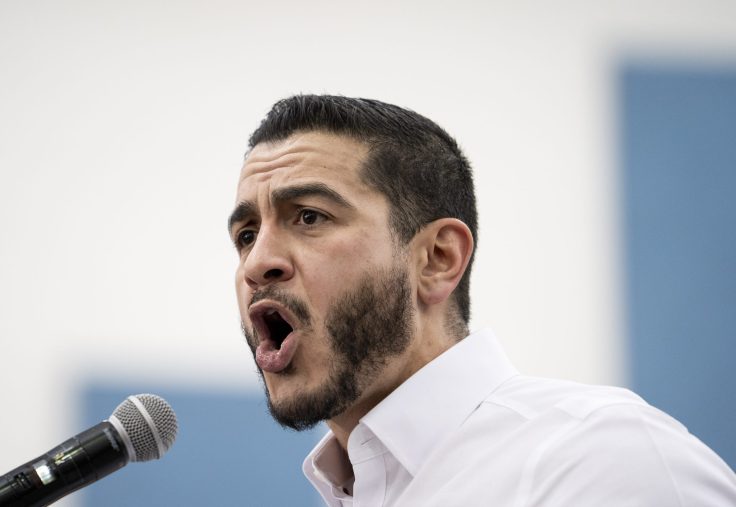
Democratic Senate candidate Abdul El-Sayed has raked in thousands of dollars in campaign donations from individuals linked to the Muslim Brotherhood, the radical Islamist and terrorist movement, campaign finance records reviewed by the Washington Free Beacon show.
El-Sayed's donors include the former spokesman for the Muslim Brotherhood's official political party in Egypt as well as individuals named in a directory of Muslim Brotherhood leaders that federal investigators submitted as part of a landmark terror financing trial.
The news comes as El-Sayed faces questions over his history of support for the Muslim Brotherhood, where El-Sayed's parents were born and where he claimed to hold citizenship as recently as 2016. In a recent Fox News interview, El-Sayed declined to say whether he supports U.S. terror designations for Muslim Brotherhood chapters, including the Egyptian branch, for supporting Hamas. "I will support a terrorist designation for any organization that is engaged in or committed to political violence," El-Sayed said, without noting whether he considers the Muslim Brotherhood to fit that definition.
Several of El-Sayed's previously unreported donations came from board members of Life for Relief and Development, a charity with close familial ties to the Senate candidate. El-Sayed's father, Mohamed El-Sayed, and his father-in-law, Tayeb Jukaku, have recently served on the group's board.
Life for Relief's CEO Hany Saqr, for example, donated $1,000 to El-Sayed in March, according to Federal Election Commission records. Saqr was listed in a 1992 phone directory of U.S.-based Muslim Brotherhood leaders submitted by federal prosecutors as part of the terror financing case against the Holy Land Foundation in 2008. The directory was seized from the Virginia home of alleged Hamas operative Ismail Elbarrasse.
Saqr has expressed support for the Muslim Brotherhood on social media. In 2018, he used a Muslim Brotherhood logo as his profile photo on Facebook and wrote a post criticizing former Egyptian leader Abdel el-Sisi—a foe of the Muslim Brotherhood—as a "dog of the Jews," according to a Middle East Forum report. He was also named as a Muslim Brotherhood member in an Egyptian news report in 2013.
El-Sayed received $1,000 from another Life for Relief board member, Mohamed Yahia Abdulrahim, last February, according to FEC records. Abdulrahim also appears to be listed as the head of the "economic department" in the phone directory of Muslim Brotherhood leaders released as part of the Holy Land trial.
Sherif Gindy, a third Life for Relief board member, donated $1,000 to El-Sayed last December, according to FEC records. In a sermon last year, Gindy called for Muslims to carry out "Jihad" in all of its "forms"—including by "force"—in order to impose hair-coverings on girls and to push the Jewish people out of Israel.
"How many mosques were destroyed in India, how many mosques were closed in the whole of the European Union, how many girls were asked not to wear the hijab throughout the world, because Jihad was ceased?" Gindy said in a May 2025 sermon at the Islamic Organization of North America (IONA) in Michigan, according to a translation published by the Middle East Media Research Institute.
"Defending the religion with force, power, and strength," he added. "Jihad is not only with force, Jihad has several forms, but one of them was due, one of them was due now." Gindy went on to lament "what is happening in Palestine" and said "the Jews" would not leave Jerusalem "except by force."
Other El-Sayed donors have links to the Muslim Brotherhood.
Abdul Mawgoud Dardery, who donated $500 to El-Sayed's campaign in June, was the foreign affairs spokesman for the Muslim Brotherhood's official political party in Egypt, according to media reports. The St. Paul Pioneer Press reported that Dardery, now a professor in Minnesota, previously served as a "member of the Foreign Relations Committee of the Egyptian Parliament before the 2013 military coup that overthrew the elected government" of former Egyptian president Mohamed Morsi.
A 2013 NPR article described Dardery as a "foreign affairs spokesman of President Morsi's party, the Freedom and Justice Party. It's aligned with the Muslim Brotherhood, of which he is a member." Dardery appears to be a dual national: A Free Beacon public records search indicated that he was issued a Social Security number in Pennsylvania in the 1980s.
Another El-Sayed donor, Sufian Nabhan, hosted a fundraiser with El-Sayed last July and contributed $2,500 to his campaign. In the early 2000s, Nabhan served on the board of directors for the Islamic Association for Palestine, a group cofounded by Hamas leader Mousa Mohammed Abu Marzook, according to a copy of the group's booklet published by the Investigative Project on Terrorism.
The Islamic Association for Palestine shut down in 2004 after a U.S. judge determined that the group had acted as a fundraising and propaganda conduit for Hamas and ordered the IAP to pay more than $50 million to the family members of 17-year-old American David Boim, who was killed in a Hamas terrorist attack. An internal Muslim Brotherhood memo from 1992, which was submitted as a government exhibit in the Holy Land Foundation trial, described the IAP as the "first initiative which was the foundation of the Muslim Brotherhood in the Shamm Countries."
The Muslim Brotherhood is an international Sunni Islamist political movement that originated in Egypt nearly a century ago, and which seeks to impose Islamic law in countries around the world. Hamas was founded as a branch of the movement.
While El-Sayed has avoided taking a stance on the Muslim Brotherhood during his Senate campaign, he expressed a sympathetic view of the movement before running for statewide office. In 2011, he wrote a Huffington Post column arguing that the United States shouldn't be concerned about the Muslim Brotherhood seizing control in Egypt after the fall of Egyptian dictator Hosni Mubarak, writing that the movement was "less hierarchical" than other Islamist political groups and showed a "willingness to compromise." And after the 2012 election of Egypt's Muslim Brotherhood presidential candidate, Mohamed Morsi, El-Sayed signed a statement calling on the new regime to "purge the media and the police as quickly as possible," the Free Beacon reported.