



In the 20th century, certain corporate brands became so well-known as to be immediately recognizable: McDonald's golden arches, the Nike swoosh, and, for a certain segment of the population, the Mary Kay pink Cadillac.
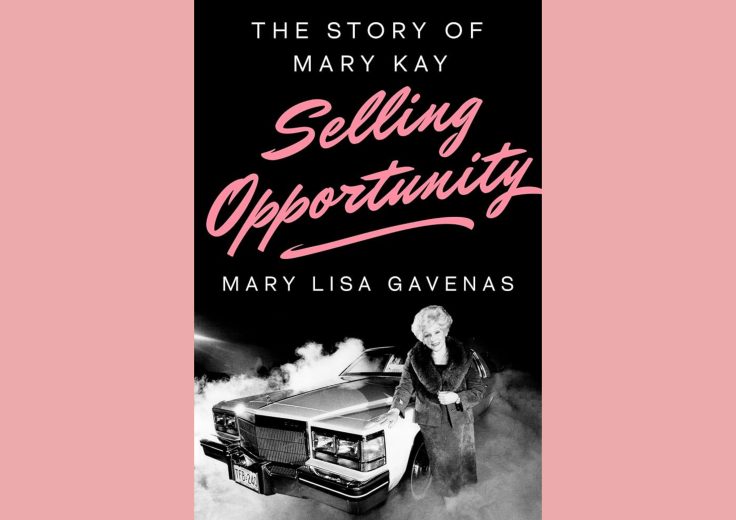
Mary Kay founded her eponymous cosmetics empire in 1963 and eventually became the first woman to chair a company on the New York Stock Exchange. She bought the original pink Cadillac as a reward for herself when her company was five years old, requesting that the dealership make the color to her precise specifications; the next year, realizing how much attention the unusually colored car brought to her business, she ordered five more Coupe DeVille "career cars" in Mary Kay Pink Pearl and gave two-year leases for them to her top five sales directors. A pink branding legend was born.
In Selling Opportunity: The Story of Mary Kay, Mary Lisa Gavenas attempts to locate the woman behind the brand while also telling the story of Mary Kay, the business. The two were inseparable because Mary Kay herself lived her life as if they were. Mary Kay also constantly edited her own history to present herself in the most flattering light possible, and Gavenas does a good job of unearthing the true details of Mary Kay's past and gently correcting the pink-tinted historical record.
Mary Kay Ash (born Mary Kathlyn Wagner in 1918) is a challenge to describe—imagine that Norman Vincent Peale and Mae West had a love child who was raised by a Fuller Brush salesman. Mary Kay's childhood in Texas amid the Great Depression, as described by Gavenas, was the definition of hardscrabble. From a young age she was used to seeing the women in her world as the most motivated actors; her mother was the family's only reliable wage-earner, and Mary Kay herself was tasked with adult responsibilities at a young age.
Married at 16 just after graduating from high school, Mary Kay had two children by the age of 18 (and a third a few years later). She seemed never to forget the feeling of the wolf at the door and often credited the deprivations of youth for fueling her ambitions. Her company's original slogan for its salespeople—"You can do it!"—was likely the same mantra Mary Kay repeated to herself from an early age.
It was a notably positive message, suitable to an era that included a potent mix of prosperity gospel messaging and old-fashioned hustling. It was the heyday of Baptist preacher Russell Conwell's infamous Acres of Diamonds speech, which he traveled the country delivering. Its message was simple: "To make money honestly is to preach the gospel." It was also a time when the business of direct selling grew significantly. As Gavenas notes, "Direct selling had a long tradition in America, but not a good one." Door-to-door salesmen were often barely tolerated rather than welcomed, which did not stop a young Mary Kay from peddling aluminum cookware and Stanley home cleaning products across Texas.
Later, Mary Kay would develop a mythology around those early struggling years as a direct salesman. She would also borrow liberally from the well-choreographed spectacle that was the Stanley Home Products Convention for her own company's retreat, which she called Seminar. At the time, Stanley Conventions were three-day events that mimicked tent revivals, with singers, testimonies from leading salesmen, and the crowning of a Queen of Sales. This last ritual triggered Mary Kay's competitive nature, and she vowed to take the crown the following year (she did). "For as long as she lived, Mary Kay would tell and retell the story of her first Stanley rally until it became a kind of hero's journey, a pilgrim's progress that compelled her to leave home, spouse, and children behind as she set forth on her path of redemption," Gavenas writes.
These years of selling honed Mary Kay's approach to sales, particularly when selling to women. "Whenever Mary Kay talked about this time in her life, she spoke only of selling opportunities," Gavenas writes. "Selling gave you a chance. Selling got you money and recognition and support from other women. Anyone listening to her already knew that housework and wiping runny noses did not." Selling as self-improvement found its perfect messenger in Mary Kay, whose own life experiences mirrored those of many of her customers—except, perhaps, in the relentlessness of her ambition.
Mary Kay eventually outgrew the Stanley company, a place where, Gavenas notes, "most unit managers were women, while all salaried executives were men," and joined World Gift, a company that sold imported tchotchkes like Venus de Milo replicas and "camel bells," marketed with over-the-top origin stories to make them seem exotic. Mary Kay, a natural at embellishing stories (her own and others), did well. Hawking a cheap wood flower made in a Rhode Island factory, Mary Kay claimed, "Ladies, this beautiful rose is handmade in a small town in Germany by elderly women who are blind!"
As World Gift grew, so did Mary Kay's success in the company—and her incremental reinvention. When she was featured in the Dallas Morning News along with other company managers, Gavenas writes, Mary Kay turned "Dale Carnegie courses and aborted attempts at college" into "educated at the University of Houston and several schools of management." No one challenged her invented credentials. After World Gift passed her over for a promotion, she decided to establish her own company selling beauty products and wigs. In 1963, at the age of 45, Mary Kay was the owner of her own direct sales company. As she told her recruits and her future shareholders, "You can have anything in this world you want—if you want it badly enough and you're willing to pay the price."
Part of that price was keeping up the appearance of a more traditional woman's role. For a woman at this time, naked ambition was about as acceptable as parading naked in the street, something Mary Kay understood. Gavenas describes how Mary Kay would "allow herself to be portrayed as forced to provide for her children, the implication being that she yearned to be a full-time wife and mother. The alternative would have been admitting that she was ambitious, competitive, and bored to tears by homemaking," which she was.
Despite her success at flattering the husbands of her top sales directors (and reassuring them that their wives' success was no threat to their manhood), her own private life was less successful. She had six husbands, four of whom she divorced (she was twice widowed), but in interviews over the decades she would often only acknowledge having had three.
Perhaps that is because she married men who were either happy to let her take charge of their lives as she had done her business, supporting them financially, or men who ended up resenting the time she devoted to work and left. As Gavenas tells it, Mary Kay never seemed very heartbroken over any of them, but she retained a keen understanding of the challenges of married life for women, especially homemakers. Today, the word "empowering" has become a tiresome "girl boss" cliché, but it is an apt description of Mary Kay's approach to her female employees.
Every year, Mary Kay hosted the highest-earning saleswomen in her home, often making the food herself, and gave out jewelry and wigs to the top earners. "She stood up and praised EVERYONE!" one consultant told Gavenas. "That filled a need. No one was doing that for these women." Mary Kay also encouraged new recruits to think of selling cosmetics as careers or self-owned businesses, and the company eventually created a Career Apparel program for company directors. As Gavenas notes, "Some women would be so proud of their Career Apparel that they would ask to be buried in it."
For Mary Kay, femininity was a sales tactic, a business weapon, and a shield against claims she was undermining traditional values by encouraging women to direct-sell. Mary Kay "was never without her false eyelashes and platinum wig," Gavenas notes. "Long before she gave away her first pink Cadillac, she had made herself into a brand." Yet underneath those feminine trappings was a businesswoman who understood her market and her employees. Discussing the prizes she gave to her best-performing saleswomen, Mary Kay said she thought they should have "things they would not normally go out and buy for themselves, like a pink Cadillac, a mink coat, a diamond ring—the things that we wait around for that guy on the white horse who never shows up to bring us."
Mary Kay also knew how to use her own life story to move product, and she taught her sales directors to do the same, "to weave setbacks like divorce, illness, and death into a narrative called an 'I-story'" where "obstacles were overcome, hard work paid off, and women demonstrated control over their lives." Today's influencers could learn something from Mary Kay; rather than posing with other people's products, make your own. Behind the Mary Kay brand was a lot of hard work and real things—products, factories, and a lot of women who believed Mary Kay's optimistic message. Mary Kay knew how to make women feel seen and valued and part of something bigger, which is its own kind of influence.
She also knew how to get rich. Her Dallas-based business empire grew under the guidance of her son Richard, with sellers in all 50 states and in Canada and South America. With success came criticism, including that her direct sales approach was akin to a Ponzi scheme. But Mary Kay had a knack for charming even her most committed critics; a Texas Monthly exposé written by a feminist writer compared Mary Kay sales consultants to cult members, yet the same writer confessed that after spending time with Mary Kay, she was persuaded to buy her entire line of skincare products. Gavenas describes how, when Morley Safer of 60 Minutes "asked if she wasn’t 'using God' to sell cosmetics," Mary Kay responded charmingly, "I sincerely hope not. I hope He's using me instead." Safer backed off.
Gavenas does a service to the reader in adopting a wry but neutral tone in telling Mary Kay's life story. At times the book goes into too much detail about the cosmetics business, and there are some unnecessary tangents about the history of other direct-sales companies. But Gavenas excels at capturing Mary Kay's success as a kind of secular preacher for prosperity. At Seminar, Gavenas reminds us, it was not uncommon for those gathered to sing "Mine eyes have seen the glory of the big commission check" to the tune of "The Battle Hymn of the Republic." Mary Kay also became a kind of hero to many different types of people, all of whom identified with her often-embellished life story. As Gavenas notes, "To MBAs, Mary Kay represented managerial genius. To stay-at-home moms, she stood for validation of traditional roles. To career women, she proved that women could excel as executives. To the Moral Majority, she was a living embodiment of Christian values. To drag queens, she was utterly fabulous."
Mary Kay died in 2001, after suffering a decline in health from a series of strokes, working almost to the very end. Her grandson now runs the company, which reported $2.4 billion in revenue in 2025. There are still more than 1,000 Mary Kay pink Cadillacs on the road, and many more women "selling opportunity," the Mary Kay way.
Selling Opportunity: The Story of Mary Kay
by Mary Lisa Gavenas
Viking, 448 pp., $35
Christine Rosen is a senior fellow at the American Enterprise Institute. Her most recent book is The Extinction of Experience: Being Human in a Disembodied World (Norton, 2024).