


Last year I met with an elected official frequently described in the press as friendly to the business community. The politician suggested the two of us could find common ground over shared "pro-business" leanings. That’s nice, I replied, but support for economic freedom does not always mean support for business. When the two conflict, I would choose the former. Annoyed, the politico said that sounded like a distinction without a difference. The conversation moved on.
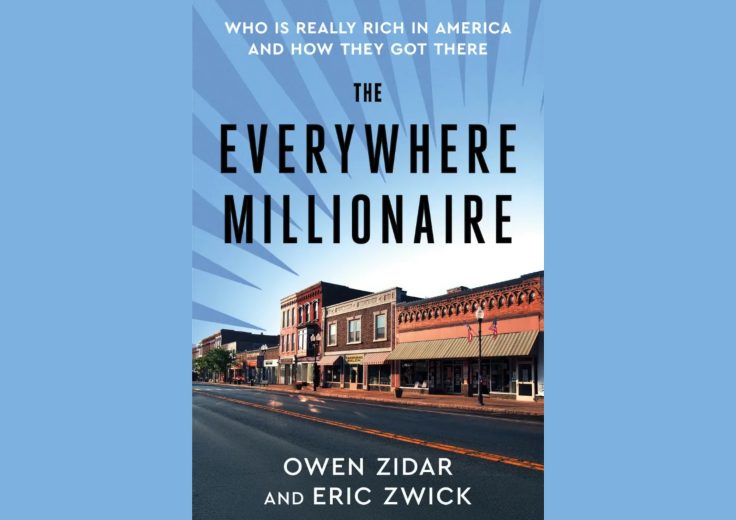
It’s not surprising that a lawmaker or executive focused on the nitty-gritty of governance has little patience for high-minded hectoring about what makes a market truly free. But it matters, and for a reminder of why, political leaders would do well to pick up The Everywhere Millionaire, a deft survey of America's roughly three million "Main Street Millionaires." By showing who is rich and how they got there, the book offers useful lessons about the benefits of free-market competition and the consequences of crony capitalism.
Owen Zidar and Eric Zwick, Princeton and University of Chicago economics professors, came to Washington in 2014 after finishing graduate school. Working out of the Treasury Department’s Office of Tax Analysis, they reconciled siloed government databases to get a better picture of who owned America’s private businesses and how much of their money the state took.
After nearly a year in the bowels of the Treasury Building, Zidar, Zwick, and another researcher built a dataset that linked millions of private businesses to their owners and workers. Whatever the Obama administration’s policy motivations, the work provided the foundation for illuminating research.
First, Americans have a distorted view of wealth in their country. Centibillionaires and sometimes trillionaire Elon Musk understandably draw attention for their massive fortunes, fame, and influence. The collective wealth of the Main Street Millionaires is 13 times that of the wealthiest 400 Americans. The sheer number of rich Americans is astonishing, even inspiring. There are more than 1,000 private business owners worth at least $25 million for every CEO of a large publicly traded company. For every member of the Forbes 400, there are 25 rich auto dealers spread around the country.
Much of this wealth is concentrated in mundane businesses organized as pass-through firms: the partnerships, sole proprietorships, S corporations, and limited liability companies that have become "America’s dominant form of business." Millions of professionals now organize their firms as pass-throughs that don’t pay corporate or dividend taxes. The tax advantages of pass-throughs invite understandable debate. Also intriguing is the tremendous diversity of the businesses and the people behind them.
Legal services, the most lucrative field, generated $109 billion in pass-through income for owners in 2021. Yet it was closely followed by "financial investment activities" like venture capital and private equity at $104 billion. The list from there varies dramatically: auto dealers ($50 billion), management consulting ($46 billion), real estate or restaurants ($24 billion each), and building equipment contractors ($14 billion), among others.
A crucial difference between Main Street Millionaires and the ultrawealthy is geography. Rather than concentrating in a few supercities, the quotidian rich can be found across every region of America. The authors go on a "road trip" to meet them, and their redistributive sympathies become obvious. (There’s no shortage of details about gaudy mansions and the pools or golf simulators therein.) Yet the college professors can’t help but admire entrepreneurs who "usually provide valuable goods and services. They meet customers’ needs, employ many workers, and form connections with clients, suppliers, and the community."
A widow overcame the pain of her husband’s suicide and built a hugely successful frozen food company. The founder of a popular fast-casual restaurant chain fended off competition by generously compensating loyal employees. There are countless other stories about how ingenuity and hard work allowed a range of entrepreneurs to succeed in a competitive environment, benefiting themselves and countless customers and workers. Zidar and Zwick even offer a nuanced take on the contributions of private equity, an industry too often willfully misunderstood in America.
No one would mistake this text as an uncritical paean to American capitalism as it exists. While many Main Street Millionaires demonstrate the extraordinary wealth-creating power of competitive markets, others lean heavily on state power to squelch competition and defend their monopolies or cartels.
Larry Summers once quipped that "large coalitions of small businesses are more evil than small coalitions of large businesses." Zidar and Zwick show why.
Consider the typical beer distributor, whose "stranglehold on local beer sales didn’t come just from operating more efficiently—state laws guarantee it by preventing breweries from selling directly to retailers and requiring that all beer flow through a middleman with exclusive territorial rights." Meanwhile, auto dealers receive artificial protection from state franchise laws that block competitors and prevent brands from closing dealerships. Even highly skilled doctors rely on medical boards to inflate their incomes by preventing other qualified medical professionals from performing simple procedures.
Patients wait longer and pay more. Cars and repairs cost more. Beer drinkers have fewer and more expensive choices. These are easily fixable policy failures. The problem is that "in each case, the harms are diffused among millions of consumers. The benefits, however, are concentrated among a distinct number" of the large coalitions of small businesses that Summers warned about.
Together, these groups often prove more politically powerful than even some of the country’s richest individuals. Musk donated hundreds of millions of dollars to Republicans in 2024 and became close with President Donald Trump. No doubt he had tremendous influence for some time. Yet he was among the biggest losers from the One Big Beautiful Bill Act of 2025, which rolled back electric-vehicle and clean-energy subsidies crucial to his businesses. Traditional auto dealers, meantime, benefited from pass-through provisions, SALT-cap loopholes, and a new deduction for car-loan interest.
This doesn’t mean reform is impossible. Dozens of states have undone overly onerous occupational licensing laws against the wishes of powerful lobbies. There’s no reason that beer distribution monopolies need to be as inevitable as death or taxes. It might not be an exaggeration to say the future of capitalism is at stake.
The distinction my interlocutor dismissed is anything but academic. America’s system of wealth creation remains robust, but its success or even survival is not guaranteed. Politicians who conflate being pro-business with being pro-market risk turning the public against both. Every special privilege granted to an incumbent makes it easier for a new generation of political entrepreneurs to argue that capitalism should be outright replaced rather than reformed. The only thing more dangerous than a socialist is a socialist with a decent point.
The Everywhere Millionaire: Who Is Really Rich in America and How They Got There
by Owen Zidar and Eric Zwick
Henry Holt and Co., 368 pp., $32.99
Adam O'Neal is a journalist in Washington, D.C.