


Back in January, the New York Times was recommending tighter sanctions against Iran. Now that President Trump is taking the paper's advice, the newspaper suddenly has decided it's a bad idea. It makes the Times look silly—as if it has no principled or reasoned Iran policy but rather simply reflexively opposes whatever Trump does.
Our story begins on January 14, 2026, after Iran's terror-sponsoring regime killed tens of thousands of pro-democracy protesters. The Times mustered a staff editorial with a strong headline: "Iran's Murderous Regime Is Irredeemable," that was actually fairly good for a New York Times editorial. It declared "The Iranians demonstrating against their government are displaying awe-inspiring bravery," and said "The appropriate response from the rest of the world starts with a unified expression of solidarity with the protesters. The Khamenei regime is too depraved to be reformed. It has had plenty of chances to choose a different path." It faulted Iran for its "misogyny," its discrimination against gays and lesbians, its support of "the terrorist proxies of Hamas, Hezbollah and the Houthis."
Among the editorial's recommendations were "diplomatic, economic and potentially military" measures that "have the best chance to strengthen the protest movement and sow division among elites allied with the Khamenei government."
The economic leg involved sanctions. Said the Times editorial, "The world can also extend the sanctions it has imposed on Iran. The Trump administration this week announced new tariffs on any countries that do business with Iran, and other democracies should impose their own economic penalties. Europe can play a vital role. European leaders have sometimes been naïve about the nature of Iran’s government, and they should step up now. Mr. Trump, for his part, should drop his thorough hostility toward Europe, including his ludicrous ambition to seize Greenland, and recognize the strength of a unified alliance."
The editorial went on, "One potential policy involves targeting all significant officials in the Khamenei government, and close to it, with individual sanctions and asset seizures. They should know that they will be isolated forever, without the ability to do the luxury shopping and tourism many enjoy, unless they break with the regime. The goal should be to create competing pressures on Iran's elites and split them. Such moves would make good on Mr. Trump’s promise to the protesters that 'help is on its way.'"
Now that President Trump and his Treasury Secretary, Scott Bessent, are literally doing, with Operation Economic Outcast, what the Times editorial told them to do, the Times news section is rolling out a campaign of articles explaining why it is a terrible idea that almost certainly won't work and may even be counterproductive. It almost makes you think what's driving them is not the substance of Iran policy but knee-jerk opposition to Trump.
The drumbeat of opposition to the Iran sanctions included a news report by Times reporter Michael Crowley in the August 27 print newspaper. It asserted that Trump's "demands that other nations stop doing business with Iran underscore the difficulty in trying to impose sanctions on Iran's economy to the point of collapse."
It went on, "Thoroughly enforcing sanctions is notoriously hard, and in Iran’s case would require messy run-ins with allies and powerful rivals capable of retaliation, most notably China. Imposing a full ban on global trade with Iran, as Mr. Bessent called for, only multiplies those challenges. Mr. Bessent himself admitted doing so could roil the global economy."
Crowley continued, "Those factors help explain why U.S. officials are still struggling to strangle Iran’s economy despite the mountain of sanctions Washington has heaped on the country over the past five decades ... All that provides reason for skepticism about Mr. Trump's latest plan for coercing Iran through economic pain."
Where were the worries about enforcement and roiling the global economy back in January when the Times was editorializing in favor of this approach? When it was the Times plan rather than Trump's plan, the skepticism was absent. The Times news and opinion pages are technically separate, though both report to publisher A.G. Sulzberger, and they share a revulsion to Trump that is widespread among college-educated salaried employees in coastal cities.
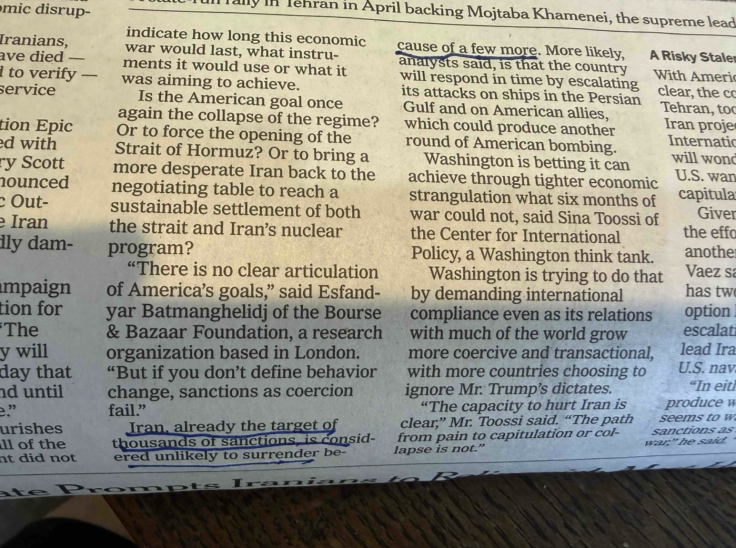
A "news analysis" by Steven Erlanger that ran on page one of the Saturday, August 29 print Times recycled Crowley's point for any readers who might have missed it the first time around. "Iran, already the target of many thousands of sanctions, is considered unlikely to surrender because of a few more. More likely, analysts said, is that the country will respond in time by escalating its attacks on ships in the Persian Gulf and on American allies, which could produce another round of American bombing," Erlanger wrote. "Is considered" is one of those classic passive voice constructions that Times editors and reporters use to slip their own opinions into the newspaper. Quoting "analysts" to give the reporters' and editors' opinion while maintaining a veneer of journalistic objectivity is another trick of the trade.
The analyst that gets served up is "Sina Toossi of the Center for International Policy, a Washington think-tank," who declares, "The capacity to hurt Iran is clear … The path from pain to capitulation or collapse is not." Erlanger might as well have just directly quoted his colleague Crowley from a day before about "the difficulty in trying to impose sanctions on Iran’s economy to the point of collapse," rather than laundering the point through some think tank analyst.
Erlanger is based in Berlin, a place where the fall of the Berlin Wall and the East German Communist regime it symbolized might reasonably engender some humility about the endurance of brutal tyrannies.
It all looks difficult and unclear until suddenly the dictatorship collapses. That happened to Bashar al-Assad, whose Syrian regime was subject to U.S. sanctions. It happened to Mikhail Gorbachev, whose Soviet Union crumbled in part because of the Jackson-Vanik Amendment denying trade benefits to Moscow. It happened to Nicolás Maduro in Venezuela, whatever concerns people may have about what followed. Venezuela had also been subject to U.S. sanctions.
Sure, sanctions alone won't do the trick. But many of the same people opposing Trump and Bessent's sanctions against Iran are also among the first to credit divestment for toppling the Apartheid regime in South Africa and also to advocate for economic warfare against Israel. It suggests the real driver of reaction to the policy is less the efficacy of economic measures and more how people feel about the administration being targeted or imposing the sanctions.
I'm not so cynical as to think the Times newsroom is desperate to prevent a successful Iran regime change (and concomitant drop in gas prices) before the October 27, 2026, Israeli election or the November 3, 2026, U.S. election. But if the economic pressure does help decisively to defeat "Iran's Murderous Regime" between now and then, it'll be something to celebrate. At that point, if the Times editorial board, or Crowley and Erlanger, are looking for "analysts" to explain how the unlikely outcome came to fruition—well, we'd be happy to suggest some sources. Or just the underlying principle, which is that as much as brutal dictators determinedly cling to power, once the people rise up with "awe-inspiring bravery," when America and Israel both decide to help, things can move quickly in the direction of freedom.