





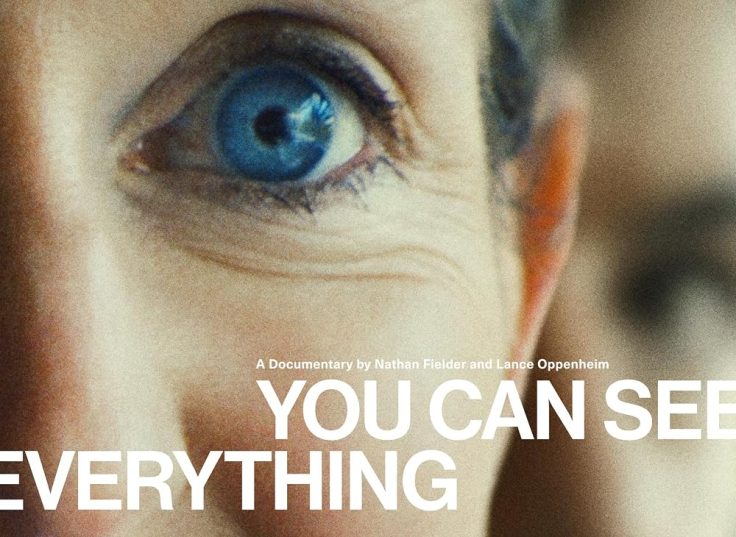
You Can See Everything is nominally a documentary about the medical-tech fraudster Elizabeth Holmes and the 34 days she spends with her family before she is finally compelled to begin her 11-year prison sentence in 2023.
I say "nominally" because by the time it's over, 2 hours and 54 minutes after it begins, what we've experienced is an entirely different movie—and one hell of a movie it is, the most memorable experience I've had in a theater this year besides The Odyssey and Obsession.
You Can See Everything is, on the surface, nothing special. There are versions of it released every week on the streaming services—it's a "you are there behind the scenes with a notorious person" true-crime story. The first half is set in a rental house Holmes is sharing with her boyfriend Billy Evans and two small children on the beach in San Diego. Holmes and Evans have sought out the uncategorizable deadpan HBO fixture Nathan Fielder to document these days—Fielder, whose two nonfiction series Nathan for You and The Rehearsal are comic tests of the boundary lines between reality and fakery.
Holmes and Evans tell Fielder they will make their own lives an open book to him as her freedom comes to an end. First indicted in 2018, she stayed out of court and out of prison due to the COVID pause in trials and incarceration in 2020 and 2021. Oh, and not only that. There was the matter of the two extremely convenient pregnancies she conceived with Evans that allowed her to argue for compassionate treatment so that she could deliver and nurse the babies and raise them a little bit before hitting the hoosegow.
Her first trial was delayed so she could deliver her oldest, and even after her conviction and sentencing in 2022, Holmes was allowed to remain free for another six months before entering the Texas prison farm where she is currently serving her time. Those two (admittedly adorable and cherubic) kids and COVID bought her years of freedom that would have been denied a less famous, less well-resourced, and—let's face it—less astoundingly canny and nervy defendant.
Interestingly, almost none of this is explored in any detail by Fielder (working with the director Lance Oppenheim). He has been brought in to get up close and personal with Holmes and Evans. They want her to have a receptive ear into which she can "speak her truth" to someone willing to think "outside the box." We all know that, time and again, true crime podcasts (like The Serial) and documentaries (like The West Memphis Three) have succeeded in creating populist groundswell on behalf of convicted murderers and felons and have succeeded in getting cases newly adjudicated.
That's what Holmes and Evans surely wanted, without saying so, and they have turned to Fielder because Evans knows Nathan is an awkward weirdo who likes to follow Emily Dickinson's admonition to "tell all the truth but tell it slant—success in circuit lies."
And boy, do Fielder and Oppenheim tell this movie slant. About halfway through, they turn You Can See Everything into a work of metafiction—the term we use to describe any creative work that turns around and makes the work itself the subject of the story it's telling. But the ironies here are so bottomless that this work of metafiction then turns into a critique of metafiction, a parody of metafiction, and a commentary on the factitiousness of documentaries altogether.
It's effing amazing.
Simply put, the second half of You Can See Everything makes it clear that the real subject of this film isn't Elizabeth Holmes. It's Nathan Fielder. Or rather, a character named "Nathan Fielder" being played here by the director-interrogator-performer named Nathan Fielder. Once Holmes disappears from view because she is serving her sentence, he becomes obsessed with the question of whether she ever knew her boyfriend had negotiated profit participation in the release of You Can See Everything behind her back. If she did, that means she lied to him. If she didn't, maybe Billy Evans is playing her.
This is an important detail, because Fielder shows us how Holmes says flatly in the movie's first half that she doesn’t care about money. She also says that she has never, not once in her adult life, lied. Ever. Not even a white lie. Not even an "oh, I'm sorry, I can't come to your party because I'm sick" kind of lie.
"Her mind works differently," the love-besotted Billy insists. Yeah. The question is, is Holmes profoundly autistic, or is she, as Fielder wonders later, "the most manipulative person on the face of the earth?"
He determines that the only way she could possibly be innocent of the charges for which she was convicted would be the result of her overly literal reading of language. For example, she tells Fielder that the system she created to "disrupt the $60 billion blood testing industry" functioned perfectly. It was just the "chemistries" that weren't ready yet. So she said the machine worked when it didn't. Theranos did work—her system talked to the cloud, and when the cloud would see what the machine sent up, it would determine which tests the machine should run on the blood, send the tests back, and voilà—the $60 billion blood-testing industry was being disrupted forever! She deserved to be a billionaire by 21!
The problem was the chemistries, you see. In other words, the actual blood being tested and its viability. The at-home Theranos device that pricked your finger and got the blood sample needed to be able to store and keep pristine the patient's blood. That part never worked, and probably could never have worked, because blood congeals too quickly and becomes unusable for analysis. Holmes says the machine was great, it was the chemistries that weren't—as though the blood being tested wasn't the be-all and end-all of the process. Nobody needed the Theranos system to talk to the cloud and then have the cloud talk back to you. We can already do that. It's called email.
She knew it didn't work, but she told her investors it did. What she did was send out testing materials to 40 ordinary Walgreens drugstores in Arizona. They ran conventional tests and sent her back the results. Since the patients tested in this way were not harmed—they got the medical information they needed—she was acquitted of defrauding them. But there was no question the people who threw $1 billion in investment capital at her were led to believe those results were generated by the Theranos system—which, again, never worked and likely will never work. It is to those investors that she now owes $452 million in restitution, and the con job she played on them is what has bought her 11 years in jail.
Fielder isn't all that interested in telling the story of the fraud. What he wants to know is if Holmes herself believes she is telling the truth.
And here's where the movie becomes something you've never seen before, because Fielder radically changes gears. (From here on out I have to add a spoiler alert, because the movie's impact relies on some of these surprises.) What begins as a true-crime documentary about a case of fraud suddenly turns into a film noir. And it is filmed deliberately to look like one. In the second half, the lighting gets very dark and shadowy, the staging gets paranoid and jumpy, the music becomes tense and jangly, and all in service of shifting the focus to Nathan Fielder the truth-seeker and what he is so desperate to uncover.
He turns into a detective, albeit a postmodern one—a hangdog middle-aged Jewish guy from Canada who barely even knows how to smile but nonetheless functions as a 21st-century version of the tough-guy cop Dana Andrews from Laura or the tormented neurotic private dick James Stewart in Vertigo. Both these characters are in love with women they believe are dead.
Indeed, the gorgeous Bernard Herrmann theme music of Vertigo literally takes over the soundtrack for about 30 seconds as Fielder is driving down a road in Connecticut—a short sequence parallel to the famous (and far longer) tracking shot of Stewart driving through the streets of San Francisco in pursuit of an elusive dame who looks just like his lost love.
Then there's the role played by Fielder's interlocutor in the second half of the movie, the person with whom he talks at length about whether Holmes believes she is innocent (I won't say who or why she is). Like the Kim Novak character in Vertigo, this interlocutor serves as a stand-in for Holmes in a way that makes her increasingly uncomfortable. Novak was forced to dress like the lost woman of Stewart's dreams; Fielder's interlocutor is told to repeat words into a microphone to make herself sound as much like Holmes as possible.
The question the movie seems to be posing at its end is whether, in the course of making You Can See Everything, Nathan Fielder has been seduced by Elizabeth Holmes. And there's the rub. Because he drops clues from beginning to end that the seemingly ingenuous Holmes is playing him. From the first minute he meets her, she is unsettlingly direct and focused. She stares into his eyes, unblinking, and trembles a little, and she speaks quietly and intensely. Ever heard of the term neuro-linguistic programming? It's as though, through voice and look and comportment, she is forcing her will on his, compelling him to believe her.
When she tells him that she has never ever lied: She. Just. Stares. And stares. As if pushing this reality into his head while she speaks what is clearly a totally demented thing to claim.
Holmes also flatters Fielder by acting as though she cares about him, even when she barely knows him. Only mere minutes into their conversation, she tells him she thinks he would be a good dad. He says that made him feel good. When she hears he's had a breakup, she tells him from prison that she knows he will find someone.
By the end of the movie, Fielder is openly expressing his sympathy for Holmes's plight. And we cannot help but share the emotion. How else would you feel while watching an ingenuous young woman holding and nursing her baby while tears fall silently from her eyes as she realizes what she is about to lose? How would anyone feel listening to her getting the tea over the phone on what an "invasive strip search" is like? The way Fielder and Oppenheim have cut and staged the movie, Holmes is not the villain of the piece. Rather, it's her consort Billy Evans, who is made to look like a controlling and delusional lunatic.
At one point someone calls Evans "bats—t crazy." That's in part because he defends Charlie Kirk (my Upper West Side audience sputtered with typical UWS scornful laughter) and in part because he says with bulging eyes that what Elizabeth Holmes will be known for in history are the "monuments" she is building "to their love."
That is crazy, without a doubt, as is their plan somehow to launch Theranos 2.0. But then, Billy Evans has every right to be bonkers. He stood by Holmes's side as she went through trial and conviction and jail and is alone with two children in Austin as he awaits her release from prison. He loves her, he wants to believe she is innocent, and he is suffering the torments of a single dad whose children's mom is in prison. The last time we see him, he tells Fielder he has not been able to touch the love of his life for 899 days, with thousands more to come, and yet, he insists, they are more in love than ever. Both of them profess to him that they converse inside their heads with their beloveds and know exactly what the other is feeling and thinking.
So this is a very brilliant bit of storytelling. Because Billy's membership in the cult of Elizabeth helps explain implicitly just how it was this 30-year-old managed to con Rupert Murdoch (to take one example of her marks) out of $125 million. Her ingenuousness, her seeming nerdy unworldliness, making herself into a female visual analogue of Steve Jobs—all of this, all of it, was central to her con. And Billy, like Doyle Lonnegan in the greatest of all con-job movies, The Sting, is the ultimate mark, because he's a believer in the long con—he is left innocent of the knowledge that he was taken as he cuddles his children and begins to fear unknown people for unknown reasons are tailing him everywhere.
So, too, Fielder. He never breaks character—and that's the point, because in this movie, he is a character. In fact, he's the lead character, not Elizabeth Holmes. Fielder and Oppenheim build to a conclusion in which we are led to believe Nathan has basically fallen in love with her. In portraying himself (surely falsely) in this fashion, Fielder is recapitulating the process by which Elizabeth Holmes acted on the weaknesses and desires of men to perpetrate one of the nerviest frauds in American history. He shows how she won people over, how she got what she needed, and how even, in her disgrace, she still has the power to seduce. What an achievement this movie is. There's never been anything like You Can See Everything and there never will be again.