

Maps and arrows. Too often they are the principal gist of military histories—recounting the movement of armies, ships, or aircraft. Such accounts frequently delve into technical descriptions of weaponry brought to bear. While some punctuate with anecdotes from individuals involved, those recollections are commonly offered by generals and admirals, colonels and captains.
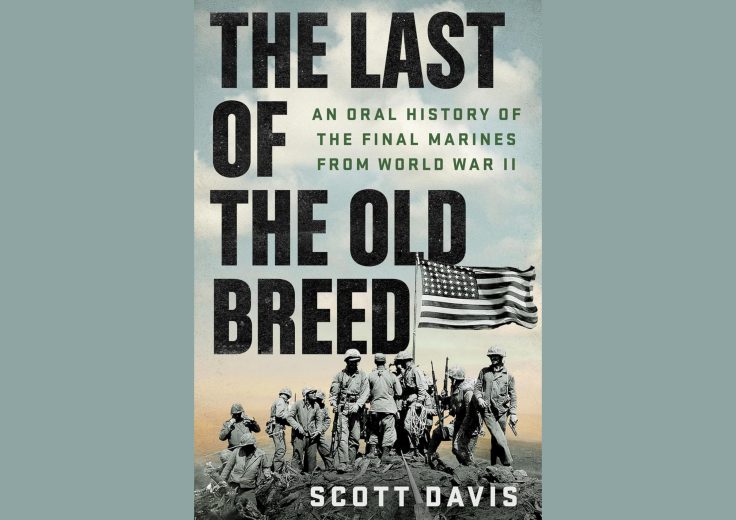
Scott Davis takes an alternative tack in The Last of the Old Breed, employing oral history to present an intensely human—while still remarkably comprehensive—primer on the United States Marines' actions amid the Pacific island-hopping campaigns that led to our nation's success in the Second World War.
The work draws from lengthy, thoughtful interviews Davis conducted with 130 former enlisted Marines and junior officers—some now centenarians, others in their late 90s—who took part in the 1941-1945 combat that cemented the Marine Corps' reputation for achieving hard-won victories in the face of daunting odds. Those who had taken part in the earliest fighting differentiated themselves from later arrivals by claiming the title "the Old Breed."
War stories are odd things, of course—subjective, potentially colored by memories fading over time and by a teller's perception of a listener's willingness or ability to comprehend. Leo Tolstoy made the point in War and Peace. A character in the novel describes a cavalry engagement "just as those who have taken part in a battle generally do describe it, that is, as they would like it to have been, as they have heard it described by others, and as sounds well, but not at all as it really was." Had the young soldier not described the action in such fashion, Tolstoy suggested, listeners "would either not have believed him or, still worse, would have thought that [he] was himself to blame since what generally happens to the narrators of cavalry attacks had not happened to him."
The Last of the Old Breed in large measure avoids such pitfalls. It benefits from the combination of a listener earnest to understand—Davis—and the candor that liberates humans in their final months.
The resulting anecdotes are painstakingly collated, chronologically laid out, and elegantly connected by brief, easy-to-follow battle synopses. They allow one to imagine the fear, chaos, grueling battle, and constant presence of death interviewees experienced on battlefields ranging from Guadalcanal to Okinawa.
The recollections describe wartime savagery unleashed by friend and foe alike—in detail many of the veterans interviewed would not have shared earlier in life. Immediately after the war, many kept quiet, some trying to bury post-traumatic stress. Others demurred because the nation to which they returned wanted to forget the fighting. "When I came back, nobody cared," one veteran explains. "'Oh, yeah? You're back? Fine.' No big celebration, because in those days, everybody was at war. Every family had a husband, wife, or child in the service. Or they'd [because of wartime rationing] given up their gasoline, sugar, or coffee." While the popular lionization of "the greatest generation" in later decades brought laudable recognition, it also led some veterans to sanitize descriptions of wartime experiences. Junior high school students, another of the veterans notes, "don't need to know the gritty part."
It can be argued that, as engaged citizens, the rest of us do. And it is the gritty part that makes The Last of the Old Breed stand out. One senses that some who have not experienced combat will find certain anecdotes shocking.
For instance: "The flamethrowers would go up to the caves and fire napalm gas inside and [Japanese soldiers would] come out screaming and on fire—and we'd shoot them." Happening across the corpses of fellow Marines beheaded and otherwise mutilated by the swords of enemy officers. Or enough recollections of Marines cutting gold teeth from the mouths of dead Japanese soldiers to imply that such desecration was not an anomaly.
The remembrances of course include the treacherous beach landings, brutal artillery barrages, and up-close Banzai attacks Marines encountered during their years-long trudge to war's end. They also, though, describe life before and after combat overseas—to include recurrent nightmares some say remain a burden.
The Last of the Old Breed is an impressive addition to World War II histories by any measure. It is particularly so given that it is the work of a historian just a few years out of college. Scott Davis's commendable—and nearly lifelong—dedication to gathering the recollections of World War II veterans was invaluable to the creation of this worthy compilation.
In documenting these unstinting memories, Davis honors not just those who survived to share them, but also the more than 24,000 Marines who—"Old Breed" though they may have been—died young on island battlefields.
The Last of the Old Breed offers useful understanding of the full cost of combat, even in what has come to be regarded as the best of wars—while leaving readers in awe of what it took those wearing the U.S. uniform at the time to prevail in the Pacific.
The Last of the Old Breed: An Oral History of the Final Marines from World War II
by Scott Davis
St. Martin's Press, 336 pp., $30
Chas Henry served as an active-duty U.S. Marine from 1976 to 1996, rising in rank from private to captain. He is author of Fuji Fire: Sifting Ashes of a Forgotten U.S. Marine Corps Tragedy.