




At a time when most royal biographers (myself, alas, included) tend to major in snark and intrigue when it comes to Britain’s most beleaguered family, it is that major-domo of probity Hugo Vickers who is on hand to restore integrity and balance to historical and social dissection of the Firm. He assures us early in this biography of Wallis Simpson—published in the United States to tie-in with the new film The Duchess and I, in which none other than Joan Collins plays the ailing Duchess of Windsor and for which, inevitably, Vickers has done duty as historical consultant—that "I had been acutely aware of Queen Elizabeth II from an early age." This might not seem an especially impressive boast—so had most people—but Vickers, who was a pupil at the royals’ neighboring school of Eton, was able to witness both the Queen and her disgraced uncle, the Duke of Windsor, up close, thanks to his access to Eton’s St. George’s Chapel.
Vickers is not a self-effacing figure. Denied entry to Trinity College, Cambridge, "the first time I had failed at an important step in life," he escapes his father’s blandishments to join the "thriving stockbroking firm Vickers, daCosta," at which of course papa is a senior partner, to take up a freelance position writing for Burke’s Peerage. In this capacity, the 20-year-old Vickers heads off to the Windsors’ Parisian home of, appropriately enough, Villa Windsor, but any hopes he had of being inveigled into their circle are soon dashed: "I saw neither of them," he writes, sorrowfully, although "there was an undeniable air of excitement" because his idol the Queen was visiting.
Vickers may have wished to be a guest at the Windsors’ dinner parties—"I longed to say that I would come and be the spare man"—but propriety intrudes. He is sent out of the house back to the "rather brassy" InterContinental hotel, his task accomplished. In fact, although Vickers was not to know this at the time, Edward lay on his deathbed, dying of the throat cancer that would eventually kill him on May 28, 1972, condemning his notorious widow Wallis to a long and lonely half-life until her own death on April 24, 1986.
By this point in the book, the casual reader might be forgiven for thinking Vickers himself is as important a figure in the narrative as the Duke and Duchess of Windsor. This book was originally published in Britain in 2011, but feels like a throwback to a far older, far more forelock-tugging era, when the royals were the subject of respect simply because they were royal, rather than because they had done anything in particular to merit such adulation. Vickers, who has also written well-received books about Cecil Beaton, Vivien Leigh, and Greta Garbo, is an unapologetic admirer of all things monarchical—he has publicly denounced the factual inaccuracies in Peter Morgan’s Netflix series The Crown—and Behind Closed Doors is not one for the irreverent.
Set against this, Vickers’s access to court circles and knowledge of privileged private information allows him to offer tidbits of insider information that cumulatively offer a bleakly fascinating look firstly at the long, slow decline of the Duchess of Windsor, and secondly at the circumstances under which she became the most notorious woman in the world, courtesy of a potted biography. It is the first section, entitled "The Death," which is the more diverting, and depressing. The Duke leaves the scene on page 22 ("he was home at last," one onlooker sighs) and then, for the next couple of hundred pages, Vickers follows the hapless Wallis into her lonely grave. As he writes, "How very much better it would have been for the Duchess of Windsor to have followed her husband swiftly to his grave at Frogmore."
A villain soon appears, in the formidable form of Wallis’s Parisian lawyer Maître Suzanne Blum. As Vickers writes of her, "They had nothing in common, whether in background, temperament, style, mutual interest or anything else." It is the dynamic between them—"one of the most sinister relationships ever formed between lawyer and client"—that gives this initially reverential book its dramatic impetus, as the near-satanic Blum, Wallis’s "captor, spokeswoman, keeper of the flame and of the keys," gradually assumes complete corporeal and financial control over the ailing, helpless Duchess.
It was said of Wallis that she was "definitely on the way out" in 1976, but she somehow lasted another increasingly miserable decade, during which she was beset by worsening mental and physical health. Vickers depicts Blum’s machinations in understandably appalled detail as the lawyer assumes power of attorney, sold the Duchess’s possessions, and kept her alive at a time when, as Wallis’s friend (and fascist) Diana Mosley observed, "a good doctor would have put her to sleep." When she died, finally and mercifully, a rogue’s gallery including Blum and the "phony pharaoh" Mohamed Al-Fayed saw to it that the Windsors’ possessions were sold in the so-called sale of the century at Sotheby’s, realizing over $45 million, against any wishes that she had had in her lifetime.
This half of the book is rich in detail—sometimes exhaustingly so—and Vickers’s waspish dismissal of rival biographers, most notably Michael Bloch, makes for engagingly bitchy reading. If Behind Closed Doors had stopped there, this would be a useful, if self-regarding, account of a neglected period in royal biography.
Yet there are still another two hundred pages to go that fill the reader in on Wallis’s early life, her meeting with Edward, the abdication crisis, and their later lives together. These are similarly closely researched but, in a crowded field, do not stand out particularly—Anne Sebba’s more readable Wallis biography That Woman remains superior—and leave the exhausted reader all but begging for mercy.
Vickers also must deal with Edward’s Nazi flirtations post-reign, which he downplays considerably. He writes of the former king’s supposed fascist sympathies that "He was no [Nazi]. But he was naive, and having been brought up with people to advise him all his life until December 1936 he was hardly competent or equipped to deal with men like Hitler. Nor should he have undertaken this trip independently." All of which is perfectly true, but it also ignores Edward’s wartime near-treachery, which Vickers calls "both difficult and foolish, but … not disloyal." Other interpretations are available.
By the time Vickers includes appendices about who sat where at the Duke and Duchess funerals and which aristocratic English families the Duchess was distantly descended from, only the most obsessive—or prurient—monarchist is likely to care.
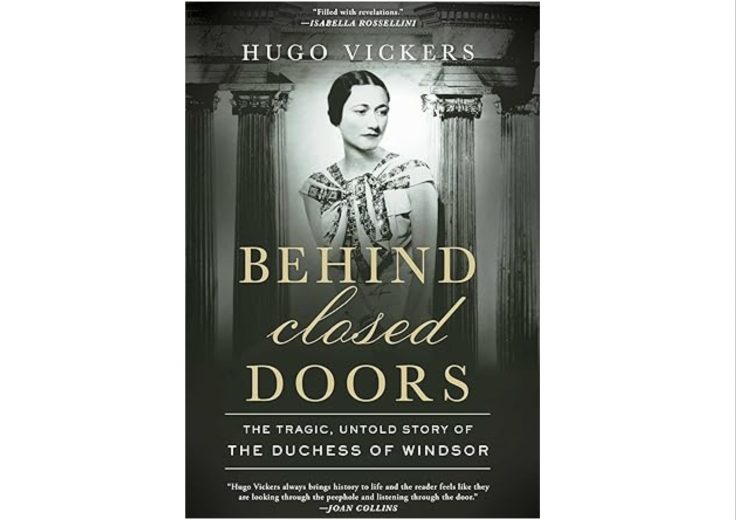
Behind Closed Doors: The Tragic, Untold Story of the Duchess of Windsor
by Hugo Vickers
Pegasus, 463 pp., $29.95
Alexander Larman is a journalist, historian, and author, most recently, of Lazarus: The Second Coming of David Bowie.