


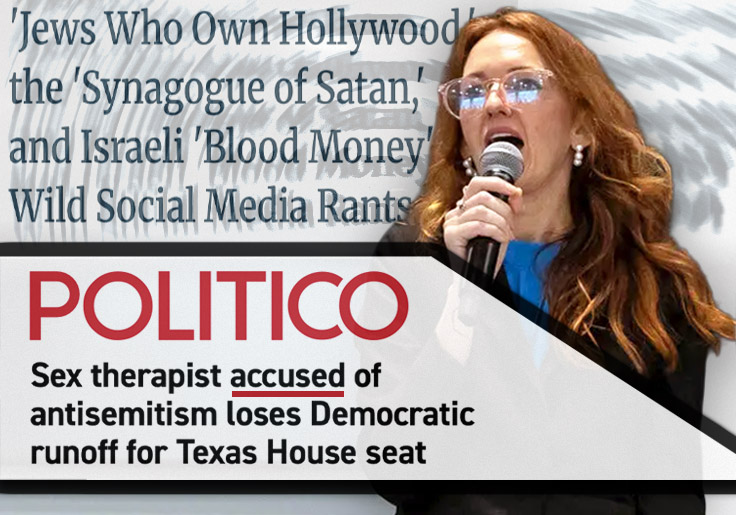
Maureen Galindo, the kooky San Antonio sex therapist and Democratic House candidate who lost a primary runoff this week after receiving the most votes back in March, has made a series of comments most objective observers would describe as antisemitic.
In light of Galindo's past remarks about "the Jews who own Hollywood" and "worship Satan"—not to mention her recently announced plan to establish a "prison" and "castration processing center" for "American Zionists" and other "pedophiles"—even some mainstream media outlets have conceded as much.
Axios and CNN described Galindo's comments about Jews as "antisemitic." PBS observed that she had "repeatedly expressed antisemitic views." Democratic politicians largely concurred.
House minority leader Hakeem Jeffries (D., N.Y.) blasted Galindo as the "antisemitic and anti-American candidate." Rep. Alexandria Ocasio-Cortez (D., N.Y.) condemned Galindo for spouting "bigoted garbage" and endorsed her conservative, pro-Israel Democratic opponent, county sheriff's deputy Johnny Garcia. The endorsement did not sit well with antisemitic influencer Hasan Piker, who called it "ridiculous."
Nevertheless, some mainstream outlets persisted in their reluctance to describe a Democrat's rhetoric as antisemitic. The New York Times said the race had been "roiled by antisemitism accusations" in response to Galindo's "critical comments about Israel and its supporters." Days earlier, the Times noted that Galindo had "attracted national attention and anger" for vowing to castrate pedophiles—a group she said would likely comprise "most of the Zionists" she planned to imprison.
Politico described Galindo as being "accused of antisemitism," while noting the candidate had denied those accusations while claiming the Democratic Party was trying to "inflame [her] comments" to promote her "Israeli-backed opponent." Last week, Politico reported that Galindo had been "broadly condemned by Democrats over a string of comments they say are antisemitic," while again noting that she denied the allegations because her "last serious relationship was with a Jewish man," among other reasons.
Neither the Times nor Politico has been hesitant to use more assertive language when discussing Donald Trump, who has been condemned by critics over a string of comments they say are racist. In October 2024, Politico published a so-called analysis of the "increasingly dark, graphic imagery" of Trump's "xenophobic and racist rhetoric," which experts compared to Nazi propaganda.
Earlier this year, Politico asserted that Trump was "no stranger to racist rhetoric" after he deleted a "racist post" that contained a brief video clip depicting Barack and Michelle Obama as apes. The Times described the offending post, which critics pounced on to accuse Trump of racism, as a "blatantly racist" depiction of a trope used by "slave traders and segregationists to dehumanize Black people and justify lynchings."
The definitive framing has also accompanied stories involving Republicans of lesser prominence. In October 2025, Politico described obscure influencer Nick Fuentes's comments during an interview with Tucker Carlson, the former television personality, as "laced with antisemitism." Fuentes, like Galindo, has denied being antisemitic.
In March, Politico eventually acknowledged that it had featured a blatantly antisemitic cartoon in a roundup of the "best" political artwork of the week. The cartoon, drawn by former New Yorker cartoonist Sean Delonas, depicted Trump and Israeli prime minister Benjamin Netanyahu (with an enlarged nose) wearing blood-drenched Jewish prayer shawls aboard a "Ship of Neocons" with a blood-soaked money bag tied to the mast.
After the Washington Free Beacon reported on the cartoon, Politico removed the cartoon from its website and added an editor's note suggesting the image did not meet its standards because it "could be reasonably interpreted to rely on ethnic stereotypes."
Politico, a Virginia-based news blog located many, many floors beneath the Free Beacon's global headquarters, did not respond to a request for comment seeking its process for assessing whether a politician has made racist or antisemitic comments or if they have merely been accused of doing so.