

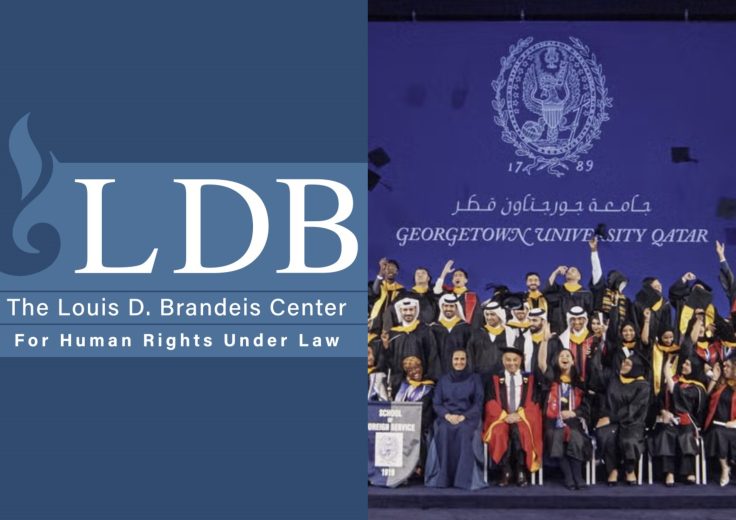
The Louis D. Brandeis Center for Human Rights Under Law on Thursday called on the Department of Justice to investigate Georgetown University in the wake of a Washington Free Beacon report on a contract requiring that Georgetown consult with a Qatari government group when selecting "themes and speakers" for events in Washington, D.C.
"It is now publicly reported in The Washington Free Beacon that Georgetown University ('GU') had a hitherto secret agreement between GU and Qatar that clearly violates the Foreign Agents Registration Act ('FARA')," the letter, sent to Acting Attorney General Todd Blanche and the DOJ's FARA Unit, reads.
"There can be little doubt that putting on a series of conferences to support the Qatari point of view falls squarely within the scope of [FARA]," the letter continues. "These so-called conferences and events are simply the presentation of speakers deemed acceptable to Qatar to promote Qatar's point of view in the United States. Indeed, by running the money through an ostensibly objective institution, it goes to the heart of what the law was originally intended to address—the secret creation of propaganda under the direction of a foreign nation."
FARA requires that entities acting on behalf of a "foreign principal" must register with the U.S. government. The Brandeis Center argued in its letter to the Justice Department that the contract between Georgetown and the Qatari government means the university should legally have to register as an agent of a foreign government.
That contract, the Free Beacon reported Tuesday, outlines a $630,000 grant from the Qatari government to Georgetown's Bridge Initiative, which the university describes as a "multi-year research project on Islamophobia" and is located on the school's Washington, D.C., campus. The contract, which Georgetown's vice president of advancement signed in June 2024, stipulates that Qatar will make three payments of $210,000 to the Bridge Initiative between 2024 and 2026 in exchange for Qatari oversight of the center's "conferences" and "events."
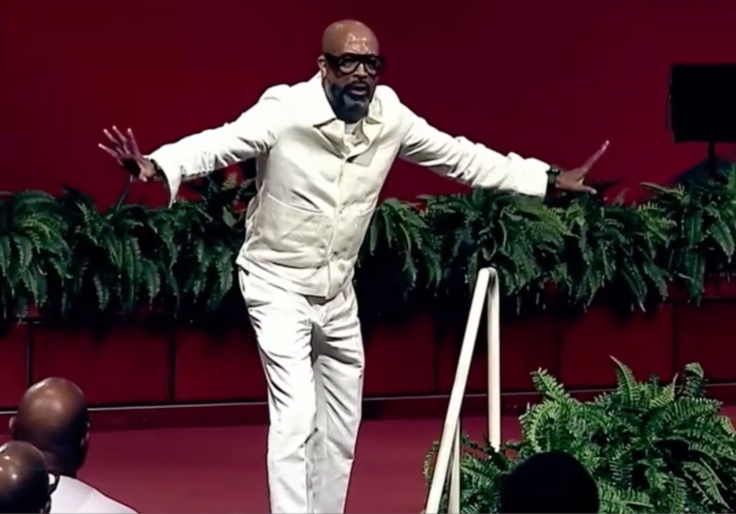
Though it is not clear which events fall under the contract, the agreement states that the university must "consult" with the Qatari "Islam and Muslims Initiative" over those themes and speakers for events. Georgetown's Bridge Initiative has boosted several individuals whom the Qatari government has also promoted, including Bridge Initiative advisory board member Dalia Mogahed and cleric Omar Suleiman—both of whom have endorsed terrorism against Israel—and Siraj Wahhaj, an unindicted co-conspirator in the 1993 World Trade Center bombing.
The Bridge Initiative has shared Suleiman's work in its daily newsletter, "Today in Islamophobia," sharing an essay calling to abolish ICE and an NPR interview with Suleiman on "the recent rise of Islamophobia and the impact it's having on the Muslim community in the U.S." The Islam and Muslims Initiative, for its part, produced an educational series featuring Suleiman, who has called for an "intifada" against Israel.
The Islam and Muslims Initiative hosted Wahhaj for a July 2024 talk at the National Museum of Qatar, and the Bridge Initiative defended the controversial imam from what it termed "'Islamophobic' attacks" after he met with then-New York City mayoral candidate Zohran Mamdani (D.) at his Brooklyn mosque in October.
The Islam and Muslims Initiative, which the contract requires Georgetown to "consult with" on events, does not have a large public profile. The group, based in Qatar's capital city of Doha, bills itself as "an [international] platform that connects Muslims and non-Muslims in the realms of religion, politics, media, academia and civil society." It received coverage in the Qatar Tribune in 2023 as a "strategic partner" of the Qatar Foundation's QatarDebate Center, but its website appears to be inactive and it has not posted to its Instagram account since November 2024.
Brandeis Center chairman and CEO Kenneth L. Marcus said in a statement that the contract between Georgetown and the Qatari government sheds light on how foreign countries can exert sway over colleges and universities in the United States.
"Qatar has spent untold amounts of money embedding itself in American higher education, and what this contract reveals is exactly how that influence works in practice: a foreign government quietly shaping what gets said and who gets to say it at events held in our nation's capital," said Marcus, who directed the Department of Education's Office for Civil Rights in two presidential administrations. "Our foreign agent laws are designed to address situations just like this, and we must ensure accountability in order to protect the interests of students."