





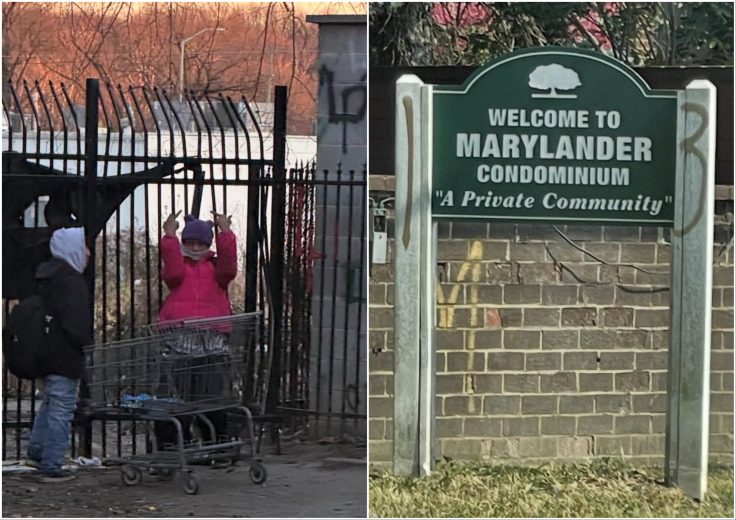
The Marylander Condominiums were in dire straits.
Residents of the 200-unit complex, located in Prince George's County, Md., were facing eviction after members of a nearby homeless encampment allegedly vandalized the boiler room, leaving 100 units without heat and in violation of local safety codes. The damage—which would cost at least $4.7 million to repair—had prompted building inspectors to deem those units "unfit for human habitation" in December and order their occupants to leave. Though most residents defied that order, a judge ruled on February 5 that police could begin evicting owners later this month.
It was the culmination of years of neglect by the most Democratic county in the country, where officials turned a blind eye as gangs, prostitutes, and homeless vagrants set up an open-air drug market on the doorstep of the condominium.
The situation made the Marylander toxic to lenders, who feared that it was all but guaranteed to default. Starved for credit and at risk of collapse, the condo finally found financing from a local institution, Mainstreet Bank, that agreed to lend on one condition: The county would have to guarantee the loan.
"The approval is subject to Prince George's County unconditional guaranty of the loan," the bank wrote in a term sheet on February 4.
But when the county took the condominium to court the next day, it refused to guarantee the loan.
At a hearing on the evictions ordered by the county's Department of Permitting, Inspections, and Enforcement (DPIE), property managers say, the department's deputy director, LaMont Hinton, took them aside and stated that the county would not serve as a guarantor.
He "outright refused to guarantee the loan," said Phil Dawit, the managing director of the condo's property management firm, Quasar Real Estate.
The exchange came after DPIE's citations had torpedoed a separate credit agreement with Mainstreet Bank, which rescinded a $2.5 million loan in December after the condemnation notices were posted. Now, with eviction set to begin as early as Thursday, the condo has no money to fix a problem for which property managers say the county itself is responsible, given its decision to sanction the condo for damage caused by the encampment.
"It's the actions of his department that jeopardized the financing we had to begin with," Dawit said of Hinton, who did not respond to a request for comment.
Kenneth Brown, Quasar's CEO, said he had contacted several other officials about securing the loan but received no response. Prince George's county executive Aisha Braveboy (D.) did not respond to a request for comment.
The fight over financing is a microcosm of how Prince George's County, where police have warned against "criminalizing the unhoused," exacerbated a homelessness crisis for which it is now punishing lawful home-owners.
Rather than arrest trespassers or clear the encampment, the county demanded that the condo pay for private security. It also lambasted residents for delivering food to the encampment, even as the county did just that via a "street outreach" program.
The result was an escalating series of citations that further strained the condo's budget. At the hearing authorizing the evictions, a judge also placed the condo on fire watch due to the risk of vandalism posed by the encampment. The complex must now pay for hourly maintenance patrols between the hours of 6 p.m. and 6 a.m., which will cost approximately $15,000 per month.
Without county backing for the Mainstreet loan, the condo's only alternative is government assistance. Brown, Quasar's CEO, said he is eyeing the Department of Housing and Urban Development's Section 108 program, which provides low-interest loans for development projects.
The catch is that the condo itself can't apply for the loan. The application must be submitted by Prince George's County—the very government that made federal assistance necessary.
Brown said on Friday that he had contacted three separate officials about applying but had not received a response. The county's Department of Housing and Community Development only got back to him on Monday after the Washington Free Beacon asked for comment, leaving him a voice message at 9:37 a.m.
"We understand that you've tried to reach our office with no success," the department's public information officer, Alexis Yeoman, said.
Less than 30 minutes later, Yeoman told the Free Beacon that she was still "waiting to hear back" from Brown after she had reached out to schedule a meeting.
"The Prince George's County Department of Housing and Community Development (DHCD) does not have a record of Mr. Brown contacting this office," she wrote in an email. "After your inquiry last week, DHCD reached out to Mr. Brown to set up a meeting and are waiting to hear back from his office … DHCD is prepared to review his concerns and provide a response with factual information."