


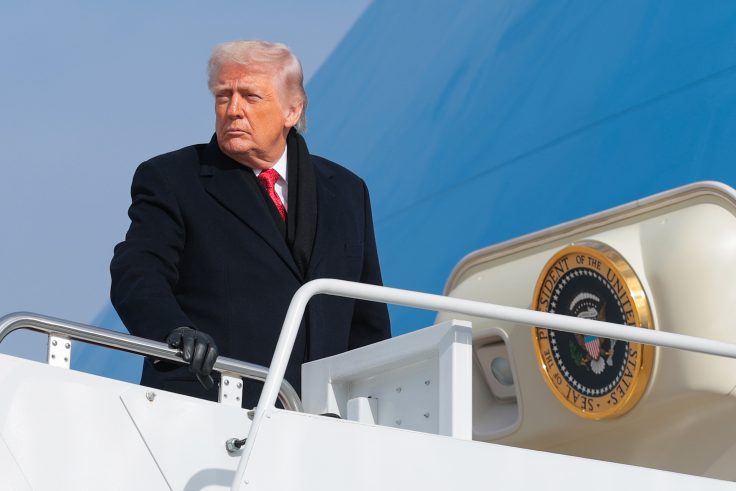
As a "massive armada" sails closer to Iran and President Trump gives its leaders one last chance to "quickly 'Come to the Table' and negotiate," the latest crisis in the decades-long standoff between the Islamic regime and the United States is coming to a head. Arab and Israeli officials are pounding the pavement in Washington—still only partially cleared from the recent snowstorm—and most other countries are helpless bystanders to an imminent eruption in the Gulf.
To some, these events mark the latest unraveling of the rules-based international order. The sight of a great power, untethered from any multilateral constraints, openly threatening a smaller one is exactly what they have devoted their careers to preventing. Ironically, this crisis reveals that despite his own preference for disruption and open disdain for settled conventions, Trump is one of the staunchest champions of one of the most important pillars of the post-Cold War order—nuclear nonproliferation.
For much of the past few decades, most democratic countries have adhered to a particular vision of global order. They preferred for nations to resolve their disputes by working through international bodies, such as the United Nations, and to smooth out the rough edges through intensive diplomatic processes.
Those processes might prove to be interminable and never actually resolve the dispute at hand, but the main goal of these diplomatic tracks was to keep the participants talking. Meanwhile, easing the travel of goods and people around the world would focus other countries on making money rather than using force. The journey, even if endless, was often more important than the destination.
Many Americans rolled their eyes at this, but the United States went along because it largely suited its interests. Keeping fierce rivals—like the French and the Germans, the Greeks and the Turks, or the Japanese and the South Koreans—at the conference table was infinitely better than having them resolve their differences the old-fashioned way. Enduring harangues from tinpot pipsqueaks was irritating, but welcoming potential rivals into multilateral bodies seemed cheaper than dealing with their military forays. And since Americans tend to dominate fair competitions, free trade made a lot of sense.
But the rise of unfriendly powers like China and the consequences of economic projects like mass migration became too much for the system to bear, and Trump rode his critique of this international project into the White House. He broke with the chattering class's preferences on most of these alleged rules, such as on trade, democracy promotion, and mass migration.
And yet his concerns about nuclear nonproliferation vastly exceed theirs. The destructive power of these weapons has alarmed him since the mid-1980s, and he is not overly enamored of multilateral processes or preexisting treaties. So, while many international elites shrugged at the glaring flaws in Obama's nuclear agreement with Iran, Trump tore it up and tried to pressure the mullahs into a better deal in his first term.
This helps explain why he sees Israel much more positively than most international elites do. By any serious measure, Israel is a nonproliferation superstar: It did develop its own nuclear deterrent, but unlike several other nuclear-weapons states, it has not exported the know-how needed to build the bomb. Instead, Israel's military set back Iraq's nuclear program by several years in 1981, crippled Syria's in 2007, and together with the United States devastated Iran's program last summer. Like Trump, Jerusalem does not rank an abstract commitment to diplomacy above the need to prevent the spread of the bomb.
That does not mean Trump is unwilling to use diplomacy. At this very moment, he is offering Khamenei another chance to peaceably denuclearize. One hand is outstretched, but the other wields a very big stick.
The usual crowd has taken a break from lamenting the outcome of World War II—an American victory—and is back to hyperventilating about the imminence of World War III. But there are strong reasons to think that further strikes on Iran's nuclear program would not trigger a regional war, let alone a global conflagration.
For one thing, despite his pronounced theological affinity for martyrdom, Ayatollah Khamenei has shown a marked aversion to practicing what he preaches. He is not eager to usher in a conflict that would end in his regime's destruction, and his own.
Trump, moreover, prefers short actions to attain limited objectives, which reduces the risk of a broader conflict.
As the old Pax Americana fades into the background, the new global scramble for power is becoming sharper and more perilous. Trump understands well that this kind of environment is dangerous enough without murderous fanatics gaining the ability to annihilate entire cities.