


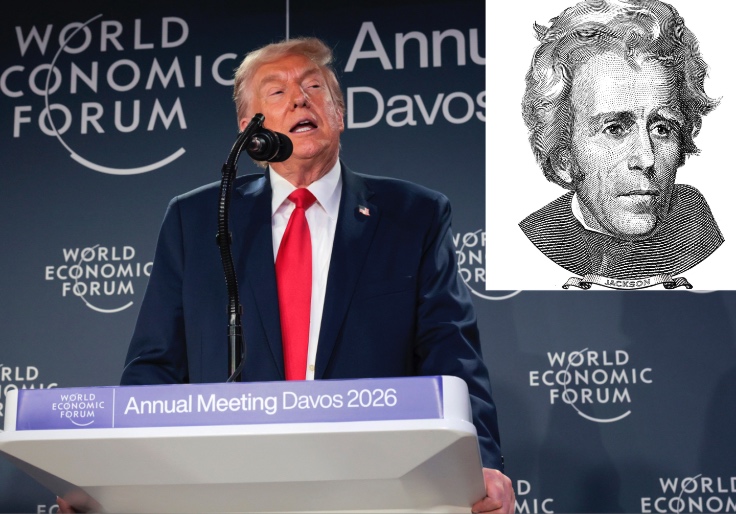
President Donald Trump, who keeps a portrait of Andrew Jackson in the Oval Office, brought a heaping dose of his predecessor's energy with him when he alighted in Switzerland on Wednesday.
The contrast between the international assemblage of sophisticates and the president from Queens brings onto a global stage one of the longest-running dramas in American political history. Mastering the forces unleashed by Jacksonian America is the key not only to Trump's presidential success, but also to the preservation and renewal of the American-led international order. If the announced agreement with NATO secretary general Mark Rutte holds, this act in the drama will end on a high note.
Each year, business and government leaders trek into the Alps to attend the World Economic Forum for earnest discussions about topics like carbon emissions. This gathering of the rich and powerful—and kooky panels about feeding insects to the global poor—fuel conspiracy theories worldwide. According to attendees, however, it is more like the ultimate business meet-and-greet extravaganza than a hive of international intrigue.
The real business of Davos happens away from the cameras, but in a sense it reflects the carnival of activists and poindexters who hog the microphones. The organizers hope to transcend national sovereignty and prod the world toward a future where citizenship matters less than commitments to their preferred moral standards. As climate change has become the international cause célèbre, the Davoisie have warmed to massive governmental interference in economics.
Trump stopped by to tell them this is all nonsense: "The USA is the economic engine on the planet," he reminded them. "The places where you come from can do much better by following what we're doing because certain places in Europe are not even recognizable, frankly, anymore." On green energy like windmills? "Stupid people buy them."
This contrast shocks many, but it should not surprise. This interplay between the well-heeled technocrat and the common man was the defining story of Jackson's political life, and it has burst forth again in the era of Trump.
Before Jackson entered national politics, an elite consensus emerged in the United States to build up, not grow out. Its adherents generally steered the country in a more technocratic direction rather than focus on expansion. They wanted high taxes on land sales to fund a government-directed modernization program, and the quasi-public Second Bank of the United States embodied their idea of progress.
The Jacksonians thought this was backward. They were hardly technophobes, but they preferred to double down on America's greatest comparative advantage—practically unlimited fertile land—and expand as fast as possible. Elected officials were meant to fend off America's enemies and keep pointy-headed bureaucrats out of the way, and banks were only as good as the terms of the loans they offered.
Trump largely thinks along these lines. He believes that "the explosion of prosperity, in conclusion, and progress that built the West did not come from our tax codes." He boasted about the red tape his administration has cut, marveled at the latest advances in artificial intelligence, and lambasted the Federal Reserve for keeping interest rates higher than he prefers. He also pointed out, "Without our military, which is the greatest in the world by far, without our military, you have threats that you would never, you wouldn't believe."
Of course the greatest controversy at Davos raged over Greenland. Trump wants to acquire the Danish-owned island and cited his concerns about Arctic security and missile defense. He ruled out seizing the island forcefully, which had stoked fears among America's allies in recent weeks, but he is exerting a lot of pressure. He posted Wednesday that he and Rutte reached an agreement that "will be a great one for the United States of America, and all NATO Nations."
If so, this would be in line with one of Jackson's greatest successes. Jackson thoroughly despised his political opponents, but some of his greatest accomplishment came with them. He teamed up with diplomatic superstar John Quincy Adams to pressure Spain into selling Florida to the United States. This removed a national security threat and gave southeastern Americans access to waterways they needed to export to international markets.
Jacksonian energies are tremendously powerful, and they can destroy as easily as they can build. Jackson's war on his central bankers ultimately led to an economic crash. Florida turned out well, but later conquests heightened the tensions over slavery and brought about the Civil War. Despite these ups and downs, the United States emerged from the chaos as the dominant power in North America.
Trump is doubling down on America's strengths and trying to talk sense into the Davoisie. If he can do this and keep America's allies on board, his portrait will hang in the Oval Office long after he leaves it.