



After the death of Hulk Hogan this past summer amid 17-time champion John Cena’s final year wrestling, countless WWE fans debated who is the greatest wrestler ever. Who can blame them? Fighting over who is the GOAT is as American as apple pie.
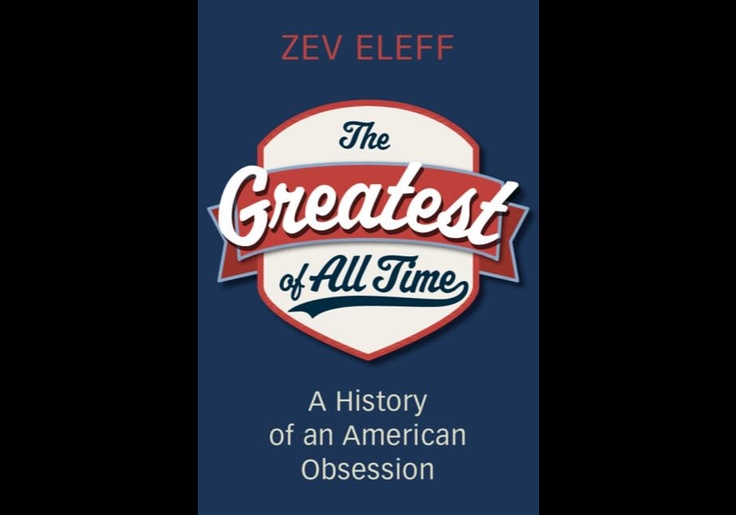
As Zev Eleff details in The Greatest of All Time: A History of an American Obsession, the United States stands uniquely fixated over such rankings, though they have in the past few decades lost a bit of their popularity.
Eleff, president of Pennsylvania’s Gratz College, begins his learned and entertaining study by recounting how on May 8, 1973, Pelé came to visit President Nixon in the White House. "You are the greatest in the world!" Nixon exclaimed. The New York Times’s headline, "A Quick and Awkward Meeting Between a President and Pelé," tells you all you need to know. The Brazilian soccer star, who knew little English at the time, handed Nixon a rolled-up newspaper clipping recapping an earlier encounter they had had and hurried through their brief exchange.
"The history of greatness discourse," Eleff argues, "provides a uniquely American language for participants to discuss their ‘ideal’ values and make meaning." Advocating for one person’s greatness as compared with others actually reflects "more about those carrying on the conversation than it does about the famous people under discussion."
That is because greatness has no objective standard. Is Shohei Ohtani better than Babe Ruth? Why, because the former pitched for more years than the latter? But Ruth has had hundreds more homers, and everyone knows homers are the best part of baseball! Does Michael Jordan outrank LeBron James simply because he won more championships, despite James scoring more career points? Was Henry Ford a great American despite his virulent anti-Semitism? Good luck resolving these or countless variations of such conversations.
What accounts for the American proclivity for weighing greatness, the belief that an individual’s accomplishments transcend one’s field and enter a higher ground, heavenward? The concept is "intuitive to Americans’ collective understanding" and tied to the concept of change, Eleff argues. "Americans," with their liberal, revolutionary spirit, have historically "fawned over changemakers, social disrupters with designs to transform the status quo." Contrast that not only with South Americans but with Europeans, who long favored "established traditions and status."
Eleff’s most fascinating chapter details America’s first Hall of Fame. Henry Mitchell MacCracken, NYU’s chancellor from 1891-1910, is credited with inventing the idea. His university’s Hall of Fame for Great Americans opened in 1901. The philanthropist Helen Gould donated the funds. Controversy ensued over who merited inclusion in the pantheon. Originally, only native-born candidates were eligible. The Caribbean-born Alexander Hamilton was thus disqualified. Women had a separate hall of fame, founded in 1904.
In the inaugural class, George Washington’s selection was unanimous (somehow Lincoln’s was not, though he made the cut). Americans took pride in the notion that "their statesmen—Washington, Franklin, and Jefferson—could rival the legacies of England’s and France's ruling classes." Robert E. Lee made it—after all, the argument went, he was a great general, albeit on the wrong side of history. Authors Emerson, Hawthorne, and Longfellow were also part of the initial cohort.
Years later, Edgar Allan Poe got the call, but only after great debate. He came in second among voters that year, behind Harriet Beecher Stowe. Foreign-born citizens only began being inducted in 1915. The hall operated for seven decades (businessman Andrew Carnegie was in its last class) and has now largely been forgotten.
Other chapters of the book trace the rise of great figures both real and imagined, including Charlie Chaplin and the cartoon figure he inspired, Mickey Mouse—whose greatness would be superseded in the public eye by Donald Duck and Bugs Bunny.
Eleanor Roosevelt was mourned by Martin Luther King Jr. and Israeli prime minister Golda Meir as "the greatest woman in the world," after refashioning her image from earlier decades as a reforming feminist to that of "an idyllic wife and mother," carrying on the work of her late husband. This despite well-documented accounts of infidelity by both her and FDR.
The Babe, the Beatles, and Muhammad "I am the greatest thing that ever lived!" Ali, who trademarked G.O.A.T Inc., of course, each get their own comprehensive analyses. The latter pushed against the boundaries of palatability as an American great by joining the Nation of Islam and refusing to serve in the Vietnam war.
Eleff concludes by lamenting the death of valuing transcendent greatness today. "Einstein was the greatest Jew since Jesus," one Cambridge scientist once put it. "It’s just God disguised as Michael Jordan," the not-too-shabby Larry Bird proclaimed of his competitor at the peak of the latter’s powers. Today, no one worships at the altar of LeBron. His greatness is contained to his sport (unless you count Space Jam 2, and I don’t).
Listicles bear a brunt of the blame for the recent decline of the belief that any one individual stands head and shoulders above us mere mortals, the author argues. He cites Allan Bloom’s stated belief—during the Jordan era, no less—that America "now wants everyone to feel comfortable in his skin without having to suffer unpleasant comparisons." Today’s "list production is not at all interested in great symbolic exemplars. On the contrary, they seek to provide a menu of options for readers to consider, perhaps mix and match attributes, and to find in the many complex personalities something unique, even great, about themselves." We now want to see in celebrities not rare air, but relatability.
Social media personalities have therefore replaced transcendent figures who actually contributed something to society. Citing the German sociologist Leo Löwenthal, Eleff identifies these "self indulgent" Instagrammers and their ilk as "idols of consumption," famous due to their influence, "not meaningful achievement."
In an op-ed published after the release of Eleff’s book, the Wall Street Journal’s Jason Gay, reflecting on Hogan’s passing, suggested a bridge between the heroes of old and today’s TikTokers. "Hulk understood a very old-fashioned wrestling concept: To be seen, it’s better to be outrageous. To be heard, you need to be loud. If it earns you love, great. But even if you are hated, you are still noticed. … Influencers, business antagonists, media flame-throwers, the performative fray of social media, the exhausting not-very-real ‘reality’ programming on television … there’s a little bit of wrestling in all of it."
The obvious conclusion to draw then, is of course, clearly, no one would disagree, that Hulk Hogan was the greatest of all time.
The Greatest of All Time: A History of an American Obsession
by Zev Eleff
Cambridge University Press, 238 pp., $39.99
Stuart Halpern, senior adviser to the provost and deputy director of the Straus Center for Torah and Western Thought at Yeshiva University, is the author, with Wilfred M. McClay, of Jewish Roots of American Liberty: The Impact of Hebraic Ideas on the American Story (Encounter).