

In January 2020, five months before the wave of left-wing activism unleashed by George Floyd's death, the writer Christopher Caldwell published a provocative book about the brewing cultural war. Titled The Age of Entitlement: America Since the Sixties, the book traced contemporary identity politics back to the Civil Rights Act, which, in Caldwell's telling, had created the enforcement apparatus for modern progressivism.
It was civil rights law, Caldwell argued, that spawned the HR bureaucracies that would become DEI. It was civil rights law that forced companies to censor speech that could create a "hostile work environment," and civil rights law that had given rise to racial quotas via the concept of disparate impact. Conservatives often contrast the color-blind standard articulated by civil rights luminaries with the racial preferences embraced by their successors. For Caldwell, there was a direct line from the former to the latter.
The Age of Entitlement initially divided the right. But as the Biden administration sought to institutionalize cultural progressivism—in part by using the civil rights bureaucracies Caldwell had criticized—what began as an outré thesis soon became passé in conservative circles. Center-right scholars published essays, legal articles, and books on the connection between anti-discrimination law and "wokeness," including transgender issues and the rise of DEI. A new consensus seemed to be emerging among conservative intellectuals: "Woke institutions," as the writer Richard Hanania put it, "is just civil rights law."
But six months into President Donald Trump's second term, that nascent consensus has been shattered. The Trump administration has launched an unprecedented campaign against diversity programs, affirmative action, and transgender initiatives—and its weapon of choice has been the civil rights state.
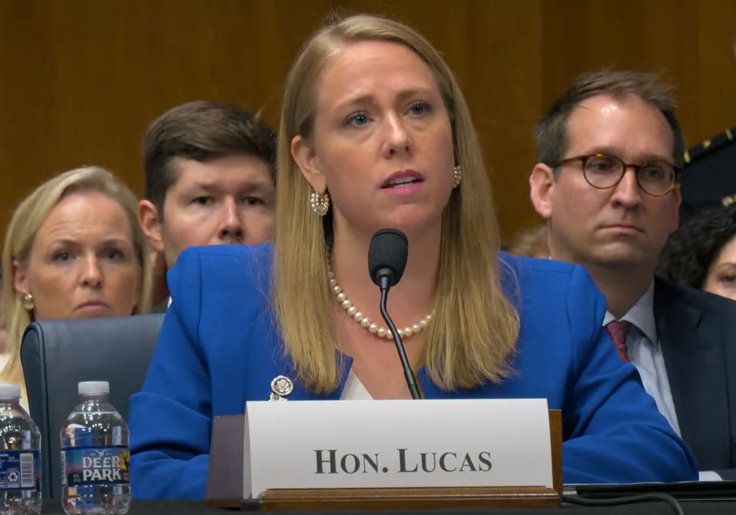
A key wielder of that weapon has been Andrea Lucas, the acting chair of the Equal Employment Opportunity Commission. Appointed as a commissioner in the final year of Trump's first term, Lucas, a Republican, remained on the EEOC throughout the Biden administration and was tapped to lead the agency in January of this year. Since then, she has gotten top law firms to ditch their DEI initiatives, opened an investigation of Harvard University, and obtained a $21 million settlement for Jewish employees at Columbia University. She has also pledged to protect American workers from "national origin discrimination" and defend the biological definition of sex.
Lucas was confirmed by the Senate last week for a second term as EEOC commissioner. Now, in an exclusive interview with the Washington Free Beacon, she lays out her priorities for the agency and the conservative case for civil rights.
Lucas rejects the idea that anti-discrimination law has a built-in left-wing bias. The problem, in her view, is that conservatives "ceded the field to liberals," eschewing jobs in the civil rights bureaucracy and leaving it in the hands of their enemies.
"When the only people who use civil rights laws are leftists, the law will always trend left," Lucas says. "Conservatives did not realize how conservative civil rights law was and let the left skew it in all sorts of ways."
Lucas's goal is to right that left-wing skew. In her interview with the Free Beacon, which has been edited for length and clarity, she describes how she used her time in the Biden administration to lay the groundwork for Trump's assault on DEI. She argues that Republicans should embrace tools like the commissioner's charge, which allows an EEOC commissioner to launch a probe unilaterally. And she argues that a host of common practices—including the preferential hiring of migrant workers—are in fact unlawful under Title VII.
"We are going to make sure there are consequences if you break the law," Lucas says. "I hope people realize we're really serious."
The interview was conducted at Lucas's office in Washington, D.C.
Aaron Sibarium: When you became the acting chair of the EEOC this year, you promised to crack down on DEI, anti-Semitism, and gender ideology. How is that going?
Andrea Lucas: It's going great. We are operating on full throttle. We're really busy. We have a big docket. So much of that docket is confidential, but you can start to see from some of the things we've been putting out in the press that we’ve taken big, specific actions on each one of those fronts. With gender ideology, some of the biggest work will have to wait until we have a quorum [of EEOC commissioners] in terms of rolling back some things, but obviously, some of the actions we've already taken have made a lot of press.
[Editor's note: The EEOC needs a quorum of three commissioners in order to make policy. Following Trump's removal of two Democratic commissioners, Charlotte Burrows and Jocelyn Samuels, the EEOC's leadership panel only has two members. The nomination of a third commissioner, Brittany Panuccio, is pending before the Senate.]
One big win was having the Biden EEOC harassment guidelines on gender identity vacated by a federal court. I thought portions of those guidelines were unlawful and had dissented on them during the Biden administration. Another win was pulling back on a number of lawsuits to comply with the executive orders on gender identity/defending women. Some big picture reform has happened already in that space. And on anti-Semitism, the Columbia settlement is huge. It's super exciting to finally have that out in public. And then on DEI, we've put out new technical assistance documents and scored some major settlements with law firms. So, on each of those things, there's a lot of quiet work, but then there are also some nice, big public wins.
AS: You said that a lot of your docket is confidential. Some agencies, including the Department of Health and Human Services and the Department of Education, have been very vocal about their investigations, whereas the EEOC has been a lot quieter. Could you explain in more detail why the agency seems so hush-hush?
AL: This is really important. I very much want the public to understand that just because we're quiet doesn't mean we haven't been working. We just have a different statutory framework than some of the cabinet agencies. The Department of Education and Department of Health and Human Services have a whole different statutory framework. The Department of Justice also enforces Title VII, so we do share some jurisdiction there, but the DOJ is governed by different portions of Title VII. The part of Title VII that applies to the EEOC says that we have to keep our investigations confidential up until the point in which we have an actual resolution or the institution of a legal action arising out of the investigation. So, filing a lawsuit, filing a subpoena enforcement action, pursuing injunctive relief, announcing a settlement or a conciliation—when we've gotten to one of those parts, we can talk about it, but everything in the run up has to be confidential. Just because there's more noise about other agencies on an issue or matter doesn't mean the EEOC isn't involved.
AS: You were also an EEOC commissioner under President Biden. How would you describe the agency's priorities during that time?
AL: Well, I was also an EEOC commissioner for the last few months of Trump's first term. Then I continued in the long winter of the Biden administration. The advantage of being an EEOC commissioner is you run your own shop [your own commissioner's office and staff] and have a lot of unique authority. And I thought it was important, because of that, to stay on as a commissioner even though I knew it was going to be in hostile territory.
I was one of very few Trump appointees who remained throughout Biden's term. There were a handful of us in these multi-member commissions, but very, very few. I felt it was important to establish dissent and oversight and also tee up things for a new administration. I had to play the long game. And I did.
I've spoken a lot about how much I admire Justice Clarence Thomas. He was a former EEOC chair. Then when he got onto the Supreme Court, he was willing to dissent for decades and just stick with his principles and just keep on dissenting. I tried to take some courage from that and decided that it was worth it for me to be a voice in the wilderness [during the Biden administration].
AS: So as an EEOC commissioner, were your dissents mostly symbolic, or were there times where you were able to block some of the more extreme things that Biden's EEOC wanted to do?
AL: The dissents were neither of those things. I couldn't block the [majority votes of the] other commissioners, but the dissents were not just symbolic. They teed up and provided support for states to challenge the then-majority's overreach. For example, when states sued to block the EEOC guidance on gender identity [in the agency's Enforcement Guidance on Harassment in the Workplace], my dissent was cited by multiple lawsuits filed by various states, as well as the federal court which vacated the objectionable portions of the guidance.
AS: And what exactly was that guidance?
AL: In April 2024, after years of trying to get this off the ground, the Democrat majority on the EEOC voted to approve harassment guidance that effectively eliminated single-sex spaces at work. It took the position that it was unlawful harassment to demand that bathrooms and locker rooms be limited by sex as opposed to gender identity. It took the position that the use of pronouns that wasn't consistent with someone's so-called gender identity could be harassment. Basically, it was all of the things that Bostock didn't talk about, and I thought it wildly exceeded our regulatory authority. We don't have substantive rule-making authority under Title VII, but [the then-majority] basically took a bunch of positions and tried to regulate through this heavy-handed Enforcement Guidance that everybody viewed as effectively binding.
[Editor's note: Bostock is a reference to Bostock v. Clayton County, the 2020 Supreme Court case that held the Civil Rights Act protects employees from discrimination on the basis of gender identity.]
AS: And where did these overreaches come from? Were they coming from the Biden White House? Were they coming from some faction within the EEOC? Were they coming from outside NGOs? What was the most important force that was driving these overreaches?
AL: The sexual orientation and gender identity stuff has been a passion project for certain political appointees in the EEOC since the Obama era. It's really driven by the political appointees, who are in close contact with the White House. You have some people who started this movement in the federal sector in the Obama era, and then they expanded it to the private sector under Biden [via the harassment guidance].
AS: I want to underscore this point. It seems like you're saying it would be a mistake to ascribe some of the more extreme gender stuff to the so-called deep state. It was driven by political appointees making political decisions.
AL: Yes. It was not a bottom-up thing coming from the EEOC. It was very much top-down. The core political movement, the politicization of the EEOC, comes from the commissioner's offices, from the then-chair, from the White House.
And so, who's in the White House and who's leading the agency makes a gigantic difference. The leadership really, really can shift where the agency focuses, because we are an executive branch agency. Contrary to what many people on the left are saying, for the past 50 years the agency has taken the position, in consultation with DOJ, that we are an executive branch agency. And so, you do see swings between Democrat and Republican administrations, and that's not a surprise, right? My Democrat colleagues knew this was how it worked. It's why the agency got so radical when Obama or Biden were in office, and why we have a real opportunity to radically shift it back to first principles.
AS: Now that the political winds have changed, can you offer a rough approximation of how much of the EEOC's caseload stems from so-called reverse discrimination—that is, discrimination against whites and men—versus "old school discrimination"—that is, discrimination against women and minorities. Both of those things obviously go on, but could you gauge the relative prevalence of these phenomena?
AL: Based on our confidentiality rules, I can't say too much about that. We publish some high-level charge data, but we don't go into that level of granularity. I will also say, though, that a big problem with some of the things I have highlighted is not just underenforcement, but underreporting.
Anybody can look around the world and see that these things are happening on a large scale. For example, you don't have to be blind to know that anti-Semitism is surging in our country, especially on college campuses. But many people don't feel comfortable filing a charge, either because they're terrified of retaliation or because they don't think it will be taken seriously. That is a huge problem. It's important to keep in mind that charge numbers alone don't always tell you the full picture of how much discrimination there is in a particular area. And it's really important that people who see violations happening feel comfortable approaching us and filing a charge, because we're a charge-driven agency.
AS: What do you think is the biggest misconception that your liberal colleagues have about civil rights law? Or just the biggest misconception about civil rights that liberals have in general?
AL: Well, I think it's important to draw a distinction between liberals on the commission and liberals in the general public. My colleagues on the commission often didn't disagree about the state of the law, we just differed on what we emphasized.
I would frequently speak on panels and debate about DEI with one of my more liberal colleagues, and she really didn't fundamentally disagree with me [on the applicable legal principles]. When it came to DEI, she had a very different viewpoint about how she should spin it, or the messages she wanted to take away, but she conceded that the law is extremely restrictive about the use of race in employment decisions. I've never had any of my Democrat colleagues disagree with me on that.
But among liberals who aren't employment experts, there's this misconception that affirmative action in hiring was widely permissible. The best faith argument for how that misconception came about is that, before Students for Fair Admissions v. Harvard, people got the idea that because [under Regents of the University of California v. Bakke] you could use diversity as a plus factor in university/college admissions, you could also use it in employment. But that was never the law. I think a lot on the left either misunderstood this or aggressively exploited that misunderstanding. Whereas my colleagues on the commission understood the state of the law, but they were not interested in talking about it.
AS: What do you think is the biggest misconception that conservatives have about civil rights law?
AL: I think that for decades, conservatives have ceded the field to liberals. They thought that civil rights was always synonymous with woke, or they were interested in doing other things like building companies and industry—all good things.
But, without conservatives caring about civil rights law and talking about how it connects to first principles and the founding principles of equality and inherent dignity, there was a big vacuum, and wokeism arises in that vacuum. When the only people who use civil rights laws are leftists, the law will always trend left, and it affects the development of law. It affects companies' risk assessments. So, I think that's the biggest misconception. Conservatives did not realize how conservative civil rights law was and let the left skew it in all sorts of ways. Even though it could have been a neutral, bipartisan thing.
AS: But what some conservatives argue is that civil rights law has a built-in left-wing bias. Christopher Caldwell traces the origins of the modern DEI bureaucracy back to the compliance departments set up in the wake of the 1964 Civil Rights Act. Gail Heriot, who's a member of the U.S. Commission on Civil Rights, wrote a paper arguing that the roots of wokeness lay in the 1991 Civil Rights Act, which let plaintiffs recover monetary damages from hostile environment complaints. And in an essay on the link between DEI and civil rights, the writer Richard Hanania noted that your own agency sued Dollar General in 2019 for conducting criminal background checks that had a disparate impact on black applicants. What's your response to these arguments?
AL: There are a couple responses. First of all, if tomorrow we woke up and Title VII was gone, corporations would not suddenly go back to not discriminating against people. They would continue doing it. The current culture is one in which the companies, not the government, are driving the DEI insanity. The corporate culture is so bought in with DEI, and has been for the last four years, that removing civil rights law would never solve the problem here. If anything, civil rights law is the only way to push back on it.
Because, again, I do view Title VII as a fundamentally colorblind statute. It was written in a way that was a bipartisan compromise, and it protects all races and both sexes. It's very different from the Americans with Disabilities Act, which only protects disabled employees, and the Age Discrimination in Employment Act, which only protects older workers. But Title VII doesn't say we're only protecting "historically underrepresented minorities." It's protecting everyone. And the EEOC, actually, in the '60s and '70s, led in that space and held in various application decisions that Title VII also applied to white employees [as well as other races] and applied equally to men and women. And the Supreme Court then adopted that framework in the McDonald v. Santa Fe Trail Transportation Company case in the '70s.
So, the agency actually has been leading in color blindness for a long time. I do agree disparate impact has caused a lot of problems, and I fully support the president's executive order encouraging and directing agencies to deprioritize disparate impact. The Civil Rights Act was designed to go after intentional discrimination, and it makes sense to tell agencies to focus on the cases where we have someone intentionally discriminating.
AS: You said earlier that conservatives haven't wielded the tools of civil rights law effectively, leaving a power vacuum in their wake. But then why shouldn't conservatives use disparate impact as a tool? Suppose a firm is hiring disproportionately few whites and Asians relative to their share of the population. Why not bring a lawsuit arguing that the racial imbalance is unlawful under disparate impact theory?
AL: I think that would be morally wrong, and I don't think we need to do it, either, strategically. Again, I believe in the founding principles of civil rights law, which is that all men are created equal. I think we should be focused on an equality vision, just as a moral matter. And then, separately, I don't think you need disparate impact to attack statistical imbalances arising from DEI, because that’s intentional discrimination.
We already have tools to go after discrimination. The main one is pattern or practice liability, where you use statistics as evidence but are driving toward a theory of intentional discrimination.
AS: But presumably, for that to be distinguishable in any substantive way from disparate impact, the statistics alone can't generate liability, right? They can only be used as one piece of evidence for intent.
AL: You'd have to have anecdotal data [supporting statistics in a pattern or practice case] under the Teamsters model. But there's no question we have that right now, right? You've got lots of corporations that went out of their way to announce their intent to everyone—to their investors, their employees, their managers. They went out of their way to share demographic information from HR, breach the firewall, and hand it directly to the hiring managers. You've got not just anecdotal-level data, but per se, facial violations everywhere.
AS: But suppose there's a world where, because your agency is so effective at stamping out the really obvious DEI programs, companies get better at hiding their discriminatory practices. Race-based hiring decisions are still made, but with a wink and a nod rather than a paper trail. There are no more race-based fellowships. They stop putting DEI targets in writing. They don't have compensation schemes that link bonus pay to hiring quotas.
The only real evidence of discrimination is (a) the statistical disparities that raise an eyebrow, and (b) the knowledge that, some years in the past, companies were doing unlawful DEI. How would you approach a case like that, where the kind of per se evidence we have now is no longer available?
AL: Well, if all of those things happen, I think that the administration could take something of a victory lap. It would mean that we've cleared out a lot of really overt, egregious discrimination. That would be a tremendous place to be at. And then, if we get to a point where people still have concerns, there are many different ways you get evidence of discrimination. It's not just policy documents. It's also investigatory work—interviewing witnesses, for example. It's why a lot of our work is human capital-intensive. Almost all of the budget of the agency is our staff, including our investigators, who will interview people and assess their credibility.
AS: Could AI help with that? In principle, I could imagine AI being used to interview far more people and process more complaints.
AL: I am deeply skeptical that AI can do investigatory work. I think that AI can help us automate routine things and streamline routine processes. It could help us analyze data. But in terms of making a sophisticated judgment about credibility, I'm skeptical.
We're basically a civil police department. A lot of our investigators are former law enforcement officers, veterans, or firefighters. They are trained to know how to assess credibility, to pick up on minor shifts in tone of voice or behavior. I wouldn't trust AI to do those things. I think that you really need to have a human touch there. But there are, of course, lots of routine things that can be made more efficient by technology.
AS: I want to go back to the question of statistical evidence for a moment. When you see racial disparities in a labor market, there are typically two explanations: it could be that there's discrimination in the relevant labor market, or it could be that one group is simply outcompeting the others for meritocratic reasons. I assume you favor the second explanation in at least some cases. But how do we get people to accept that explanation in a culture shot through with egalitarian assumptions?
AL: I think it's really fact-specific. The disparity can be due to a host of reasons, but sometimes it is due to discrimination. It just varies.
I do think that when we focus more on intentional discrimination than disparate impact, it can be easier to isolate the root cause of the disparity. For example, one reason why some groups might not compete as well in a particular marketplace could be due to different levels of literacy. If we weren't trying to fix the problem on the back end by using the Band-Aid of disparate impact, we might focus more on education and literacy gaps and end up with a better front-end input.
The other thing I want to say is that numbers can mask things and hide problems. When you only focus on disparate impact and whether some diversity goal has been met, it doesn't matter whether workers are doing well qualitatively, or whether discrimination has actually occurred to any individual person. All that matters is the group's outcome.
Let's say you [an employer] have an employee who is constantly harassing black workers, but as long as you keep doing affirmative action, your overall representation numbers "look good." Your representation looks fine, but you're not fixing the qualitative problem, which is that there's rampant harassment.
DEI was not only morally wrong, but it was lazy. It missed how discrimination can manifest in all sorts of ways. We ignored discrimination against white and Asian workers, and we probably also had people who were ignoring discrimination against black workers because they didn't care about the individual person. They just cared about the group outcome.
AS: This reminds me of Goodhart's law. Bureaucracies need ways to measure their success, but any measurement they choose will eventually become a target in and of itself. And as a result, they end up missing the reality on the ground.
AL: Justice Thomas talked about this when he was chair of the EEOC. He talked about how goals and timetables were an easy out for employers, because a company could pay a little money to boost its number of minority employees on the front end via affirmative action in hiring—even if there was still a ton of discrimination or harassment of current employees going on. It was cheaper for companies to do affirmative action in hiring than to pay money to specific victims of discrimination. Thomas criticized that practice, and that’s something I’ve taken inspiration from.
AS: Disparate impact is one way in which you might trace wokeness back to civil rights law. Hostile environment is another. Conservatives argue that this form of liability leads to the policing of offensive speech, including the sort of corporate cancel culture we saw in 2020.
In response to those cancellations, the journalist Zaid Jilani proposed making political views a protected trait under civil rights law. Do you agree with that?
AL: I don't know if I know enough about the debates over whether or not to make political speech a protected trait. I know that D.C., for example, does use that as a protected characteristic. I generally would say I wouldn't want to add more protected characteristics as I think it goes down a rabbit hole.
But I would also say that in 2020, there were a lot of people who suffered hostile work environments, who were conservative, and who could have brought hostile work environment claims but didn't. If you don't use the tools that are there, the left is always going to use those tools. Hostile work environment is a longstanding Supreme Court precedent that is not going anywhere. And so, faced with that reality, you can complain about it, or you can use it.
AS: The EEOC uses a "reasonable person" standard to determine whether some conduct is offensive. But that inquiry is not values-neutral. It relies on normatively loaded assumptions about what is and isn't offensive and how "reasonable people" think.
Isn't this a First Amendment problem and a content-based restriction on speech? I realize hostile environment law is here to stay, but do you have a substantive defense of the doctrine beyond that?
AL: I'm a realist and a pragmatist. All of the civil rights laws, even in the '60s, stirred up debate about freedom of association and freedom of speech, and we have made a bipartisan decision as a country that we're going to have these laws and rules. That's pretty settled. So now the question is, okay, now that the tools exist, what are you going to do about it? If conservatives don't exercise their rights under the laws that are there, the statutes become weaponized because only one side uses them.
AS: You've promised to apply these principles of hostile environment law to anti-Semitism and the workplace disputes that have arisen amid the Israel/Gaza war. Obviously, people disagree about what constitutes anti-Semitism. So could you give us a big-picture overview of how you would apply hostile environment law in these cases? What's the line between protected speech and workplace harassment?
AL: A lot of that is going to be fact-specific. But at a high level, I can say that the standard is severe or pervasive. Whether or not you've met that standard will depend on a constellation of facts.
I am sensitive to the concerns about free speech. I think the way to avoid getting too close to that line is to focus on the clear-cut stuff that involves crimes like assault, bomb threats, etc., or other conduct that violates neutral time, place and manner requirements.
The First Amendment doesn't give you the right to say whatever you want, whenever you want, at whatever time or decibel. That's not controversial. You can have debate, but in order to have an orderly debate, you do need some neutral rules that apply to everyone.
And what we saw on many of these college campuses is that they had some rules, but they were not applying them evenly. So when Jewish students wanted to invite a speaker to campus, they had to follow 10 steps and all this paperwork, and they still got shut down. But when the protesters wanted to do something, they didn't fill out the paperwork. They showed up in the middle of the night or breached a classroom.
All of these things were obvious, facial violations of policies. You don't have to get anywhere close to the First Amendment line to say it's discrimination or harassment if you're allowing them to break your neutral rules or engage in crimes.
AS: Or subjecting different students to different procedures for the same activity.
AL: Yes. Or not following your standard disciplinary procedures. We saw so many schools that were not investigating Jewish students' complaints or Jewish employees' complaints. We saw schools that were giving some people slaps on the wrist and other people a much stronger investigation. That's disparate treatment.
AS: Your agency was involved in the Trump administration's deal with Columbia University, which is going to have to pay $21 million into an EEOC claims fund for victims of anti-Semitic employment discrimination. The deal also requires Columbia to pay $200 million to settle Title VI claims, which your agency doesn't enforce, against the university. What, in your view, are the most significant aspects of the deal?
AL: I think the overall deal covers a lot of different roots of wokeness at Columbia, so it's a tremendous win for the whole of the government. For my own agency, we're really excited about the $21 million. To be clear, it's not an EEOC fine. It's operated by a third-party claims administrator and is a standard remedial fund. No portion of it will go to the EEOC. All of the money goes to the victims.
That's really important, because a lot of people don't know how the EEOC works. And it's really, really exciting to be able to give money to people who suffered harm.
AS: That's part of the deal because you initiated a commissioner's charge.
AL: Yes. During the Biden administration, I opened a commissioner's charge in spring 2024, and so the investigation was already teed up. It sat for a while, but we were able to move aggressively on that once Trump took office. And because I had already done a lot of the legwork, we were able to recover for a really big class. The class covers literally every Columbia employee affected by anti-Semitism.
AS: So going back to what you said before, the deal is an example of how, as a dissenting commissioner, you were able to lay the groundwork for the next administration.
AL: Yes, because I had unilateral power under Title VII to file a commissioner's charge. It's a rarely used tool, but a really powerful one. And I think some prior iterations of Republicans in this agency have not been willing to use that power, even though it's very clearly in our statute.
AS: And I take it progressives were fine with using that tool?
AL: They were, yes.
AS: Some Jewish alumni have argued that the deal doesn't go far enough to ensure a comprehensive transformation of Columbia's culture. And a few have even accused this claims fund of being a kind of payoff, a way to get the Trump administration off Columbia's back without actually solving the problem. What's your response to those criticisms?
AL: I think this is a big, super meaningful deal. The government is never going to be able to completely run a university. That can't be and is not the goal.
The goal is to say, in our role as a federal enforcer, that we are going to make sure there are consequences if you break the law. If we're talking about a department that doles out federal funds, there will be consequences for whether or not we fund you. If we're talking about the EEOC, there's going to be a financial cost if you discriminate against your employees. If you engage in or permit rampant anti-Semitism, there's a cost to that, and that cost isn't going to us, it's going directly to the victims.
AS: I want to end with a few questions looking ahead. You've launched an extraordinary effort to crack down on racial preferences, not just at private companies but in higher education. How are companies and universities attempting to circumvent your efforts?
AL: I don’t know how much I can say about this, other than that I hope people realize we're really serious. Again, even in the Biden administration, I tried to use my bully pulpit as much as possible to inform companies about the state of law. They've been hearing it from me for a few years now. But it's even more important for them to take it seriously now that it's the Trump administration.
AS: One way I've seen institutions try to get around the law is by strongly encouraging certain groups to apply. They'll say that a fellowship is open to all races, but add that blacks and Hispanics are strongly encouraged to apply, which they don't say about other groups. Is that kind of disparate encouragement itself a potential Title VII violation?
AL: It could be part of a fact pattern to show that there was discrimination. It certainly could be evidence, I think, though again, it will depend on the specific fact pattern.
The EEOC has guidance on race discrimination on our website. That guidance says that you should not be expressing preferences for any particular race. And that's pretty obviously what you're doing when you are encouraging particular groups to apply and singling them out. It certainly implies a preference, at best, if not something even more overt.
AS: We've been talking a lot about your efforts to go after DEI. I think some liberals will read this conversation and come away worrying that the culture war is your only priority, that you're going to train all of your fire on DEI but let other forms of discrimination off the hook. What would you say to someone concerned about that? Is the EEOC still going to investigate "old school" discrimination?
AL: All race discrimination is abhorrent, across the board. There's no good form of race discrimination against black workers, white workers, Asian workers, or Hispanic workers. And the more we have a multiracial country, the more varied the fact patterns get. I'm not just concerned about situations where race discrimination arises from DEI, but also additional areas where it's not your standard black/white binary that only goes one direction. Liberals often act like the only form of discrimination is a white manager discriminating against a black worker. Well, that happens, and we should continue to attack it when it happens, but discrimination can also come in a lot of other iterations.
For example, we get a bunch of these national origin cases, which involve a preference for an illegal alien or a visa holder. There, the discrimination flows against a multiracial group of people—black, white, and Asian—with a preference for illegal alien Hispanic workers. That's a different fact pattern in which national origin discrimination is also race discrimination. And if companies don't realize that's a form of discrimination, they aren't going to care about it.
We've filed lawsuits in the last few years involving all sorts of iterations of race discrimination—Indian workers discriminating against black workers, black workers discriminating against white workers, intra-racial, color-based discrimination. It's just a lot more complex.
AS: Does that imply that we need to rethink some of the racial categorizations that the government uses? Because those classifications are really broad and encompass a huge amount of internal variation. Some scholars have argued this whole system is arbitrary and needs to be overhauled. One law professor, David Bernstein, has even flirted with the idea that the classifications themselves are unconstitutional, at least in certain contexts. You don't have to get into the Bernstein argument, but I'm curious whether you think we need to rethink our system of racial classifications.
AL: That's going to have to be a whole-of-government decision. Anything the EEOC specifically would do on that would require a quorum of commissioners. So, I probably can't forecast that too much, other than to say that, yes, a lot of times our classifications are blunt instruments that don't actually tell you anything, and they aren't necessarily giving us super intelligible data. Across the board, I think we should be trying to do the harder work of qualitatively assessing whether discrimination is happening in the workplace
AS: Last question. You just mentioned the data that the EEOC collects from employers about the racial composition of their employees. Effectively, the agency requires companies to keep track of the demographics of their workforce—while simultaneously telling them that they cannot use that information to implement racial preferences.
Do you think these regulations are outdated? Is it possible to require this sort of record-keeping without incentivizing some level of discrimination?
AL: As interesting a question as that is, we're getting so close to the quorum that I don't want to prejudice potential future rulemaking in that space.