

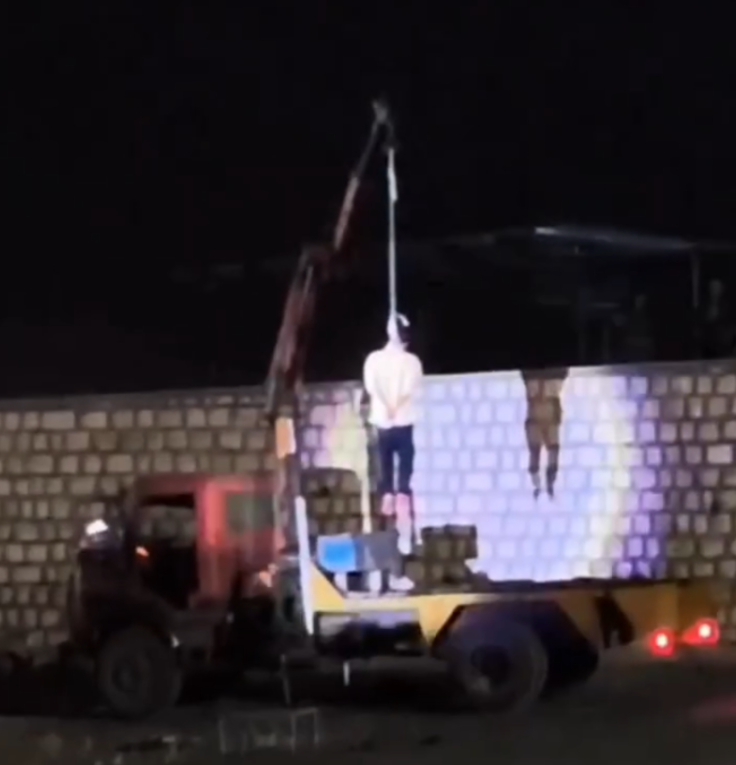
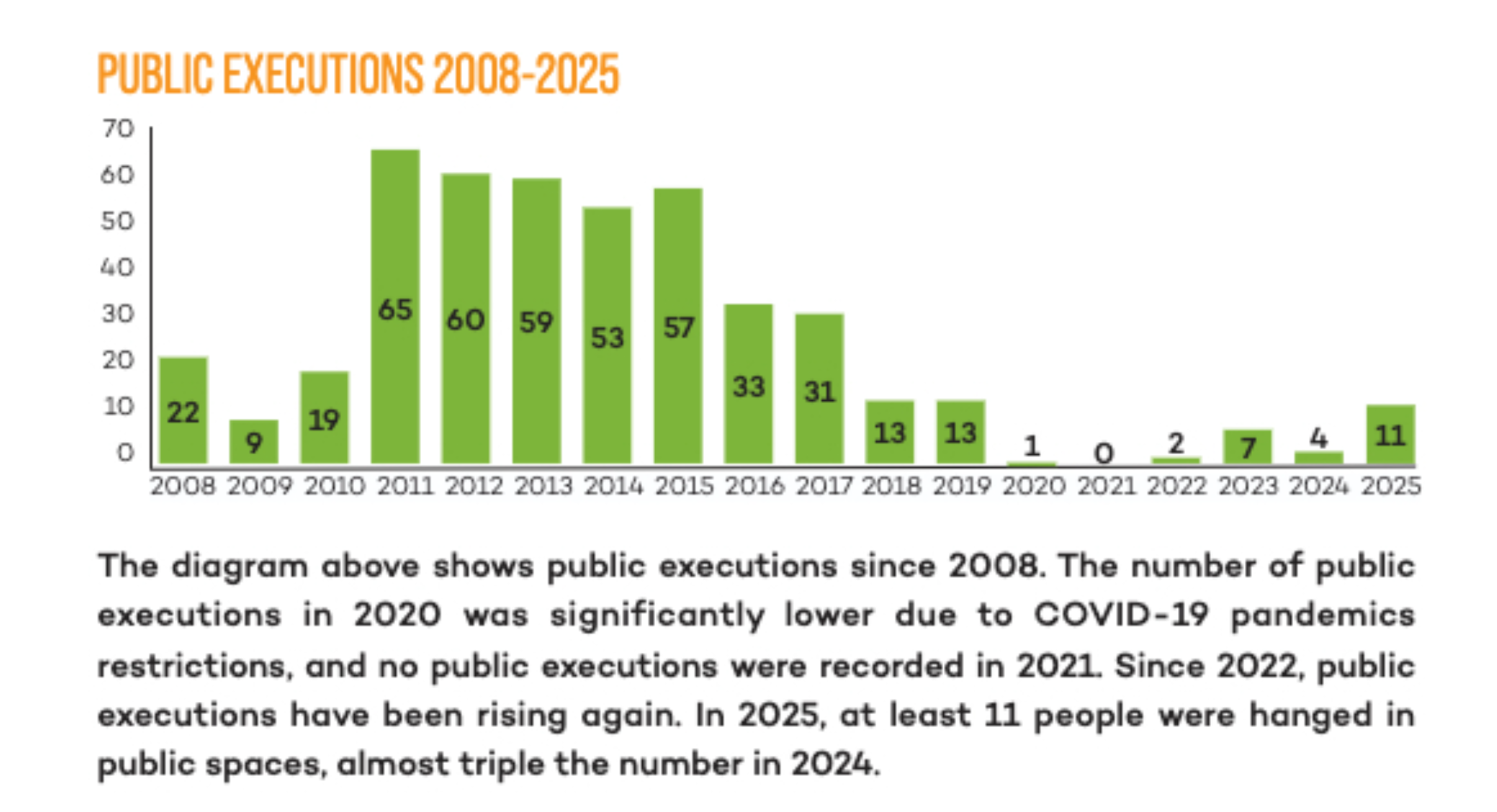
The Associated Press says "Public executions are not uncommon in Iran." The watchdog group Iran Human Rights counted 459 such executions between 2008 and 2025, frequently featuring large audiences, including children. United Against Nuclear Iran reports that Iran "regularly carries out executions in public. In many of these cases, the victim is publicly hanged from a construction crane, an especially slow and painful execution method." And that doesn't even mention the extrajudicial killings of pro-democracy protesters. President Trump has said between 30,000 and 52,000 of them were murdered this year by the Iranian regime, many shot in the forehead.
So how did the New York Times spin its own news article on two recent executions? With the absurd, false claim that "Iran has long been one of the world's most frequent users of capital punishment, but public executions are extremely rare."
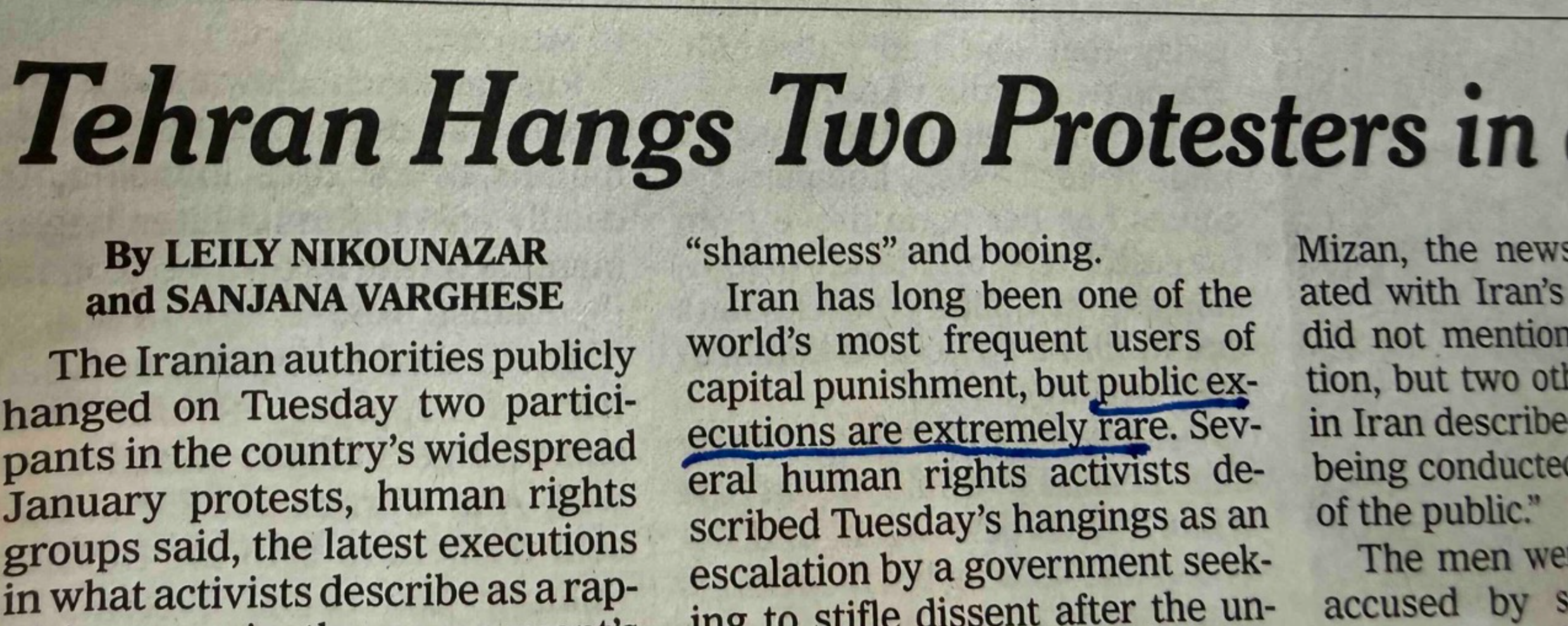
The article appeared under a joint byline. Leily Nikounazar is, according to her LinkedIn profile, a 2010 graduate of "Tehran's Faculty of News." Sanjana Varghese's New York Times bio says she has freelanced for Al Jazeera, the Qatar-owned outlet that has harbored Hamas and Islamic Jihad terrorists. Her main job before the New York Times was at Airwars, which is funded by anti-Israel nonprofits including George Soros's Open Society Foundations and the Rockefeller Brothers Fund. Neither Nikounazar nor Varghese, who lives in London but "grew up between Canada and Bahrain," immediately returned my queries about whether they planned a correction.
Adverbs are frequently trouble in news articles. The Times might have gotten away with calling public executions unusual or rare. But "extremely rare" pushes the envelope in a way that makes the Times' extremely slanted coverage extremely obvious.
Maybe the Times Iran team is attempting to ingratiate itself in hopes of obtaining permission to make a minder-accompanied trip to the Islamic Republic to cover the eventual funeral of Mojtaba Khamenei, the same way it covered the funeral this month of Ali Khamenei with two Times video journalists, a photographer, and a correspondent. ("We had two handlers with us throughout the trip … he would tell us we could not photograph certain places or say we couldn't go to certain places without explaining why. ... Iran contains multitudes. ... I came away wishing we had more time and opportunity to document that complexity," Times Middle East correspondent Abdi Latif Dahir said earlier this month.)
In the past, the New York Times has been more accurate about the issue. The Times itself reported in 2012: "Executions are very public events in Iran, with authorities setting up building cranes at the scene of the crime or on the central square of the city where the crime took place. ... The convicted criminal is often brought in around dusk, arriving at the square where a crane or scaffolding with ropes and nooses await him. Families, both of the victim and the convicted cheer and wail, often there are last minute pleas for a pardon. An Islamic judge, always present at the scene, will also officially ask the family of the victim for forgiveness. Usually crowds try to influence such decisions by calling for forgiveness or for the execution to take place."
In 2012, the Times went so far as to publish a slideshow of the pictures of the hangings, preceded by a disclaimer or trigger warning: "Please note that this slideshow includes some graphic images."
There was a pause in public executions during the COVID pandemic, but that had more to do with an attempt to avoid mass gatherings than with any liberalization of Iranian practices. An Iranian judge in 2008 banned public executions and restricted news coverage, but the "ban," like the so-called fatwa against nuclear weapons, was more public relations than reality, and it came with enough exceptions to drive a portable gallows through.
The annual report by Iran Human Rights on the death penalty in Iran notes that "the number of public executions increased dramatically after 2010, reaching an annual average of 50 to 60 between 2011-2015."
In 2025, the report says, "11 executions were carried out in public spaces, where children were amongst the spectators, a practice intended to spread fear and reinforce the state's policy of intimidation."
According to the report, among the crimes punishable by the death penalty under Iran's Islamic law are incest, rape, adultery, consensual gay sex, apostasy, insulting the prophet, and tafkhiz, or intercrural sex where the "active party" is non-Muslim and the "passive party" is Muslim. Approved execution methods include "hanging, firing squads, crucifixion and stoning."