




Talent and capital are fleeing Britain so fast that the Labour Government is announcing sanctions against Israel.
Rokos Capital founder Chris Rokos, reportedly the third-largest taxpayer in the U.K., is leaving Britain for Greece, Bloomberg News reported. Other billionaires who have left the U.K. recently amid government plans for tax increases include Lakshmi Mittal, Sharvin Bharti Mittal, Guillaume Pousaz, Nassef Sawiris, John Fredricksen, and Michael Platt.
Platt, who left for Switzerland and the UAE, declared, "the UK is no longer a serious contender as a jurisdiction in which to do business."
Fredericksen, who decamped to Cyprus and the UAE., said, "Britain has gone to hell."
The bond market views British long-term debt as increasingly risky, sending long-term government borrowing costs soaring to the highest levels since 1998, nearly 6 percent for the 30-year gilt.
The news about Rokos means that four of the five originally London-based founders of the asset management firm Brevan Howard will have left. The firm was named for Jean-Philippe Blochet, Rokos, James Vernon, Trifon Natsis, and Alan Howard. Howard and Blochet moved to Geneva, and Natsis reportedly relocated to Abu Dhabi.
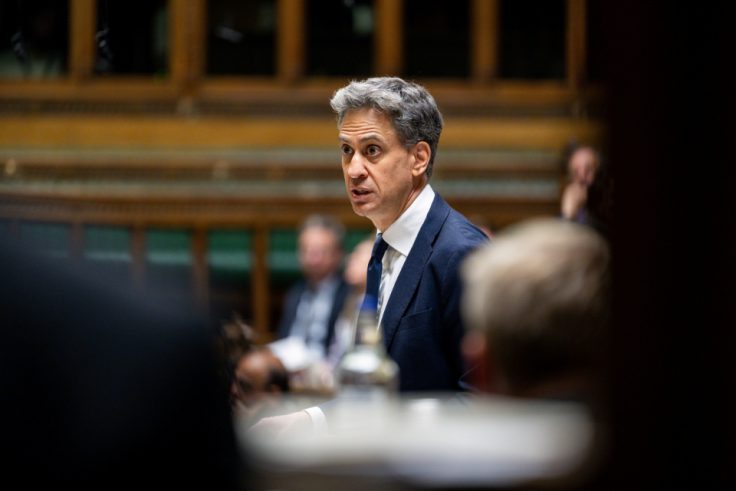
Instead of focusing on stanching what Bloomberg describes as a "wealth exodus," British politicians are pretending as if their country is still a colonial power in territories it took over from the Ottoman Empire after World War I. The British foreign secretary, Ed Miliband, rolled out a series of new sanctions, including a ban on British arms sales and "other exports that materially contribute to the occupation." Miliband also announced "an import ban on goods from illegal settlements in the occupied territories," while making clear that he defined "the occupation as a whole"—by which he means allowing Jews to live in Jerusalem and its suburbs—as "unlawful." He also promised, "We will take action against specific companies and individuals who provide services such as construction, infrastructure, financing, or real estate for settlement expansion."
There was some attendant rhetoric from Miliband about how "The sanctions regime will target illegal settlements and settlement expansion, not Israel." That is disingenuous, because many companies and organizations don’t discriminate against Israeli Jews depending on which side of an arbitrary 1948 ceasefire line, the pre-1967 border, they happen to live on. While many Israelis are open-minded about eventual Arab self-rule in some of the West Bank—which exists to a considerable extent now under the Palestinian Authority—the notion of creating a Gaza-like terrorist-dominated state alongside Israel strikes many Israelis as insane.
Britain corralled a crew of other countries—Canada, Denmark, Finland, France, Iceland, Ireland, Norway, Poland, Portugal, Spain, Sweden—to express support for singling out goods and services provided by Israeli Jews for boycotts, reminiscent of Nazi-era bans on engaging in commerce with Jews. At least Germany had the decency to refrain from participating. As is typical of these situations, a frontman is deployed. Miliband described himself while announcing the sanctions as a "proud British Jew." In a 2014 interview he called himself a "Jewish atheist," explaining, "I don’t believe in God."
"These sanctions do nothing to advance the cause of peace. Nor do they make anyone safer – quite the contrary," said the chief rabbi of Britain, Sir Ephraim Mirvis. "Gesture politics of this kind feeds into an increasingly hostile discourse about Israel, and the cumulative effect of such punitive policies is to further embolden those, at home and abroad, who use hatred as a weapon against Jews."
The Israeli foreign minister, Gideon Sa’ar, announced that Israel would close the British consulate in Jerusalem, expel some British representatives, and ban the entry of others. "The message to any government that harms us is clear: Whoever acts against Israel - Israel will act against him, and he will lose his influence and relevance in the region." Sa’ar also said he had a "great conversation" with leaders of the British opposition, Kemi Badenoch and Tom Tugendhat. "I thanked them for their firm opposition to the hostile Labour Government’s announcement today," Sa’ar said.
Mirvis spoke of the timing, "On the eve of Rosh Hashanah," the Jewish New Year, which begins Friday night. He or others might have also noted that it is the week of the 25th anniversary of the September 11 terrorist attacks. Those attacks were motivated by a variety of the same radical Islamist ideology, seeking to expel infidels from Muslim lands, that aims to oust Jews from the land of Israel.
Fewer than half of people in England and Wales identified themselves as Christian in the 2021 census, and the New York Times is reporting, in a stunning dispatch, on the planned repurposing of tens of thousands of churches across Western Europe "expected to become vacant in the coming years as their societies’ connection to Christianity wanes."
The most relevant timing, though, may not be Rosh Hashanah or the September 11 anniversary, or even the impending Israeli and U.S. elections. It may have instead to do with the need for the British Labour Party to find a scapegoat, an issue to distract the public from its own class-warfare tax and regulatory policies that are driving successful individuals and job creators away. In the loss of talent and capital it resembles the Great Puritan Migration that eventually led, in a way, to the American Revolution and to the rise of America as a global military, economic, and cultural superpower that far surpassed Britain. The per capita GDP in the U.S. in 2025 was $90,026.50. The United Kingdom’s was $57,602, according to the World Bank. Israel’s was at $60,336.80, even with the disruption of a multi-front war. Maybe if the British government backed off the "gesture politics," it might start attracting talent and capital rather than repelling it. Whether it’s rich-bashing with taxes or Israeli-Jew-bashing with sanctions, the effects are the same: self-defeating.