




The Democratic Party is heading into the 2026 midterm elections and 2028 presidential elections pushing legislation that would increase federal income tax rates to levels not seen since before Alexandria Ocasio-Cortez and Zohran Mamdani were even born.
The politicians are billing some of the legislation as a tax "cut" on the basis of promises to redistribute the revenue from their tax increases. Some of the press is even falling for that spin.
But drill down, and it’s clear that what Democrats are proposing is an immense tax increase that would bring top marginal rates to levels not seen since the 1970s for capital gains or the mid-1980s for income.
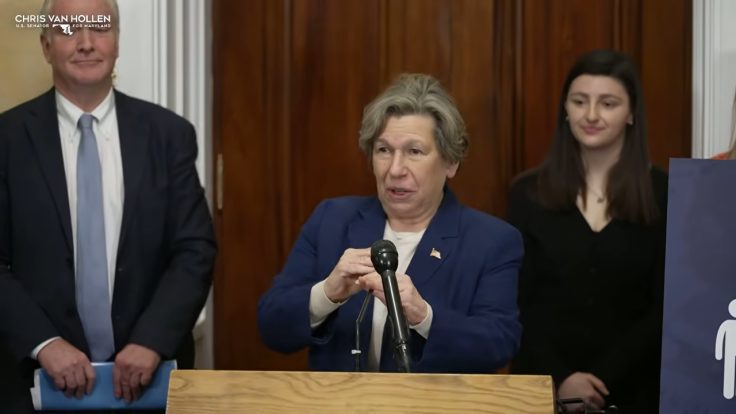
Senator Chris Van Hollen of Maryland rolled out his legislation at a press conference on March 12, 2026. It is essentially a national version of a millionaires tax that Mamdani has been pushing for New York State.
Anyone tempted to portray a millionaire tax as a fringe policy proposal pushed by class warriors such as Senator Elizabeth Warren of Massachusetts or socialist Senator Bernie Sanders of Vermont would get a sobering reality check from Van Hollen’s rollout. It featured Senator Mark Kelly of Arizona and Rep. Don Beyer of Virginia, along with the president of the AFL-CIO, Elizabeth Shuler, and the president of the American Federation of Teachers, Randi Weingarten. "I do see our plan as a fundamental pillar of any Democratic plan," Van Hollen said.
Van Hollen said he’d hit the 615,000 Americans who earn more than $1 million a year with a "surtax." The surtax would start at 5 percent of adjusted gross income for those earning over $1 million and climb to 10 percent for joint filers with income above $3 million or individual filers with income above $2 million, and 12 percent for joint filers with income above $7.5 million or individual filers with income above $5 million. The top individual income tax rate now is 37 percent, and Democrats raise that back to the Clinton level of 39.6 percent whenever they get any significant leverage in Washington. A 12 percent surcharge would take the marginal rate to 49 percent immediately, or 51.6 percent with a 39.6 percent base rate. Top-earning New York City residents pay a combined 14.776 city and state marginal income tax rate; the Van Hollen bill would leave them with a mere $3.62 out of the next $10 they earn, with government of one sort or another claiming $6.38. And that’s before the additional millionaires tax that Mamdani is pushing at the state level.
"This is the AFT’s no. 1 priority," said Weingarten, whose union is a major force in Democratic politics. It’s a remarkable statement from the leader of a union that helped to defeat the Soviet Union and has also prioritized education policy.
"What I really like is the surtax doesn’t just apply to wages. It applies to all the capital gains," Beyer said. He cited French economist Thomas Piketty’s 2013 Harvard University Press book Capital in the Twenty-First Century and also a Yale Budget Lab estimate that said the millionaire tax would raise "one and a half trillion bucks" over the next decade.
Van Hollen said the Senate legislation had 19 cosponsors. Those named included Kirsten Gillibrand of New York, Cory Booker and Andy Kim of New Jersey, Chris Coons of Delaware, Jeff Merkley of Oregon, Sanders, and Angus King, an independent from Maine who caucuses with the Democrats.
Also appearing at the press conference was a doctoral student in psychology at Georgetown, Katherine Hayes, a member of the American Federation of Teachers, who identified herself as a "graduate student worker." "I want a tax code that treats working people fairly and that isn't shy about taxing the wealthy," she said. "A few extra thousand dollars might not mean much if you're a multi-millionaire or a billionaire."
Van Hollen stressed that his bill isn’t the only Democrat tax-increase legislation but will proceed in parallel with other proposals.
Those include:
— Legislation by Senator Booker that would "raise the top tax brackets from 35 and 37 percent to 41 and 43 percent," which the University of Pennsylvania’s Penn Wharton Budget Model estimates "would raise about $1.4 trillion over the 10 year budget window." Booker, who ran for president in 2020 and is a possible 2028 presidential candidate, would also increase the standard deduction.
— Legislation that would make the Social Security payroll tax of 12.4 percent apply to income above $250,000 a year. That’s backed by 36 House Democrats, including AOC, Ilhan Omar, Summer Lee, Rashida Tlaib, Mark Pocan, and Ro Khanna. There’s a lot of overlap between the worst anti-Israel members of Congress and the most aggressive tax-increasers; what might be called the Zohran Mamdani approach. In the Senate that approach also has backing from 10 Democrats and Sanders, an independent socialist.
— A new 5 percent annual wealth tax on billionaires, backed by Sanders and Khanna, a Democrat from California best known for trafficking in Epstein-related conspiracy theories and confusing an Hermès factory with CIA headquarters. It would raise $4.4 trillion over a decade, according to a letter from Emanuel Saez and Gabriel Zucman, economists at the University of California, Berkeley.
Americans for Tax Reform, which advocates for lower taxes, denounced the Van Hollen plan. The group focused its criticism on the effect on the capital gains tax. "Democrats just cannot stop raising taxes. Their latest proposal would increase the top capital gains tax rate to 35.8% from the current 23.8%. This would impose the highest capital gains tax since 1978, the stagnant Jimmy Carter era," ATR’s John Kartch and Rachel Loren wrote. "A 35.8% capital gains tax rate would saddle the USA with a much higher burden than our competitors … the combined federal-state capital gains tax rate will exceed 40% in many states. Van Hollen’s constituents in Maryland would face a 47.6% combined top capital gains tax rate. Californians would face a 49.1% combined top capital gains tax rate."
The Democrats are cynically marketing these tax increases as tax "cuts" on the grounds that they are promising to use the money to provide benefits to lower-income Americans. Yet there is a long history—Bill Clinton in 1992, for one—of politicians campaigning while promising middle class tax cuts, then arriving in office and forgoing the promised cuts while keeping the tax-increase part of the plan. At the state level the "millionaire tax" politics have generated at least some wins for the unions, in part because non-millionaire voters far outnumber millionaires. For all the complaining about how the rich have too much power, in a one-person, one-vote system, it’s tempting for the many non-millionaires to gang up on the small millionaire minority and use the power of the state to take their money.