
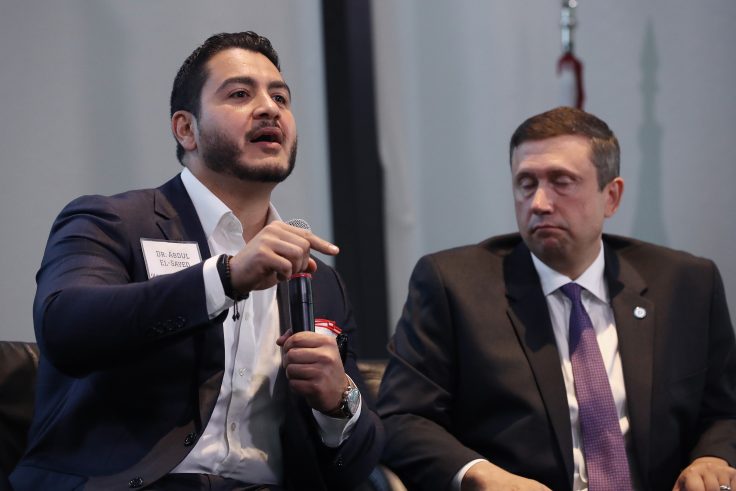
Democrat Abdul El-Sayed has pledged to "crack down on dark money" if elected to represent Michigan in the Senate. But as an activist in the Great Lakes State, he helped run a left-wing group that raked in hundreds of thousands of dollars from the Democratic Party's dark money machine.
El-Sayed served as a president and board member of the Michigan United nonprofit group from 2019 to 2023, according to tax disclosure reports. During this time, Michigan United had a dark money political arm and associated super PACs. It also received funding from the George Soros-linked Arabella Advisor network, a hub notorious for its opaque financial practices in support of the Democratic Party.
The news is at odds with El-Sayed’s public comments on money in politics during his Senate campaign. He has criticized "super PAC spending in Democratic primaries," signed a pledge to "crack down on dark money," and touted his opposition to undisclosed political spending.
"We’ve gotten this far without a dime of dark money," El-Sayed wrote on Facebook last month. "But to close the gap and win this race, we need to show up—together."
El-Sayed has benefited from super PACs and undisclosed financial funding even as he bills himself as a vocal critic. During his unsuccessful 2018 gubernatorial campaign, El-Sayed received financial backing from a state-level super PAC called Michigan People’s Campaign Independent Expenditure Committee. The group spent $9,352 on canvassers, advertisements, and materials in support of El-Sayed’s campaign, Michigan campaign finance records show.
After he lost the primary that year, El-Sayed joined the board of Michigan People’s Campaign’s 501(c)(3) arm, Michigan United. He served on the board from 2019 through 2020, as the group’s president in 2021, again as a board member in 2022, and as president once more in 2023, according to the organization’s tax disclosure filings.
With El-Sayed on the board, Michigan United touted its dark money arm on its website, noting that the organizations shared office space and employees.
"Michigan United, along with Michigan People’s Campaign, our affiliated 501(c)(4), is serious about building long-term, political power with the aim of transforming our political and economic system into one that puts people and the planet first," reads an archived page on Michigan United’s website. "Our main office is in Southwest Detroit, with additional offices in Kalamazoo, Grand Rapids, and Flint."
While neither Michigan United nor Michigan People’s Campaign discloses their donors, some of their funding can be traced through tax disclosure reports filed by donor foundations. The groups that gave include some of the most famous left-wing donors in U.S. politics.
During El-Sayed’s time at Michigan United, the group—using the name "Michigan Organizing Project"—received $112,000 from the Hopewell Fund.
The Hopewell Fund, which does not disclose its donors either, was managed by Arabella Advisors, a for-profit consulting firm that built a hub for pro-Democratic mega-donors to anonymously steer money to left-leaning groups. The New York Times described the Hopewell Fund as part of a "broader network of progressive nonprofits that donors used to fill specific spaces on the political chessboard."
The Michigan People’s Committee also received $795,000 from the Sixteen Thirty Fund, another group in the Arabella Advisor network, between 2020 and 2023.
This is not the first time El-Sayed’s time with Michigan United has come under scrutiny. As the Washington Free Beacon reported in November, the group organized an anti-police protest that turned deadly during El-Sayed’s tenure on the board. The event, which drew an estimated 1,000 protesters, later devolved into a riot, with activists defacing police cars and attacking officers with bottles, rocks, and other makeshift weapons. A police captain was hospitalized, at least 60 rioters were arrested, and a man was shot and killed after a gunman fired into the crowd, according to reports.
El-Sayed’s campaign did not respond to a request for comment.