



Menstrual cycles are not an illness, and medicating them as if they are—suppressing the body's natural hormonal rhythms—clashes with what was once left-wing skepticism of corporate influence in medicine, while conveniently profiting Big Pharma. This should not be a controversial or political claim. And yet, as the New York Times recently noted, it has become one—and a conservative one at that.
In the wake of a health-focused political realignment driven by Health and Human Services Secretary Robert F. Kennedy Jr.—a development that's left Democrats awkwardly choosing between being "pro-health" and "anti-MAGA"—opposition to contraceptives is now widely seen as right-wing, part of the broader "Make America Healthy Again" ethos. This is true even though a garden-variety "Reddit atheist" could reach similar conclusions: that such products are unhealthy, un-feminist by their own standards, and feed the medical-industrial complex.
These dynamics converge in a moment of rising awareness. A recent essay by Madeleine Kearns is telling. Writing about her struggle with chronic pain, miscarriage, and unexplained infertility, Kearns travels across the country to pursue NaPro (Natural Procreative Technology), an approach that treats underlying conditions rather than suppressing cycles or bypassing them through IVF. The results led to better health, reduced pain, and ultimately, a daughter. The virality of her story suggests that Americans are increasingly curious about what the concept of "fertility awareness" can offer, and are willing to question whether birth control and IVF have too often been presented as default, conveniently profitable substitutes for real care.
But awareness, for all its promise, is only a means, not an end. Fertility awareness does not mean guaranteed pregnancy. Even as NaPro advances, some women will discover not solutions but sterility—and we do them no favors by pretending otherwise. If we are willing to affirm that the menstrual cycle is sacred and that artificial contraception represents a kind of pharmaceutical insult, then intellectual honesty requires accepting nature's limits, too. In that light, sterility deserves reverence, not erasure. For some women, fruitfulness may mean not denying reality, but learning to honor it—and welcoming forms of generativity that extend beyond biological childbearing.
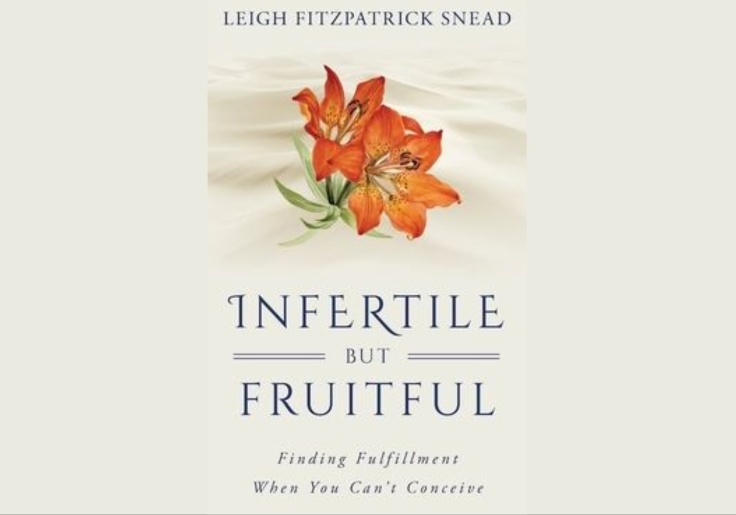
Into this conversation enters Leigh Snead. In her new book, Infertile but Fruitful, Snead—an Indiana mother of four—tells not of overcoming biological infertility, but of love, marriage, and yearning. Writing in the hilarious, relatable voice of a big sister—a stylish one who happens to have studied doctoral-level philosophy, run a popular fashion blog, and moved effortlessly through elite intellectual circles—Snead chronicles a life contoured by longing, tracing how marriage and vocation take shape in the absence of a heart's deepest desire.
The story unfolds across unlikely settings: from rowdy West Virginia football games to champagne-soaked London cocktail parties; from cut-throat, striver scenes in Washington, D.C., to slower, more domestic life in South Bend, Indiana, surrounded by a network of fellow crunchy Catholic moms. Along the way, she recounts her own experience with fertility awareness and NaPro, including treatment at the same clinic that helped Kearns—only with a different outcome. Thus, Snead's story is not a case study in medical success but a meditation on ache and endurance, on infertility not as a problem to be solved but a reality to be lived. Her marriage to O. Carter Snead, a leading Catholic bioethicist at the University of Notre Dame, forms a quiet throughline—not as magisterial corroboration, but as part of the academic ecosystem in which she lives rather than theorizes questions of body, limit, and faith.
In addition to weaving an absorbing narrative, Snead mounts controversial arguments. She warns against IVF for reasons similar to Kearns's: It bypasses root causes, imposes staggering emotional and financial costs (despite "abysmal" efficacy), and, at its worst, commodifies wombs and exploits the poor—dynamics New York Times Magazine recently exposed in a harrowing global-surrogacy exposé. Yet politically, opposing IVF is harder than opposing contraception. The types of MAHA-adjacent secularists who reject contraception on the grounds of health, feminism, and anti-corporatism can argue that the abuses of IVF might someday be regulated away.
Rejecting IVF ultimately requires a deeper philosophical leap: the premise that children are not products, that the marital act is divinely ordered rather than biologically instrumental, and that suffering cannot always be solved without distorting what it means to be human (fittingly, the title of Carter Snead's last book). That leap requires faith—the quiet, radical faith Snead embodies.
I read Infertile but Fruitful on my honeymoon. On the surface, it seemed almost perverse: What newly married wife, eager to start a family, wants to contemplate infertility—especially during Advent, as Christians anticipate a child's birth? And yet, it was pitch-perfect, setting the tone that marriage is a gift of self—not only for my spouse but for those around us—not an exercise in self-gratification. The fruit it yields, physical or spiritual, is never guaranteed, nor mine to control.
Like the Virgin Mother, whose "fruitful" virginity Christians acknowledge in Advent, one can have fruitful infertility, too: in raising a rambunctious brood of boys, in placing a long-awaited adopted grandchild into the arms of a dying parent in a hospital bed, in accompanying a vulnerable biological mother through the sleeplessness of labor and delivery. In Christianity, the paradox of sterility culminating in the most bountiful outcome possible is not a consolation doctrine but the central reality of the Savior's birth.
Snead is magnetic and hilarious, the book a quick read. She speaks vulnerably of lactation with an adoptive child and acknowledges that had NaPro been even a decade further along when she pursued it, she may have conceived. I cried when she asked God, in a particularly moving passage, "What is wrong with me?" Not because I'd experienced infertility, but because all of us know the isolating feeling of having assumed life would progress in a certain way, and waking up one day to realize it's not.
Today, roughly half of U.S. women aged 20–39 are childless, a dramatic increase from historical norms. Many tears will be shed as the dynamics contributing to these figures unfold: delayed childbearing, overconfidence in IVF, and years lost to a culture of unrelenting anti-natalism. Thus, Snead's book is urgent. Written in the voice of someone you'd trust both for Kate Moss–level fashion advice as well as for the hardest conversations about life and loss, it offers valuable guidance for those pursuing NaPro. And it offers something even dearer for those who may never see those two pink lines: encouragement not to suppress sorrow, but to honor it, to grieve honestly, and to accept, courageously, other forms of fruitfulness that may blossom beyond their wildest dreams.
Infertile But Fruitful: Finding Fulfillment When You Can’t Conceive
by Leigh Fitzpatrick Snead
Sophia Institute Press, 144 pp., $18.95 (paperback)
Nora Kenney Mittiga works for a nonprofit and writes from New York City.