


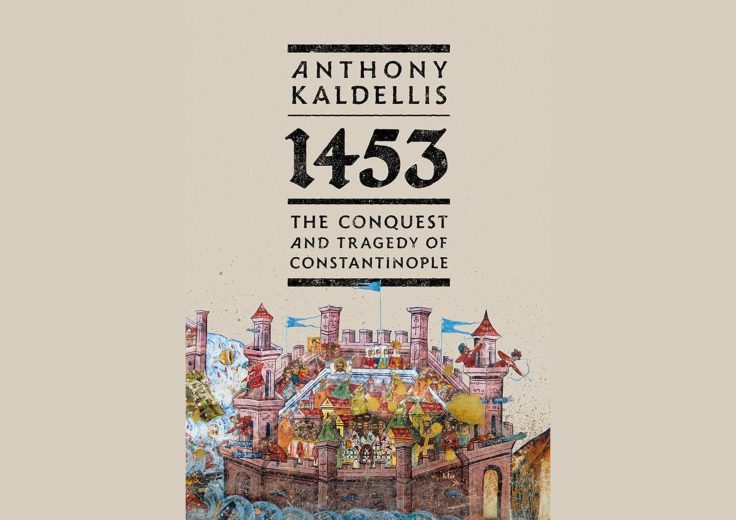
"On May 29, 1453, the city of Constantinople disappeared." So writes Anthony Kaldellis in 1453: The Conquest and Tragedy of Constantinople, a riveting, passionate, indignant, eloquent, and—notably—revisionist book of history.
Mr. Kaldellis, born in Athens, is a professor at the Department of Classics at the University of Chicago. His perspective is frankly philhellene, and no reader will doubt that his sympathies—as a man—lie with the dogged defenders on the battlements of Constantinople, as they "climbed, dodged, thrust, shouted, hacked, slipped, fell, bled, and died" in the face of the conquering Ottoman swarms.
Yet Kaldellis never discards his academic rigor, as befits a preeminent historian of Byzantium. His is a book that should now make much less compelling (and perhaps even redundant) the last major account of the same event in history. Which is… The Fall of Constantinople 1453 by the English popular historian Steven Runciman—published in 1965.
That work has been regarded for some time as the classic treatment of the Ottoman conquest of this Queen of Cities. Six decades old, it is, remarkably, the most recent serious narrative reconstruction of the city's siege by Sultan Mehmed II before Kaldellis's own book. And as he writes—perhaps a little too sharply—Runciman's narrative is "outdated in many respects, more than I can list here. Yet it is still cited as an adequate reconstruction of events." (The wise Runciman's book deserves a dignified burial.)
As Kaldellis tells us, Constantinople had been—at the time of its capture by the Muslim Turks—the capital of "the east Roman polity" and a center of Greek scholarship and Orthodox Christianity for over a millennium. In the first half of the 15th century, it was still "one of the most visited places on earth." Why did visitors come? Kaldellis lists the reasons: "trade, pilgrimage, diplomacy, espionage, exploration, and classical study." But thanks to various ravages—the Fourth Crusade, when crusaders torched the city; and terrible bouts of plague, especially in 1347, when a third of the populace perished—the population of Constantinople in 1453 was but a tenth of its historical peak.
The terminology Kaldellis uses in his book, while confusing at first, is faithful to the way the Constantinopolitans saw themselves and the world. They called themselves "Roman"—and so does the author, although the Western Europeans called them Greeks. To differentiate these Greek-speaking, Orthodox Christians from the Christians to their west, he refers to the latter as "Latins," since those people used the Latin rite in their (Roman Catholic) churches.
That much settled, Kaldellis tells his story, which is that of a once-wondrous place that was, by 1453, "visibly in decline." Although its basileus (or emperor, the closest, least inaccurate English synonym) Konstantinos XI Palaiologos ruled almost no territory, its people "proudly clung to their heritage and foundations." Those, Kaldellis writes, "came to an end on that May day" in 1453, "a day of tragedy and triumph"—tragedy for the residents and their civilization, and triumph for Sultan Mehmed II, who had begun his siege in September of the year preceding.
The lesson Kaldellis wants us to imbibe—for which he draws from eyewitness accounts in Latin, Italian, Greek, Russian, and Turkish—is that Constantinople's fall to the Turks wasn't (as most modern accounts would have us believe) preordained or inevitable. The city's defense was not "ineffectual," "futile," or "doomed to fail," with Konstantinos and his men only going through the motions of resistance in a fatalistic, oriental manner. "Konstantinos XI did not choose to resist the sultan because he wanted to die fighting," Kaldellis tells us. He almost won. He and his men "managed to counter all the sultan's assaults and stratagems until the very last day." This doesn't only rescue his reputation from one of fruitless or suicidal heroism, but also elevates Mehmed II, offering "a testament to his tenacity, determination, and strategy." The defenders "made Mehmed work for the prize, and he rose to the occasion."
Kaldellis wants to cleanse "Byzantium"—which became as much a metaphor for groan-inducing stagnation as it was a specific toponym—of its negative stereotype as "an already defunct civilization" at the time of its erasure. How could it have been a moribund place when "its people believed it was worth fighting for"?
The resonances of their resistance—and the existential passion that undergirded it—might be said to persist to this day. Kaldellis points out that modern, post-Ottoman Turkey has officially celebrated May 29 as Fetih Day—Conquest Day—since 1953, the 500th anniversary of the city's fall. (Constantinople was renamed as Istanbul only in 1930; the Turks had, for centuries, continued to call it "Konstantiniyye.") Under Recep Tayyip Erdoğan, Turkey's hypernationalist-Islamist president, Conquest Day is "accompanied by stirring rhetoric about the world-critical mission of the Turkish people" and parades that involve some unintentionally hilarious "janissary cosplay"—janissaries being the shock-troops of the Ottomans, consisting, in the main, of Balkan Christian men who had been abducted in their childhood and converted to Islam. Although they were often boisterously uppity, and recalcitrant in matters of pay, their loyalty to the sultan was legendary.
On May 29, 2025, Erdoğan reiterated that Constantinople and Hagia Sophia (the Byzantine Christian cathedral, built by Emperor Justinian, that lies at the heart of Istanbul) "will forever be ours." A pungent Kaldellis observes in response that "one cannot imagine, say, the Prime Minister of Spain feeling the need to say the same about Andalusia." It is as if, he says, that "the tenacity of the defenders in 1453" never lost its moral force. So much so that they "must be periodically re-defeated."
Today's cosplay recasts—in triumphalist pageantry—the aftermath of a conquest that resulted in citywide slaughter. Constantinople was "emptied out and its population dispersed as captives across the Ottoman empire." Women, Mr. Kaldellis tells us, "were raped on a mass scale and continued to be raped while they were held as captives." A lamentation written shortly after the city's fall said: "Now they will be taken to Turkey to be sold as slaves, / and scattered from East to West / naked and barefoot, beaten, hungry." The city was plundered with a triumphalist ardor, and "the work of looting and enslaving the population was efficient, swift, and thorough, and was carried out by experienced professionals." Hagia Sophia was the last place to fall, and the eyes on icons were gouged out, "anticipating the building's conversion to Muslim use."
Kaldellis's most beguiling chapter is his last, in which he examines the aftermath and legacy of the fall of Constantinople. The conquest of the city upgraded the "standing of the Ottoman state in the eyes of both Muslims and Christians." Muhammad, the prophet of Islam, had, it was believed, proclaimed that great glory would shine on the city's conquerors. Mehmed II now basked in that holy light.
Constantinople, writes Kaldellis, "changed the Ottomans as much as they changed it," transforming them from rubes on saddleback to imperial overlords in possession of the world's greatest city. "It catalyzed and accelerated their conversion from nomadic warriors expanding the frontiers of Islam to a centralized state with a sedentary capital."
Constantinople, Kaldellis tells us pithily, "de-nomadized" the Ottoman regime. And in turning them into "palace-obsessed civilian rulers focusing on law, piety, and administration," the city, it could be said, ended up conquering the Ottomans just as profoundly as they had conquered it.
1453: The Conquest and Tragedy of Constantinople
by Anthony Kaldellis
Oxford University Press, 352 pp., $29.99
Tunku Varadarajan is a writer with the Wall Street Journal editorial page, a fellow at the American Enterprise Institute, and a fellow at New York University Law School's Classical Liberal Institute.