


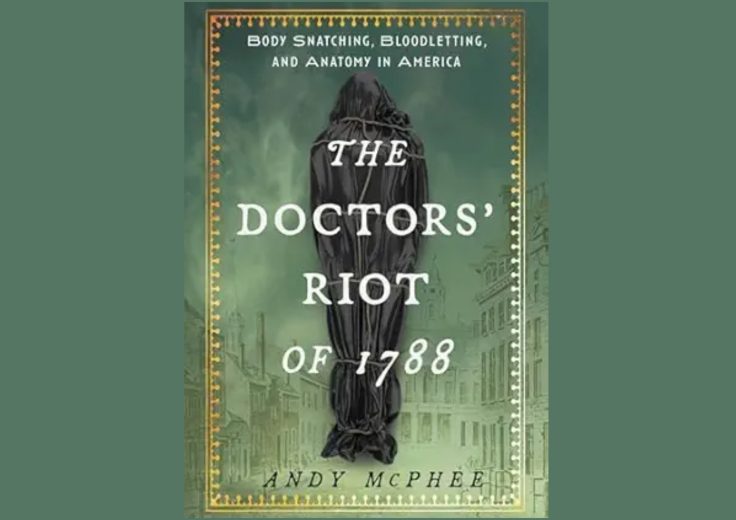
This book explores not death itself, but what remains after it: the human body. For most species, the dead simply decay where they fall. Humans, however, have long venerated their deceased, which explains the visceral disgust evoked by acts like body desecration, grave robbing, or unauthorized dissection. The book’s title nods to the "Doctors’ Riot" of 1788, a violent uprising in New York City triggered when teenage boys spotted a dissected arm dangling from a window at what would become Columbia University’s medical school. An enraged mob stormed the school and hospital, forcing doctors and staff to flee and hide in a nearby prison for safety. Order was restored only through the intervention of prominent figures like Alexander Hamilton and John Jay.
Such riots were not uncommon in the 18th and 19th centuries, with the book documenting several in the United States and Europe. Yet this episode forms only a minor part of the narrative. Instead, the text weaves together the history of medicine and medical education in Europe and early America, the grim trade of body snatching to supply cadavers for anatomical study, and the contemporary use of cadaveric materials in treatments like bone grafts or dental implants. What unites these threads is the evolving procurement of human remains for medical training and, more recently, therapeutic products.
Intriguingly, body snatching—often euphemistically called "resurrecting"—was not illegal in the early American Republic, provided resurrectionists left behind personal effects like clothing or jewelry. Bodies themselves were not considered property; only possessions were. Snatchers worked urgently against decay, as decomposition quickly rendered cadavers useless for anatomists. A limited legal supply existed: Executed criminals were handed over for dissection. As a 1763 newspaper quipped after a black man accused of rape was killed, "the body has since been taken up and likely to become a raw head and bloody bones by our tribe of dissectors for the better instruction of our young practitioners."
The criminal justice system, however, could not meet the demand, fueling the illicit body-snatching trade. This era seemingly ended with the advent of embalming, pioneered by a French chemist and popularized during the Civil War. Before then, death was a local matter, but soldiers dying far from home required transport for burial. Embalming preserved bodies for the journey. As the author notes, when Abraham Lincoln was assassinated on April 15, 1865, his embalmed remains endured a cross-country train ride. Wars, as they often do, spurred such innovations.
Embalming revolutionized medical education, allowing students to dissect at a measured pace over months rather than racing against rot. Physicians of a certain generation still recall the pungent formaldehyde scent of anatomy labs in their first year of medical school.
While the book offers an engaging survey of medical history—including petty rivalries during the founding of America’s first medical school at the University of Pennsylvania—its modern relevance hinges on two key issues. First, the use of body parts has evolved into a lucrative industry, supplying tissues for treatments, research, and drug development. As philosopher Eric Hoffer observed, "Every great cause begins as a movement, becomes a business, and eventually degenerates into a racket." Certain facets of the body-broker trade exemplify this, sourcing cadavers from funeral homes, hospices, and hospitals.
The Uniform Anatomical Gift Act of 1968 provided a framework for states to regulate donations, affirming that bodies are an individual’s property and that a donor’s wishes override next-of-kin’s if specified. If no preference was stated, families decide. Yet alongside ethical brokers, unscrupulous operators persist. For instance, in January 2026, Jonathan Christian Gerlach faced 500 charges for grave robbing in suburban Philadelphia. Earlier, Michael Mastromarino profited millions by selling dismembered parts to medical firms; one victim was Alistair Cooke, the host of PBS’s Masterpiece Theatre, whose family believed he would be cremated intact, not harvested for heart valves and bones before partial cremation.
The author details other illicit schemes leading to convictions, advocating for federal oversight and urging caution in selecting donor programs.
The second contemporary angle concerns cadavers in medical training, a surprisingly contentious topic. Some educators view embalmed bodies as students’ "first patients," insisting dissection fosters a deep anatomical understanding. Yet this conventional wisdom warrants scrutiny.
Modern imaging technology allows physicians to view three-dimensional, color images of in situ organs. These kinds of images have replaced dissection labs in some medical schools. An elaborate full-size digital body that allows examination layer by layer by manipulating the images is used at several medical schools for student virtual dissections. Demonstrations of actual dissections of limbs or organs may be provided by the anatomy instructors. Certainly practicing on and dissecting cadavers is useful for surgeons, but even there, simulaton models may serve the same purpose. Fairly large facilities are required to maintain cadavers so that each medical student has the opportunity to perform dissection. Usually, four students are assigned a cadaver. Most medical schools have between 150 and 200 students so the cost for obtaining and maintaining cadavers is substantial.
Ultimately, the persistence of cadaver dissection may stem less from educational necessity and more from its emotional impact—fostering respect for the human form and confronting mortality early in training. This book prompts us to question whether tradition should outweigh innovation in how we honor the dead while advancing medicine.
The Doctors’ Riot of 1788: Body Snatching, Bloodletting, and Anatomy in America
by Andy McPhee
Prometheus, 248 pp., $29.95
Stanley Goldfarb is an emeritus professor of medicine at the University of Pennsylvania and father of Washington Free Beacon chairman Michael Goldfarb.