




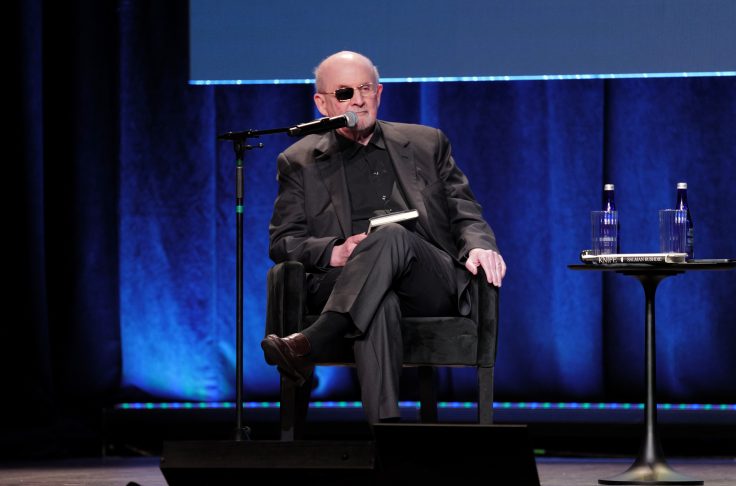
Through no fault of his own, the author Sir Salman Rushdie has become the English-speaking world’s premier purveyor of writing about death. The brutal reason for this is that, on August 12, 2022, Rushdie was stabbed several times in Chautauqua, New York, while preparing to give a talk—about, ironically enough, the United States as a place of safety for writers fleeing their home countries. Rushdie survived, miraculously, but lost an eye and the use of one hand in the process. His attacker, Hadi Matar, was sentenced to 25 years in prison for attempted murder, and now faces federal charges of terrorism under the auspices of Hezbollah.
Many who have suffered such trauma might not feel willing, or even able, to write again. Rushdie, however, has been faced with the threat of dying ever since the fatwa that was declared upon him with the 1988 publication of The Satanic Verses. When he came right up close to "the distinguished thing," as Henry James described it, his good eye blinked and he did not look away. He wrote a haunting memoir, Knife, of what happened when he was attacked, and his subsequent, often painful convalescence. Now, he has returned with his first fiction since 2023’s Victory City, and his first collection of short stories in over 30 years: the last being 1994’s East, West, which had a series of brief narratives that first juxtaposed Eastern and Western tales with one another, to satisfyingly kaleidoscopic effect.
Rushdie has retained this melding of traditions in The Eleventh Hour, which is relatively brief for him at a sharp 256 pages, but which contains three long stories (or even mini novellas) and two short stories, which bookend the volume. All have mortality as their main preoccupation, and, as the author writes at one point, "if old age was thought of as an evening, ending in midnight oblivion, they were well into the eleventh hour." The first, "In the South," sets the stage effectively. Two ancient men, ironically named Senior and Junior because of the 16-day gap in their ages, congregate outside their homes in Southern India to chew the fat, complain about their health, and muse on the inevitable with Beckettian stoicism: "Your gloom and doom," Junior sighs to Senior, "will be the death of me." Then there is first a small, painful tragedy, followed by a larger, more epochal event, but the story winds up in the same, quiet place where it began: an old man, gazing out over the ashes of his life, and wondering what is to come.
Rushdie remains in India for the second story, "The Musician of Kahani," and here the author brings in an array of his tropes and themes that will delight his loyal readers and possibly bemuse others. "Kahani" is not a city, but the Urdu word for "story," or even "tall tale," and so the games-playing is on full display; there is an allusion to Midnight’s Children—"at midnight, the approved hour for miraculous births in our part of the world"—and the author has fun with character names that might almost have come out of Thomas Pynchon, such as "Chandni Contractor" and "Hariprasad Chaurasia." There is a brief return to The Satanic Verses’s religion-baiting—"men made gods and not the other way around"—and as the narrative wears on, Rushdie has fun subverting the story of his earlier novel The Ground Beneath Her Feet, with this musician’s skill being used for revenge, rather than edification.
Rushdie is unafraid of stepping outside of the narrative, too. He has become a hero to free speech absolutists since his stabbing, and when he observes that "words such as ‘good’ and ‘bad’ or ‘right’ and ‘wrong’ are losing their effect, emptying of meaning, and failing, anymore, to shape society," you can hear the author sighing "and I won’t be around much longer to help you out, either." This is then taken to its logical extreme in the third story in the collection, "Late," which returns to a thinly disguised King’s College, Cambridge—where Rushdie studied as an undergrad—but with a macabre twist. As he writes in the first sentence, "When the Honorary Fellow S.M. Arthur woke up in his darkened College bedroom he was dead, but at first that didn’t seem to change anything."
The novella is the longest, and the best, in The Eleventh Hour, and demonstrates Rushdie at both his most allusive and playful. It is a ghost story, with echoes of another King’s College provost, M.R. James, concerning S.M. Arthur’s desire for revenge beyond the grave against an old nemesis, but if this makes it sound unduly sensational, then rest assured it is also full of Rushdie’s usual spark. Arthur, a once-promising novelist who abandons writing amid personal turmoil, is an amalgam of two alumni of King’s, E.M. Forster and Alan Turing, which allows the author to deal, elegantly, with homosexuality and repression, but the device of a young transplanted Indian scholarship student, Rosa, who is the only person who can see the shade of Arthur, feels more like an authorial conceit than a fully rounded character. But it’s cathartically nasty in places and, in its wistful evocation of the young Rushdie in Cambridge, perhaps the most straightforwardly autobiographical of the tales in this collection.
The remaining two are both typical Rushdie, and will appeal more to paid-up aficionados than casual admirers. "Oklahoma" is a tricksy piece of meta-fiction, complete with editorial introduction and afterword, that purports to be an unfinished manuscript by the novelist Mamouli Ajeeb, or "M.A." Is this a reference to Rushdie’s late friend Martin Amis, to a Cambridge masters’s degree, or something else entirely? Part of the fun—and frustration—of this story is that it’s never entirely clear. And then the closer, "The Old Man in the Piazza," returns to "The Musician of Kahani" and its themes of decrepitude and age but in a lighter, more reflective key.
Rushdie would never ask for special pleading, and so The Eleventh Hour should be seen as a middling work in his distinguished bibliography rather than a Schubert-in-winter masterpiece. "Late" apart, I doubt that any of these stories will be remembered as his finest writing. Yet for all this, the more important fact is that this great man—and Rushdie is a great man—is still able to construct narratives that challenge, enthrall, and transport, with his one good eye still observing, glaring, and, when it needs to, winking. "Our words fail us" is how the book ends. On this evidence, nothing could be less true. Long may it remain so.
The Eleventh Hour: A Quintet of Stories
by Salman Rushdie
Random House, 256 pp., $29
Alexander Larman is a journalist, historian, and author, most recently, of Power and Glory: Elizabeth II and the Rebirth of Royalty (St. Martin's Press).