


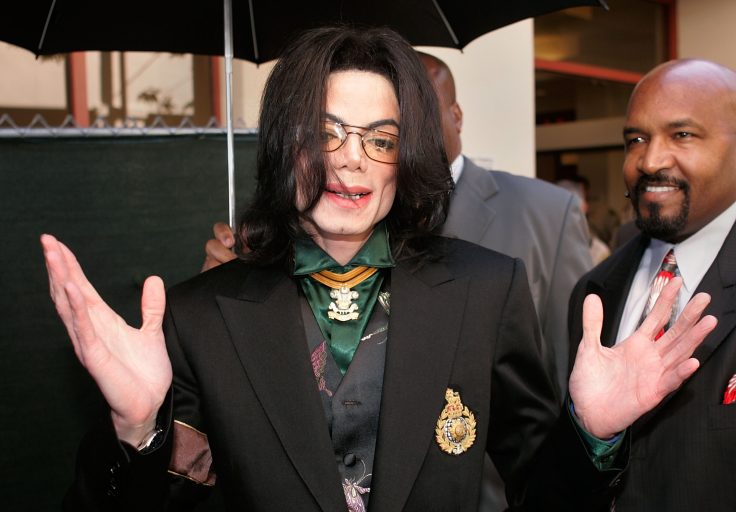
The new biopic about Michael Jackson offers snapshots of his life from ages 8 to 24. It doesn't have a plot, really, just a timeline in which he gradually moves toward separating himself from his abusive father. With the exception of his early plastic surgeries, which he ascribes to a desire to make his face more symmetrical, there's nothing remotely questionable about the behavior of the kid we see in Michael. He's gentle and childlike and in love with animals and toys and Peter Pan. We are meant to understand all this as a form of psychological protection from the soul-crushing violence and emotional blackmail committed against him by his father Joseph (played as an unadulterated demon in human form by the brilliant Colman Domingo).
The movie concludes with Michael having liberated himself from Joseph's tyranny and, now free to be truly himself, burning down the joint as he performs "Bad" at a concert in London in 1988. But this was not the original ending, according to the peerless Hollywood reporter Matt Belloni. As filmed, the last third of Michael centered on the child-molestation and rape accusations against Jackson that dominated the 1990s—but not in a way intended to complicate or deepen the movie's portrait of its subject.
Rather, Michael was designed to exculpate Jackson and thereby fulfill the purpose that the Jackson estate wants it to fulfill—to wash away the controversies surrounding him even now, 17 years after his death, and elevate the most talented and successful pop performer of his generation to the historical pantheon of great-souled and flawless human beings. To that end, the original cut featured harsh portrayals of his accusers and their families as money-grubbing charlatans and Jackson himself as entirely innocent of the charges.
Belloni discovered that, in the enthusiasm for getting the project off the ground, someone on the production team forgot to do due diligence. It turned out that a key element of the gigantic cash settlement between Jackson and one of his accusers was that Jackson (or his estate) was enjoined from making any effort to offer any kind of portrayal of the case whatsoever—otherwise the agreement would be considered breached and the case opened anew. So they had to rejigger the ending.
And lucky for them—for producer Graham King, for screenwriter John Logan, and for director Antoine Fuqua—that they did so. Had they made the original version, people under the age of 30 largely unaware of Jackson's almost unimaginably repugnant behavior would have had to confront some aspect, any aspect, of Jackson's life that might have discomfited them.
For example, he interacts with children aplenty in this movie, but those children are cancer and burn patients he comforts in hospitals or kids he encounters in a toy store whose autographs he diligently and sweetly signs. Whenever Michael is with young ones, the movie cuts to a shot of his loving bodyguard or his manager John Branca (one of the movie's producers, played here by Miles Teller) gazing with wonder at Michael's deep reservoir of self-sacrificing kindness.
What we don't see is Michael bringing one or more of these prepubescent boys home with him to share his bed, a practice he freely admitted to in interviews for decades—saying that sharing your bed with someone is the most beautiful thing you can do on some occasions, while on others saying he let the kids stay in his bed while he slept on the floor.
The movie concludes before Jackson moves to Neverland, the ranch he built far from prying Hollywood eyes in Santa Barbara County to house his many zoo animals. Neverland was a child's fantasy home, complete with its own amusement park and soda fountain and Willy Wonka-style goodies. It was, as my friend Heather Higgins once said, bait. Michael Jackson was a groomer. And truth to tell, we don't even know how many settlements he reached with the families of the boys he groomed.
We do know of eight public accusations and we know of at least one payout in 1993 in excess of $20 million ($45 million today). He was acquitted in the one criminal case brought against him, but he died only four years after that acquittal from an overdose of an improperly administered paralytic anesthetic he needed to use in order to sleep. Who's to say what more would have come out, or what more he might have done, had he lived. The best guess is that he would be 68 years old today and likely a decade into either a complete cancellation of his career or more criminal prosecutions or worse.
I wish it were otherwise, and not just for the sake of the boys he surely abused. Michael Jackson has been a presence in my life since I was eight years old and "I Want You Back," the first Jackson Five hit, was released. It was the first 45 I ever bought. Then I saw him on American Bandstand dancing with his brothers. They were doing the same kinds of steps all Motown acts had been trained to do, but there he was, this tiny creature, moving as though he was possessed by rhythm. There never had been, and likely never will be, anyone remotely like him—a perfect singing voice, his body a perfect vessel for inventive contortion, and an ability to take a song's hook and lodge it in your consciousness forever.
Watching the two performers re-create Jackson—his nephew Jaafar, who plays him as a young adult, and Juliano Valdi, who plays him as a boy—does summon the long-dead "King of Pop" eerily back to life. The scenes in which Michael records and learns dance moves and films videos and plays concerts are superbly staged. Jaafar Jackson proves to be such an eerie simulacrum of his uncle that I don't even know whether one can call what he does a "performance." He's more akin to a human special effect, so much so that he does not really provide the pathos the moviemakers clearly want us to experience as Michael tries to break free of his father's chains.
The astonishment here is Valdi, now 12, who is called upon to show and triumphs in embodying the fear and pain and heartbreak of a tormented little boy. It is Valdi who makes us believe Colman Domingo's Joseph is a monster because of the terror he is able to convey as Michael deals with his father's rage. And he is transcendent as he displays Michael's wild enthusiasm, so irrepressible that when he is recording "I Want You Back" he needs to be told repeatedly to stand still rather than dance while he sings because the studio mics can pick up the sound of his feet.
I know this movie is going to make hundreds of millions of dollars, if not a billion or more, but I have no way to gauge whether it will do so because people enjoy it for itself or whether it will just be enough to have the re-created Jackson right before their eyes and the songs they love played on Dolby or IMAX speakers. What I know is that, abused or not, successful or not, immortal by dint of his talent or not, Michael Jackson was an evil man, and this movie is a whitewash of evil.